Monthly Archives: June 2010

Pocket call

Have you ever made a “pocket call”?

I was at a Golf Galaxy retail store looking around one day and my cell phone rings. I see that it’s my wife, Dorine, so I answer.

Dorine asks, “What are you buying?”

It really caught me off balance, , , I thought she might be in the store, , , I couldn’t figure out how she knew I was about to buy something.

Apparently what happened was that I accidentally called her from my cell phone. It was in my pocket and buttons were accidentally pushed. She listened to my entire conversation with a salesman about ordering a golf club and asking him when the club would arrive.

I’ve heard other stories about “pocket calls”, , , maybe you’ve had one yourself.

The moral of the story, , , be sure you know what your cell phone is doing when you have it on your person.

IT Manager Institute Photo Album

Interested in seeing some of the photos taken in the first five years of the IT Manager Institute?

Take a look at the photo album I created that includes the first 27 classes, , , years 2003 – 2007. At the end of 2012, I plan to do another one.

CLICK HERE to view the album online.

The service I used is great. It’s called MyPublisher.com

Who should the CIO report to?

Generally, the CIO and IT Department reports into the CFO or financial organization of the company. However, more and more CIO’s are starting to report to the operations side (COO, President) or even the CEO.

I’ve reported to both CFO’s and to CEO’s in different companies.

My preference is always to report into the highest executive as possible who is close to what’s going on in the business operations of the company.

Sometimes, a CEO is close to the action, sometimes not. But generally, I want to be under the President or CEO if possible. They are almost always closer to the operations of the company than the CFO will be.

IT reports into the CFO often because many of the company’s support services organizations (Accounting, Purchasing, Payroll, Accounts Payable, etc.) report to the CFO. Also, the CEO often thinks the CFO is more technically oriented so it’s more logical for him to think that IT should report to the CFO.

The problem is that most of your client and users IT supports are probably from the operations groups who are producing the products or providing the services your company sells. For that reason, you need to be close to what’s going on in the operations groups to support them effectively.

My preference as I said is to report into the President or CEO because they are generally closer to the real operations of the company and many of the operations initiatives depend on IT to succeed. It helps me anticipate things that are coming up if I can be closer to the actual operations arm of the company, , , I’ll usually hear about it sooner when working directly for executives in charge of the business operations.

I’ve reported to some great CFO’s and you can certainly be effective reporting to a CFO. I’ve also reported to a poor CFO and that makes it much harder to be effective for your company because you can get blocked from the real needs and issues of the company.

It helps when reporting to the CEO or President in other ways. It puts you on the same level as many of the senior department managers (your customer) who also report to the CEO or President. The image of being at the same level can be important for some, possibly even the IT staff and the operational staff of the company.

It also helps you when you have support from the top. For example, when pushing an IT initiative, it is much more palatable for your client if the initiative is a company initiative and IT is just helping to make it happen. There is always resistance from the operations side when IT tries to push an initiative, , , it is usually seen as an “IT agenda”.

In the last company I was with, one of the hiring requirements I had was that I report to the CEO. It was based upon my need to be aware of what senior management was trying to do and also knowing that the CFO was not particularly strong. It helped insure I would be able to participate in key meetings and be part of planning processes, etc.

The CFO in this situation wanted IT to report into him, , , purely an ego thing I believe, , , but a condition of my joining the team was that I report to the CEO so I could be as effective as possible for the company.

A good CFO makes it a point to include the CIO in planning meetings and important sessions. A weak CFO doesn’t always understand the need for it.

Another issue is that some CFO’s tend to look at the glass “half empty” when they think of IT. What I mean by this is that some CFO’s only look at reducing IT cost as opposed to the leverage a good IT organization offers and what can be accomplished with appropriate investment in IT.

Now, most CEO’s I’ve worked for don’t want the IT department reporting into them, , , they don’t understand technology nor do they want to. In addition, they simply don’t want to spend much time listening to technology support issues.

To be effective, you have to be able to communicate with the CEO or President in business terms, not technical terms. Otherwise, they will be lost and will want you to report somewhere else as soon as possible, , , probably the CFO.  😉

Gain your senior manager’s partnership by creating a solid track record:

  • All recommendations are business driven and offer business value
  • All project recommendations are cost justified
  • You discuss things in business terms, not technical terms
  • You deliver what you say you will d0

At the end of the day, you have to navigate your way through the management structure of your company to insure your IT team is effective. Some reporting structures make it easier than others. The key is that the manager you report to is supportive of your efforts and helps you be involved at the right levels to become aware of things early that will require IT support.

Address poor performers proactively

What do you do when you have a problem or non-performing employee?

I’ve observed managers who pass their non-performers on to other managers because they don’t want to step up to the problem. Rarely does the employee become successful in another organization.

In the cases where there was improvement, it was usually because the employee was able to work on something that he/she was truly interested in. If the transfer was for that reason, it’s a good thing, , , but far too often it’s because the manager avoids the “dirty work”

In most cases of poor performance, it is my belief that the employee just doesn’t really like the work or isn’t well suited to do that type of work. Either way, there is a bad fit and avoiding the problem only allows the problems to get worse. More problematic is that it causes you, the manager, to lose credibility.

Everyone is watching, , , yes, that’s right, , , people are watching how you take care of a problem employee situation. Your employees, your clients, even senior management may know about the problem situation, and they are watching to see if you do anything, , , and how you handle the situation. If you aren’t proactive, supportive, but most importantly willing to step up to the problem, , , then your credibility is going straight to the bottom of the river.

You cannot be successful without credibility. Managers get paid to manage and part of managing is to deal with difficulties, improve performance, and to get things done through your team.

It’s not being mean or insensitive when you end up firing a bad employee. In fact, it’s mean and insensitive to your staff, client, and company when you don’t deal with these issues. More importantly – it is mean and insensitive to the poor performing employee to allow him to stay with a company or in a job where he isn’t going to be successful.

3 rules for dealing with problem employees

First rule – Try to help the employee become successful
We want all of our employees to do well and we need them to perform. Our first objective should be to help the employee correct the problem so the employee can be successful. Do what you need to do to determine what the problem is that’s causing the lack of success and coach your employee for improvement, , , in other words, start working with him or her and be sure the employee knows they are not succeeding. You cannot be vague about this, , , they have to hear from their manager that they are not succeeding and improvement is required.

Second rule – Only spend an appropriate amount of time and effort
You should coach as long as you think is necessary. For some really bad issues, coaching might be one session. For lesser things, you might coach and work with the employee for weeks, even months. At some point, if improvement isn’t coming, you need to stop coaching and go to the next step.

Third rule – Never fire anyone unless they know it’s coming and why
There should never be an employee who is fired for cause and he or she is surprised. If you aren’t direct and specific in your coaching efforts, that could happen, , , so be certain you are clear about the problem, the need for improvement, and the ramifications if the issues are not corrected.

A simple process to use with a poor performer

  1. Coach and counsel the employee and be clear about the problems that exist.
  2. After you’ve coached enough (subjective determination on your part), you tell the employee that the next time you have this discussion, you plan to put him on a formal improvement plan. Also explain that if that happens and the problems continue, then the next step will be termination.
  3. If the problem occurs again, you put the employee on a formal written improvement plan with a probationary period (3-6 months depending upon the issue).
  4. If the problem occurs again within the probationary period, you terminate the employee.

In over 90% of the cases, the employee will fix the problem or will leave your company on his own after the first 2 steps, , , if that employee is conscientious and wants to do a good job. Most of the rest that get to step-3 will correct the problem or leave on their own if they are put on a formal improvement program, , , and realize that termination is imminent if they do not fix the problem.

I’ve dealt with many poor performers in my career, but only a few ever got to the final step. When you address the problems with the employee and you are specific and direct (something many managers tend to shy away from), most employees will understand the issue has to be corrected. They will usually correct the situation or go somewhere else.

If the poor performer is a single source working on mission critical things, you may want to work in a backup before pushing him. Losing a bad employee who has the “keys to the kingdom” still puts you at risk so take care of your company by initiating things that helps reduce the risk this person creates.

Take ownership of the situation and be proactive in dealing with the issues. Managing IT is about continuous improvement and a big part of what helps you make progress is by improving the performance of your team.

Make a decision: Get in the game or get out

Yesterday was a tough, tough day of golf, , , sort of like the archer trying his hardest to hit the bulls eye above but missing time after time. I played about as bad as I can remember, , , seems like this happens more and more.

On Saturday, I didn’t score all that well but I felt I was getting better and positioned to play golf more like I know I can play. The problem is that in the last three years, I’ve just not played very many rounds, , , and like anything, you need to play to be any good at something.

What does this have to do with IT management?

A couple of things actually.

1)  Be thankful for your opportunity
On the worst day, being able to play a round of golf at a beautiful course is a good thing. Far too often, we think of the downside of situations rather than the positives.

When you have a bad day at the office, perk up, , , the odds are good that it is going to turn around, , , tomorrow could be one of your best.

2)  You must prepare yourself
It’s difficult to execute properly when you haven’t prepared yourself. In golf, this means at least some amount of practice and play, , , not three to six times a year like I’ve been doing.

In IT management, it means developing the skills necessary to manage the situations you are going to encounter.

Let’s face it, IT managers have a very difficult job, , , possibly the most difficult management position in your company. It is hard to find anyone in your company who can help you learn the skills necessary and coach you to become an effective IT manager. Senior management can’t help you, , , department managers can’t help.

Why?

Because they don’t understand technology or IT people, , , nor do they really want to. Even if they wanted to help you, most would not be able to, , , so IT managers are generally left to figure out things on their own. This can be a TOUGH situation.

To get help, you need to find a mentor or training from someone who has actually managed IT. If you are fortunate (most of us aren’t), , , you have a senior IT manager in your company, , , or possibly someone you know, , ,  who has proven success and can help you develop the management skills you need.

To succeed as an IT manager, you need many different skills, , , most of which were not developed when you were the technical expert in programming, systems administration, , , or even as a Help Desk representative.

You need some key skills, such as:

  • people management
  • client service and client management
  • business assessment
  • IT assessment
  • strategic planning
  • project management
  • budgeting
  • organization and delegation
  • communication
  • leadership and motivation

IT managers are very busy with a lot going on around them. If you aren’t prepared, , , you will constantly find yourself in a reactive mode. Reactive managers have no control over their destiny, , , they end up wherever the wind blows them, , , not a good situation to be in because you rarely end up landing where you want to be.


If at first you do not succeed, , ,
Yesterday when I got home, the final round of the Memorial Golf Tournament was on TV. The ultimate winner was Justin Rose from England. Justin is 29 and it was his first tournament win in the US. He hit the golf stage with a bang as a 17-year old at the British Open (you Brits call it “The Open”). He finished near the top of that tournament and holed a short wedge shot on the 18th to rousing cheers from the gallery, , , a truly bright young Englishman with enormous talent was destined to break onto the golf scene with much success. He turned professional the following week, , , ready to take on the big guys.

Move the clock forward, , , Justin misses the cut in the first 21 tournaments he plays in after turning professional. When you miss the cut, you don’t earn money. He goes from being “on top” as a young amateur who did so well as a 17-year old at The Open to essentially a non-participant for his first year on tour by missing cut after cut.

Finally, after 12 long years on tour, Justin wins his first US tournament this weekend. He did it because of two key attributes within himself:

  1. Perseverance  –  a great attribute for anyone who wants to be successful. Most successful people will tell you that their success did not happen overnight.
  2. Commitment to improvement  –  Justin was an amazing talent at 17, , , but to be competitive on the professional golf circuit, he realized he had a lot to improve to be successful.

3)  Take charge
Just as Justin Rose took charge by committing to improving his game by learning and practicing hours upon hours to get there, an IT manager has to do the same. Sure, you can attain a certain level of success by simply learning the long and hard way through trial and error. Unfortunately, that’s how most of us have had to learn to manage an IT organization.

Or, you can create a targeted improvement program for yourself by learning what you need to know from mentors or from management training programs to develop the skills you need in IT management.

The key is to work with someone who has experience and knowledge in the area you are trying to improve, , , and a track record of success.

The parallel I started with in this BLOG post is with my own personal golf game. Right now, it STINKS!!!! You can “flower it up” and pretend it’s not so bad, but the reality is that my golf game today is pretty awful.

I have two choices just as Justin Rose had, , , and it’s my choice. I can either do something about it, or I can continue to play poorly, , ,  and lower my expectations.

You have the same choices in your IT manager role. You can decide to improve your management skills and your ability to take charge of your career, , , or you can continue to learn as you go along and develop at a slower rate.

For me, I have always been a person who decides to do something about a situation, , , so I’m committing today to start hitting golf balls at least 3-4 days a week, , , and to get some coaching help from someone who understands the golf swing. I may not play that many more rounds but putting in practice will make a difference. I expect the improvements will start showing up in a few weeks.

Hitting more golf balls through practice and play will certainly help, , , but I need a coach if I really want to make a difference in my game, , , someone who can mentor me along and tell me what to do that WILL MAKE A DIFFERENCE. The positive results I expect will happen much quicker with a golf coach.

If you are interested in learning the processes and skills you need to succeed in your IT manager role, I can help you. Our IT Manager Institute program is recognized by managers in all parts of the world as one of the best and most practical programs to improve IT management effectiveness right out of the class.

I may not know how to fix my golf game, but I do know how to develop successful IT managers, , , by teaching them the things that helped me succeed in over 20 years of managing IT organizations.

Can’t attend a class, take a look at our online Self Study program.

I’ve decided for my golf game, , , it’s time to get in the game !

I encourage you to take a look at your IT management situation. If you want to do something about it, I have a proven formula for success.

When we take charge of our situation, no matter what it is; we can expect to hit our target.


Performance Plans and Reviews – two of your best management tools

Do you dread the effort it takes to develop performance plans and later on conduct reviews of your staff? Most IT managers don’t do it unless they are in an environment where it’s required. If you are one who doesn’t conduct formal performance planning sessions and reviews, you are missing one of the most valuable opportunities you have to define and coach your employees to improve your team’s performance.

A friend of mine uses a phrase quite often, “Anything worthwhile takes hard work and effort.” I’m not sure if he came up with it on his own or if it’s a quote from someone else, but it has real meaning. I believe there are several reasons why managers don’t develop performance plans or why they avoid conducting performance reviews for their staff:

  • It takes work
  • Don’t know how to do it
  • Procrastination
  • Don’t like confrontational situations
  • Don’t understand the value of these two tools

The most direct reports I’ve ever had was 25 although I’ve managed much larger organizations. All your direct reports need plans and reviews.

With 25 direct reports, that meant I had an average of two plans and two reviews a month to do. That’s quite a lot of effort when you consider all the other things you need to do over the course of a month. My approach to help in my own productivity has been to develop a template for each employee type such as a programmer, application specialist, manager, computer operations, etc.

Develop Standard Performance Plan Templates
When you have a lot of employees and many have similar responsibilities such as programming, you don’t need to develop a performance plan from scratch every time. In fact, you can develop a unique plan for each employee by starting with the same template. Let’s use a Programmer Performance Plan as an example.

In my employee performance plans, I always to try to include the same categories:

  • Technical Knowledge & Productivity
  • Client Service
  • Teamwork/Leadership
  • Processes & Standards
  • Communication
  • Education/Training

Start by developing key performance points for each category until you have a standard Programmer Performance Plan Template. Once you have the standard, save it and use it as the starting point for each new plan you develop for individual programmers.

Individualize each plan
Every employee is different and has different strengths and weaknesses.

A performance plan needs to be individually tailored for each person to take advantage of his or her strengths and to help them improve in their weaker areas.

My approach is to start with the standard programmer performance plan template and read through each performance point of a category and then add, modify, or delete parts that are needed to develop a plan that fits the employee being worked on. You can add additional focus points that are needed for this particular employee to pay attention to and emphasize key points of the plan.

The goal is to ensure that your plan focuses in like a laser beam to give the employee the specific areas important to pay attention to. Do a solid job and half your management battle is taken care of.

There are three ways you can emphasize a performance item within a category of the plan.

  1. Elaborate on what you expect in writing.
  2. Increase the importance weighting to a higher, more important level.
  3. Emphasize the issue in your discussion when you give the plan to the employee.

The performance evaluation weighting factor is used to emphasize the importance that you want to place on each issue. I normally weight items with a 1, 2, or 3 level rating with “1” being the most important. You can use any system you want but be sure to use something to place importance on the key issues you want your employee to focus on.

When completed, you have individualized the employee’s plan by doing two things:

  • modifying the performance points in the original standard template
  • placing individual evaluation weighting on each point

Delivering the plan is an excellent coaching opportunity with your employee. Just as team meetings are important to allow you to coach the team on objectives and improvements needed, the individual sessions are just as important to reinforce what is needed to be successful.

The performance planning session with your employee is your chance to “spell out” exactly what you need from your employee. It’s also an opportunity to insure there are no questions concerning what you expect from the employee to achieve successful performance.

You can’t afford to miss this opportunity.

Deliver the performance review
Performance reviews are also very valuable opportunities to spend with your employee. In preparing for this session, I usually spend a couple of hours or more to develop a written review.

Start your plan review preparation by reviewing the employee’s plan. Over the course of the year, it is helpful to maintain an employee file folder. When you coach an employee, receive positive or negative comments or documentation from users about an employee’s performance, , , make a note and put it in their file.

Make your comments for each of the each points in each category of the performance plan. When improvement is needed, provide specific examples of what’s taken place, , , add the improvement you need for the situation, , ,  and include specific steps to for the employee to take in order to improve the performance in a given area.

You need to be specific; you do not want to be vague. The clearer you can make your point the more likely you will obtain the desired result.

You should go back and review individual projects that the employee worked on and try to develop specific comments pertaining to your assessment of his/her performance.

Grading performance
I tend to use a 5-point numbering system

  • 5  –  Outstanding
  • 4  –  Exceeds Requirements
  • 3  –  Meets Requirements
  • 2  –  Needs Improvement
  • 1  –  Unsatisfactory

Place a grade value on each performance point in the plan from 1 to 5 with “5” representing Outstanding. When you are through, add up the grades and you have an overall plan total plus totals for each major category.

The most important part of performance planning and review sessions is the quality time it gives you with your employee. It shows them that you have a personal interest in their individual performance versus just as part of the team.

Managers who take the time to develop and conduct performance plans and reviews without being forced get more accomplished through their employees. Take the opportunity you have to do this and see if you don’t get a more focused organization.

Once you have developed standards for the types of employees you have, you will find that developing individualized plans for them in the future is actually quick and easy to do. I always try to leverage my time and this is one way that you can do it while other managers are still trying to figure it out.

Your employees benefit by having more focus and clarity to their job, and you and your company will benefit by the improved performance.

Three Performance Plan Templates are included in the IT Manager ToolKit.

Great day at Graymere

Today was a blast at Graymere CC, , , it was the annual Tillman Knox Invitational Golf Tournament. The tournament was named after Tillman Knox, one of the best golfers in middle Tennessee for many years. He is 84 now and has been a great ambassador for the game of golf in this area.

Didn’t play all that great but had a super time. Shot 84 and there will probably be days ahead when I wish I could shoot an 84.

More on this later.

Sidewalk art

It’s Friday and time for a break!!

Here are some of my favorite sidewalk art photos. All of these images are paintings on sidewalks in New York, , , the 3D effects are unbelievable. ENJOY!!

One of my favorites

Looks like a real pool, doesn’t it?

Just a painting on a flat sidewalk surface

No hole, , , just art that looks very real, , , see them avoid the hole?

No water, , , all artwork, , , even the hose and reel

Develop a career plan

It’s never too late to step back and take a look at your career, where you have come from, where you are, and especially where you want to be in five years.

I have always had a question that I ask my employees in a career discussion, “What do you want to be when you grow up?”

I still ask myself this question every year and I’m an “old guy”, or “over half a century” as my son puts it. It doesn’t mean that I’m still looking for a career; it just means that I analyze where I am from time to time and whether I am living up to my potential.

That’s a key point:  career planning is an ongoing process, not an event.

I have been very fortunate in my career in that I have had many excellent mentors and role models. The years I was with IBM taught me the importance of performance planning and reviews. It also gave me a keen sense of the importance of providing excellent client service and having fun at what you do.

Another company that helped me a lot was HBO & Company, now part of McKesson. I worked with great people and achieved some major career growth at this company. I still have many close friends who are still there.

Being associated with quality people helps mold your management philosophy and character in the right direction. I owe a lot to many that I’ve been associated with throughout my career.

If you have never been part of developing a career plan, now is the time to start. You can use the following steps to develop a plan for yourself or for an employee.

Step 1 – Take an introspective look.

Before you put a plan together, step back and take a close look at what makes you happy. In other words, what type of work makes you want to “jump out of bed” in the morning and get to your work as quickly as you can every day because you love what you do.

Too often, people settle into types of work or roles that are not that interesting or fun for them but they do it “for the money” or for some other reason. Many times a person can get “stuck” in a job that he or she literally hates, , , but will stay in it to avoid making a change.

My sincere belief is that when you find your life’s passion, the money will come. In fact, you may make more than you ever did in an unfulfilling job, , , I’ve seen it happen many times.

Money is not everything, certainly. My Dad never made a lot of money but he was one of the happiest people I know and truly enjoyed his life as anyone that knew him will attest. When you look at yourself, focus in on the type of work or the lifestyle that makes you happy. Loving your work and the people you work with makes life so much more enjoyable.

In coaching others about career planning, I always try to get them to focus on the type of work they like, , , not the position or title. Many employees will say, “I want to be a manager.”, when they do not have the slightest clue about what being a manager really entails. Too many people take jobs because they believe that’s what others expect of them. Career planning is very much about choosing the direction that you want to take in your life, , , it’s about making choices.


Step 2 – “What do you want to be when you grow up?”

To create a career plan, you have to look into the future. It’s hard for some of us to do this; it’s much easier to just sit back and take whatever comes available. You can get ahead that way but it’s similar to floating a canoe down the river without a paddle. I prefer to set a goal, build a plan, and then “go for it”, , , in other words, put a paddle in the water and row to the exact destination you want to go to.

Another thing that you need to contemplate is that once you determine what it is you really want, you will need to develop a plan to get there. For example, if you are a network administrator today and you believe that you would make a good CIO some day and really want the opportunity to manage an organization, there are many paths that will get you there. There are also paths that will block the entrance to the CIO door.

When you determine the type of work that you really want, talk to someone that’s already doing this type of work. Ask very specific questions to learn all that you can about the nice parts of the work and the issues and problems. Remember, any type of work that you choose has challenges; otherwise, everyone might be doing it.

Be honest with yourself. Visualize what your days will be like and what you have to do to be successful at this type of work. Evaluate honestly with yourself whether you have the initiative and perseverance to do this type of work with real passion. Wanting to be a CIO and liking to deal with the issues that a CIO must deal with are two separate issues. It’s not all glory and the phrase, “It’s lonely at the top.” was coined for a reason.

Determine the type of skills needed to succeed in your future career work. If strong communication skills are needed, but you are shy and more introverted, , , then you have to develop these skills. Not impossible by any stretch, but still a challenge that must be overcome.

Take the time and make the effort to look several years out. Simply looking at the next job is not really creating a career plan. You don’t have to figure it all out today, but if you are truly interested in developing a real career plan, you have to start looking further into the future.

Part of the reason for this is that when you begin to develop your plan, you want to take steps that keep doors open for future positions or roles that lead to your ultimate goal. Just taking the next job that materializes can actually limit or block access to the career work that you want.

The sooner you decide what you want, the easier it will be to develop a realistic plan to get there. And remember, just because you decide on one direction today does not mean that you can’t change it later. You may decide that you want nothing to do with a management role after experiencing your first management responsibility, , , that’s perfectly fine, , , after all, it’s your career.

The best example I can give you was when I was an IBM Systems Engineer (SE) early in my career. My manager convinced me to become a salesman rather than move toward an SE Manager path because he knew that it would develop new skills and open additional doors that would position me for greater management roles in the future.

The bottom line here is that he helped me realize the need to look at two or three positions into the future, not just the next one. I discovered that I didn’t want to be a salesman, but I’m convinced that what I learned as an IBM Marketing Rep helped me in my management career later on.

Step 3 – Create a plan.

To develop a career plan, you need three components:

  1. Where you are
  2. Career objective
  3. Paths to get there

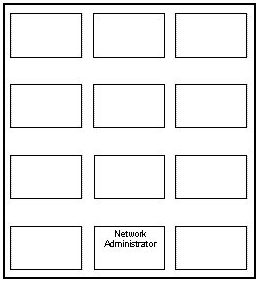
It’s always been easier for me to look at a picture or to take a 20,000-foot view of a situation. You can do the same thing in developing a career plan. Start by drawing yourself a series of three boxes in four rows and describe your current position in the middle box of the bottom row as shown in Figure 1.

Figure 1

Let’s use an example to illustrate. Assume you are currently a network administrator and that you aspire to become a CIO. This is a bit of an extreme example but will help you visualize what we are discussing.

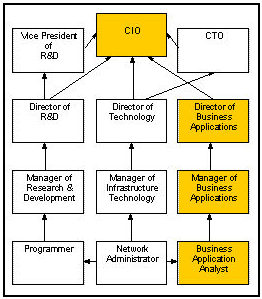
When you take a close look at the paths that normally lead to the CIO position, you will discover that more CIO’s come from IT managers of the business applications side of IT rather than the infrastructure side. On the other hand, CTO’s tend to come from the infrastructure side.

Several possible paths can be viable paths, but a CIO must be able to relate business issues with technology solutions. Managing business applications development and support tend to prepare you more for that requirement.

Using the template in Figure 1, I fill in typical technical and management positions in the boxes that will prepare one for the CIO position, ultimately getting to what you see in Figure-2. Please note that this is an example; there may be additional steps required to reach a CIO level in your company situation.

Figure 2

If you know that 70% or more CIO positions are filled from the Business Applications side, it’s logical to pursue the path of the boxes that are filled in. Another route is to follow a vertical path that leads to Manager of Infrastructure and then to Director of Technology. At this position, the possibility of filling a CIO role is doable but possibly more remote. The CTO position is a strong logical next step from the Director of Technology position. From the CTO position, you can position yourself for the CIO role.

Nothing is cast in stone and qualified individuals will always break the norm. The example intends to show that there are many paths that lead to the CIO position but one path usually gets the desired promotion more than the others. The trick is to move into positions that keep your options open.

Career planning is similar to when you started college. Some Freshmen know exactly what they want to be when they finish college and can plan their curriculum exactly. Other Freshmen don’t really know what they want to be so they take a general studies curriculum until it begins to become more clear for them.

Career planning requires you to stop and think about your career and to work out a plan that will work. Planning comes more difficult for some.

If you are developing a plan for yourself, always seek the advice of your manager and others who would know about how to reach your desired goal, , , or who have the experience and can discuss your career options with you.

Not all managers are comfortable in developing a career plan for their employees. Don’t let that prevent you from creating one yourself. What I’ve seen throughout my career is that those who decide what they want and put a plan in motion tend to achieve their objectives.

Go for it !!

Are you missing the point?

Here is a key question for you.

Are you wearing your “business owner” hat or your “technology” hat?

Maybe you wear some other type of hat, , , or no hat at all.

Something you may want to consider is what your clients think who use technology and that your IT organization supports (company senior managers, department managers, and users). They wear “business” hats.

There is a natural conflict between business managers and IT managers. Business people don’t tend to see the IT organization as part of the core business, , , after all, IT doesn’t generate any revenue in most cases.

Plus, IT people speak a techy language full of acronyms that business people do not understand, , , nor care to. Things like, , ,  SAP, USB, ITIL, VoIP, WAN, Cloud, POD, WiFi, PMP, , , etc.

Granted, many of these have become common terms, but IT people have hundreds if not thousands of acronyms we use, and business people don’t understand what we are talking about half the time. This is not good for your client nor for you.

This language difference helps create a gap between business people and IT.  Most managers of the company are thinking “business” and IT managers are thinking, , , yes, you guessed it, , , “technology”.

Business managers in general don’t profess to understand the technology, , , they focus on their areas of responsibility, , , and that’s either operating a part of the business or supporting the business.

For a business manager, it’s all about the financials. 
IT organizations sometimes get a bit confused. The desire to work with technology and a lack of desire to become strong communicators who invest in understanding the business causes them to drift away from their business clients.

If you wear a “technology” hat, your business clients don’t hear you let alone understand you. To them, you are simply a lost soul trying to force your technology on them, , , and they don’t like it very much.

They view IT as the organization that’s always changing the technology they have become accustomed to and causing havoc within their operations.

They don’t understand the changes IT dictates nor the reasoning behind most of it, , , they simply want to do their job with as little interruption as possible, , , and they don’t like IT getting in their way.
So what’s the point?

The point is that I see many IT managers who “miss the point”!

To gain partnership status in your company along with respect and appreciation for what you do, , , you have to meet the business on their ground, , , not on yours, , , not half way, , , on their turf. And their arena is all about financial aspects, budgets, and business value.

The bottom line is that if you can’t hold your own in a financial benefits discussion when recommending a technology initiative, your requests are probably not going to go anywhere.  Best case is that you get approval but the business manager doesn’t fully understand it, , , not a good scenario and opens the window for your IT organization to be considered out of sync with the business.

When you make any recommendation that requires spending money (and most of our IT initiatives definitely require money), always put yourself in the person’s shoes that you are making the recommendation to, , , and ask yourself one simple question that your client is asking himself,  “What’s in it for me?”

Business owners only want to spend money that provides some tangible value, , , so put your “business owner” hat on in all aspects of managing your IT organization.

One of the best IT situations I’ve observed in over 40 company acquisition assessments was the one where the CIO was a 50% owner of the company. He and the business were 1,000% (that’s 10 times more than 100%, you know) in sync with one another, , , it still gives me chills when I think about it because it was so good to see.

When your senior manager sees consistency in what you recommend, , , that there is tangible and quantifiable business value that truly cost justifies your recommendation, he or she listens.

When you deliver the goods, , , the benefits you expected and a project delivered on time and within budget, , , your credibility rises quickly.

Consistent high value recommendations and a track record of delivering your projects successfully sets you apart from your counterparts. All of a sudden, you will find senior management wanting to hear what you have to say, , , not avoid your conversations.

Wear your “business hat” and you will see a difference in how your clients appreciate and respect what you are doing.