Tax day

The good news is that we got a couple extra days to send in our tax forms this year, , , the bad news is that the IRS still wants our money.

When you have to pay more, you tend to wait until the last minute to send in that check, , , that’s why I spent time today getting the final numbers from our accountant and mailing in my check.

Hate this part every year, but glad to be able to do my part. It wouldn’t bother me at all except I see so much waste in our government, , , it seems to happen pretty much in every government from what I can tell.

One of the best examples I can give you is a little road project at the entrance to our subdivision. The entrance sits in the middle of a sharp curve and there have been several accidents there over the years.

It looked like there were a couple of reasonable solutions, , , reduce the curve and eliminate the blind spot by cutting the bushes and small trees on this curve or put in a 4-way stop so traffic has to slow down and yield to other traffic. Either of these approaches would work and cost very little to implement, , , but our government decides to spend what looks to be some $8 to $10 million and redo the whole interchange. It’s been a year already with no end in sight. It feels like our friendly politicians are asking themselves, “How can we spend more money?”

OK, OK, , , I apologize, , , I’m in a bad mood due to having to write that check earlier today. Even though it’s a pain, , , I’m fortunate to be able to make a good enough living to require more tax from me. I knew a rich man one time who looked at this issue in a positive light. He was glad he made so much money to require such a hefty tax bill.

I would still like to keep more of my earnings, , ,

Escalation procedures

In my last post, I discussed the need to have a “downtime plan”. Part of your downtime plan should include an Escalation Procedure.

As I mentioned in my previous post, I like to assign responsibility of key technology support components to an “Expert”, , , the person I want to empower to own that particular area of support. In the post, we identified e-mail as one of these areas.

Another key area is telecommunications or your Wide Area Network (WAN). When a remote office loses connectivity, your team needs to resolve this issue as quickly as possible, , , your company loses thousands of dollars in lost productivity every hour the remote office is down.

To minimize your downtime and the impact it has, you need an escalation procedure that kicks in as soon as we know an office loses connectivity.

Below is a sample Loss of Connectivity Escalation Procedure:

Problem ownership is clearly defined and specific communications to managers and vendors are spelled out. We have a point person in IT and also in the remote office that has lost connectivity. The point people identify themselves to their manager and make them aware of the problem and advise as to what the status update procedures will be.

In this escalation procedure, we have time limits set up so additional steps are put in motion at 30 minutes, 1 hour, 2 hours, and every hour after until the problem is resolved. 

A big part of your escalation procedure is keeping management informed. When you have a formalized escalation procedure, everyone knows who will be providing status updates and when. Keeping your client in the loop and out of the dark is key.

It is simple and easy to develop an escalation procedure for dozens of support issues you might have and that will need some level of escalation if they occur.  Here are the steps I would use:

1.  Assign “Expert” responsibilities for the technical support areas you deem important.

2.  Have your Experts identify possible situations that need an escalation procedure.

3.  Review and agree on the set of issues needing escalation procedures.

4.  Have your Experts develop a first cut draft of the troubleshooting and escalation steps that should take place.

5.  Review the procedures and fine tune them with your Expert.

6.  Create an Escalation Procedure Binder and add completed procedures as you develop them.

Your escalation procedures do not need to be lengthy or complex, , , in fact, your goal should be to keep them to 1-2 pages and simple.   

If you focus on this and distribute the work to several Experts, you can create a binder of a dozen or more escalation procedures in a week. You may want to distribute them to affected managers of the company and communicate what they are and how to use them; I would certainly share them myself, but it is your call as to whether you want to. 

The key is that you are providing managers with information so they know what will be taking place in the event of a problem, , , i.e., what you are doing to resolve the issue. IT still retains responsibility to resolve the problem.

Escalation procedures worth considering include: 

  • Loss of connectivity
  • Natural disaster situations (snow day, flood, hurricane, etc.)
  • E-mail
  • Mission critical business applications
  • Mission critical servers
  • Internet and Intranet access
  • Phone system outage

Putting escalation procedures in place demonstrates to others that you are organized and thinking proactively, , , strong images for your clients and senior managers to see in their IT organization.

Do you have a downtime plan?

Technology will break, so sooner or later you will have to deal with downtime. Will you be prepared when it occurs?

Waiting until downtime occurs is not the time to start thinking about how to troubleshoot the issue. It’s much better to have an idea of what to do when this issue comes up.

One of the things you should consider is to appoint an “expert” for each of your key technology support areas, , , things like e-mail, telecom or WAN, each of your mission critical business applications, intranet and internet access, etc.

A key responsibility of each Expert is to define the potential downtime issues that can happen for his technology area of responsibility. For e-mail, it would include things like virus attack, server failure, power outage, etc.

Once the potential downtime issues are identified, the next step is to develop escalation procedures to troubleshoot and resolve each of the issues when and if they occur.

Proactively looking at these issues and developing a downtime plan to attack the problem when it occurs puts you in a much stronger support position, , , and helps you sleep better at night.

Lead by example

In a manager role, you set the tone for the type of organization you want to be. Your employees are watching you and they will emulate what they see from your actions.

Say one thing and do another, , , you lose credibility, and your employees will follow your actions, , , not your words.



Let me give you a few examples:

“I expect you to be at work on time.”
Expecting employees to be at work on time doesn’t have much meaning if you are coming in late two or three days a week. When your employees see your actions, they follow the example you set.

“Have a sense of urgency.”
When something is broken and the clients can’t access systems to do their work, there needs to be a high sense of urgency to resolve the problem. If the manager’s demeanor and attitude is lackadaisical and without urgency, your employees will not have an urgency in resolving the issue.

There is a fine line in this one. You want to display a sense of urgency but not be running around like Chicken Little yelling, “The sky is falling.” Managers need to create a calming effect while placing importance and urgency in resolving issues.

“The client is always right.”
This does not mean there will not be differences, even heated discussions with some of your clients from time to time, , , but you don’t want a feeling of animosity to grow toward a difficult client. We always want to be professional and supportive in helping our clients  use technology effectively to conduct their business.

If you complain about one of your clients and an employee hears you do this, he or she will think it’s ok to complain about clients. That’s not good, especially if it becomes commonplace. Clients and their need for technology in their work is why we have good careers in IT. The client is why our IT organization exists, , , and you don’t want to forget this.

Before we leave this point, I need to emphasize something. Having the thought, “the client is always right”, does not mean the client is always factually correct. They may be completely wrong about something, , , but their perspective has to be managed. When their perspective is incorrect, your IT organization has to do the things that will correct their perpective.

You set the tone
An IT manager’s action sets the tone for what you want the organization to be and how you want to operate as a support team in areas like:

  • responsiveness
  • professionalism
  • ethics
  • attitude
  • competence

Be sure your actions exhibit what you want in your team , , ,

Want your employees to communicate well? You must do this and teach them how and what to communicate.

Want your employees to follow-up well? Then you must follow-up consistently and quickly, , , and explain to them how important follow-up is in your organization.

Want your employees to do what they say they will do? Then certainly you must deliver what you say you will do.

Want your employees to get along and work well with others? They will only if you set a positive example in this area.

Want employees to be on time for meetings? Then start your meetings on time and expect them to be there.

Want employees to go the extra mile when needed? It won’t happem unless their manager does this and you also explain when and why this is needed.

Your team becomes what you cause it to become, , , it all starts by your actions and the example you set for your employees.

My favorite employee appreciation event

In the fast and furious life of an IT manager, it is easy to focus on the work and forget about your employees who are doing the work. Ask yourself this question:

“When was the last time you thanked your IT staff?”

I put some things into motion that forces me to remember to thank my employees for the hard work they do. First, I include a recognition component in every monthly staff meeting. I also like to have at least one “just for fun”  event in every staff meeting, , , something that says, “I appreciate you.”.

Second, I will have my secretary remind me twice a month to do something that shows my appreciation for my employees.

My favorite employee appreciation event is to buy ice cream sandwiches or popsicles in the afternoon and pass them out to my employees. It gives me a reason to visit them in their work area, creates a short break for them, , , and exhibits the fact that I appreciate what they do for our company.

You see, that’s really the big deal, , , and it is a big deal. It shows employees that their manager appreciates them.

In the IT world, your employees don’t receive a great deal of appreciation from their customers (other department managers and users). For many, they feel unappreciated by others in the company. You can turn this around by handing out ice cream and doing other things that demonstrate an appreciation of their efforts.

IT employees have a huge need to feel appreciated and to receive recognition for their work, , , they seek out confirmation that they are doing a good job.

In your IT manager role, one of the key responsibilities you have is to build team camaraderie and motivate your employees. Appreciation and recognition events go a long way in doing this. Never underestimate the importance it has when you show your employees you appreciate them.

Doing things like this tells your employees, “Thank you.”; and it means a great deal to them.

Are you prepared to present?

I attended a 1-day photography workshop this past weekend hosted by an organization in my home town. I went more to donate and support the organization than to learn about photography, , , I’m also always interested in observing the techniques and tools of others who make presentations.

Observing others is something you have probably heard me recommend in the past. “Observe others and incorporate the good things into your approach to things” was one of the best pieces of advice I received from my first IBM manager. I’ve been doing this my entire career.

You can learn a lot from people who are capable and good at what they do. You can also learn a great deal from those who are not so capable. This workshop was one of those.

This workshop was simply awful. Even though I learned a couple of things, it was just a terrible presentation and the following information explains all.

Learn what not to do
Here is a rundown of what I consider critical flaws in this workshop:

  • Forgot his laptop power cord so he had to turn the laptop off every chance he had because he was afraid the battery would run out. It did in the middle of a point he was making.
  • Didn’t verify connection with the projector and ability to view the PowerPoint slides beforehand. As a result, he spent 10 minutes getting his laptop and the projector to sync up, , , he didn’t know how to do this.
  • Information slides were all text on a dark background, , , not interesting at all.
  • Presentation rambled and had no real organization or flow to it, ,, appeared to be very ad hoc with no sense of direction.
  • He rarely looked at students, , , rather he looked down most of the time. Got to have eye contact to gain interest.
  • His presentation was very technical. There were 21 people in the workshop and only 3 or 4 knew what he was talking about when he discussed aperture and f-stop.
  • He didn’t understand who his audience was and as a result most of his presentation was over their heads.
  • He showed some photos but did not show cause and effect of how he created the type of photo he was discussing.
  • There was no Feedback form to fill out, , , so he doesn’t learn whether he does a good job or a poor job.
  • He asked for questions but most in the room didn’t know where to start, especially with such a technical presentation they were experiencing.
  • Had to search for files he wanted to show, , , terribly unorganized.

The bottom line is that our presenter was not prepared to present. As a result, most in the class were lost or did not get much value from the class.

If you plan to get in front of a group of people to present something to them, you owe it to your students and to yourself to be organized and prepared to do a good job.

I’m glad I attended this workshop because it gave me new ideas of opportunities I think are worth pursuing and material for this post.

IT manager tools

I’m a big believer in using tools in your work. Over the years, I developed dozens of tools in my IT manager and CIO roles to help me organize, manage and monitor my IT organization, , , in other words,  to do my job. I also developed tools to assist me before I became a manager.

Five key reasons
I think there are five main reasons why you want to use tools in whatever position you currently hold, , , whether it is a senior IT executive position, a project manager, or a programmer.

1.  Improve productivity  – Completing your work faster and more efficiently is a good thing. Simple tools can help you do just that by working smarter and having aides that allow you to complete tasks quicker.

2.  Improve quality  – You will be more consistent and deliver higher quality when you use tools to help you do the job. Things like simple checklists will insure you “dot every ‘i’ and cross every ‘t’ “.

3.  Reduce stress  – Using a tool that’s appropriate for a particular task will remove stress by knowing you are doing everything needed to do the job well. An example of this is that I have a Class Checklist that I use to help me prepare for every class.  It totally eliminates any doubt or uncertainty for me as I prepare for class, , , when everything on the list is checked off, I know I’m ready to go.

4.  Make your job easier  – Probably the biggest benefit in using tools is that it makes the work easier, , , and that is always a good thing. I tell students in my IT Manager Institute class, “I’m lazy!”. In reality, I’m not lazy; but I hate doing redundant work or doing something in two hours that should take 30 minutes.  Tools make a huge difference in this area.

5.  To gain respect  – You might be surprised when someone gives you a nice compliment about how organized you are or how well you are approaching something at work because they notice a tool you are using. I’ve had many of my IT Manager Institute students tell me about impressing a senior manager or colleague by using one of my tools.

The simplest tool can be a big winner
Your tools do not have to be complex or sophisticated. Sometimes, the simplest approach to handling something is the best. Tools work the same way, , , I have many simple tools that senior managers with over 20 years experience thought were great. To me, I had a problem I needed to deal with and the tool I developed helped me deal with it.

One example is that I created a New Employee Orientation Checklist to help me get a newly hired employee off to a fast start. It’s important for the employee, my team, and me to make this happen, , , a simple checklist does the trick. I’ve been surprised at how many managers don’t have something like this, , , in fact, many ask themselves, “Why didn’t I think of this?”

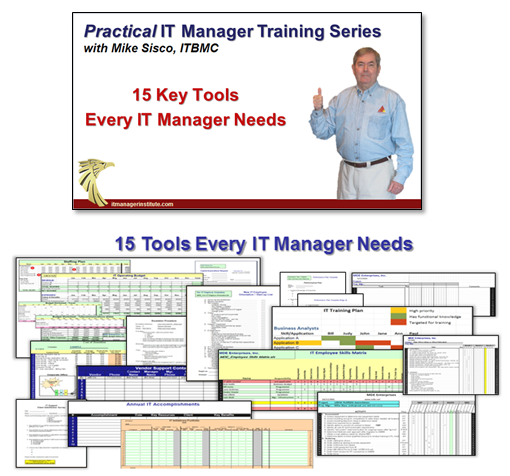
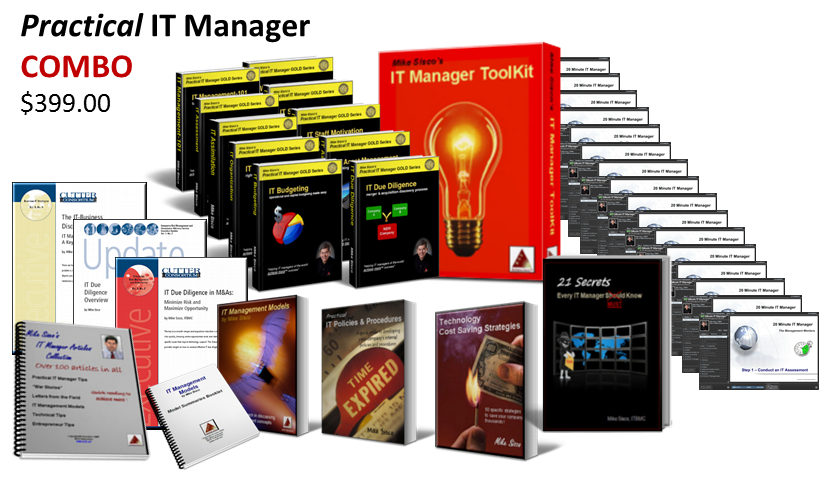
IT Manager ToolKit
I documented my tools and made them available to help other IT managers. Today, thousands of IT managers around the world use them, , , one of the more gratifying things to occur in my business. 

The IT Manager ToolKit contains 102 IT manager tools and templates, , , several of which are available for free in ITLever.

CLICK HERE for a complete list and to learn more.

Summary
Tools can make your life easier and more productive and much less stressful. When you have problems or challenges, I highly recommend you take a close look at the issue and determine if you can develop a simple tool to help you deal with it more effectively.

Two questions you must be able to answer

Every time you introduce change, , , any type of change to clients, employees, or senior managers, , , there are two questions you must be able to answer.

They may not ask you these questions directly, but in their thinking they want to know:

1.  What’s in it for me?
2. Why is this beneficial?

Implement a new software release, hire a new employee, reorganize the company, cancel a project or recommend a new project, , , any time you want to do something different, you need to be able to determine who will be affected and answer these two questions.

Lat’s take an example I used in my last post, , , you plan to hire a senior programmer to add expertise to the team you do not have. If you recall, I mentioned your employees being high detail and analytical people probably come up with negative implications regarding this new hire. The don’t identify the new hire as something that will be good for them.

So, your communication with your programming team, even managers and leaders of these teams, needs to answer the two key questions.

1.  “What’s in it for me?”  You have to explain the reason we are hiring a senior programmer is because of the experience and expertise this person has in an area that we need experience in. It will help our progrmming staff develop and come up to speed faster in an area where we have no experience.

2. “Why is this beneficial?”  It will benefit each of our programmers by learning an area of technology we need faster and in a more consistent manner and it will help our organization in gaining this expertise. The company benefits because of the work we will now be able to do and the business value we will be able to deliver.

Clients and senior managers ask these questions as well every time you intrduce change, , , so prepare ahead of time to communicate and answer their questions proactively.

IT people are very analytical

Your IT employees are analytical by nature, , , in fact, over 90% are high detail oriented people  and high detail people are analytical.

There is nothing wrong in being analytical. It’s actually a good trait for an IT employee, especially when troubleshooting a problem.

However, it can also be a dangerous thing for your organization if you do not understand the dynamics that take place.

Here is the issue, , , when high detail people are faced with change and they don’t fully understand the change, they analyze the issues they are being confronted with. It could be a reorganization, adding a new employee, changing priorities, cancelling a project, , , any of the things that happen in our day to day work.

Analyzing the situation is not the problem. The problem comes when the analysis results are arrived at by the person, , , ,and in almost all cases, the results high detail people come up with are negative.

Let me give you an example. Let’s say we plan to add a senior programmer to our programming support team so we hire this new employee. If we don’t explain why we are doing this to our other programmers, they start analyzing and come up with their own results as to why the manager is doing this.

They come up with things like:

  • “I should have been promoted.”
  • “They don’t think I’m doing a good job.”
  • “I might lose my job.”

They do not arrive at, “This is going to be a good thing for me.”

What this means is that when you introduce change into your IT organization, it is important to know that over 90% of your employees are high detail people who analyze change. It is critical that you explain what’s going on and why we are making these changes, , , and why this will be helpful to each and every programmer on your team.

If they can’t get to why this will be helpful to them, you will meet resistance, possible morale issues, loss of productivity,  etc.

Head all of this off by communicating with your team so they better understand change and why the change is important.

Best weekend of the year – The Masters

Our family looks forward to this week every year, , , yep, it’s time for, , ,

THE  MASTERS

If you are a golfer and have never been to Augusta National Golf Club, you can’t imagine what you have missed. When you first walk onto the grounds, you know this is something special.

As you walk past the historic clubhouse and out to the first tee you can see out over the course and you sense something magical about the place. This is truly hallowed ground with rich history and tradition unlike any other place in golf with possibly the exception of St. Andrews in Scotland.

One of the first things you notice is how elevated you are and how hilly the course is. The clubhouse and first tee actually sit high above most of the grounds, , , 200 feet higher than #12 and Rae’s Creek. When you walk the course, you learn firsthand how hilly it is; I can’t think of a single flat hole unless it is the short and dangerous par-3 12th.

The Masters Invitational Golf Tournament started in 1934 by Bobby Jones and a few of his friends. It has become one of the best and most recognized tournaments in the world.

As I prepare to watch the 2nd round of this year’s tournament, I thought it would be fun to write a post and share some of the interesting things about this great event.

A number of traditions and iconic images come to mind when you think of The Masters, , , things like, , ,

  • Bobby Jones  –  Bobby Jones is Augusta National. A truly heartwarming scene for all who remember him was when he would go out to the course to watch some of the action in his later years.

  • Amen corner – Holes 11, 12 and 13, , , one of the most scenic and most treacherous walks in golf and always deliver some great moments in the tournament.
  • Hole #12, , , shortest and hardest – Hole 12, a par-3 across Rae’s Creek is usually the hardest hole even though it is the shortest. As I write this, Matt Kuchar has just made double bogey and Graeme McDowell is in process of making triple bogey 6, , , little wonder some call this hole the “toughest par-3 in golf.
  • Gene Sarazen’s double eagle – Gene Sarazen hit a 4-wood into the hole for a 2 on the par-5 15th in the 1935 tournament. He goes on to win the tournament in a 36-hole playoff against Craig Wood.
  • Amateurs – Something Bobby Jones felt was important was to include the best amateur golfers, , , there are 6 in this year’s tournament.
  • Palmer, Nicklaus, and Player – Arnold Palmer helped put Augusta on the map as he won the ’58, ’60, ’62, and ’64 Masters tournaments just as TV coverage was coming into play. His charismatic style and The Masters created tremendous growth in golf. Jack Nicklaus has won the most with 6 victories, , , his most popular was in 1986 as a 46-year old, still the oldest to win. His 30 on the back remains one of the most memorable rounds in golf. Gary Player was the first international player to win in 1961 and has won three times. Gary played in his 52nd Masters this week. All past champions have an automatic invitation to play in the tournament every year.

  • The Crows Nest – A room in the tower of the clubhouse is designated for amateur players, , , a unique and memorable event for those who get to stay there.
  • The Masters trophy – A silver replica of the clubhouse.

  • Crystal goblets for eagles – Make an eagle and you are awarded a pair of crystal goblets.
  • Champion’s dinner – The previous year’s winner hosts a dinner for all past champions, , , he picks the menu and organizes the festivities. It began when Ben Hogan invited past champions to a 1952 dinner at the club before the tournament started.
  • Roars of the crowd heard through the pines – You can tell what goes on in the tournament from the roars, , , even to an extent who is doing it. There are birdie roars, there are eagle roars, , , and there are Nicklaus and Palmer roars of old and the Tiger and Michelson  roars of today.
  • Green, , , everything green – From fan bleachers, TV towers, sandwich wrappers to scoreboards, winner’s jackets and especially the grounds with not a blade of grass out of place, , , everything is a beautiful green at The Masters.
  • The Green Jacket – All winners receive a green Augusta National member’s jacket, , , but you aren’t allowed to take it with you, , , just ask Gary Player who mistakenly took his with him. A phone call from the club requested prompt return of the jacket. First green jacket was awarded to Sam Snead in 1949.
  • Hogan Bridge – The bridge crossing Rae’s Creek on the 12th hole was dedicated to past champion, Ben Hogan.

  • Ceremonial first tee shot – The tournament begins with a tee shot from one of the great past champions.
  • Tiger Woods – Tiger has won 4 times already, beat everyone by 12 shots in the 1997 tournament and is the youngest champion.
  • Magnolia Lane – The drive into the club is lined with huge magnolia trees and one of the most impressive entries into any club.
  • Azaleas and dogwood – The 13th hole is one of the most beautiful in the world with azaleas and dogwood in full bloom, , , and Rae’s Creek accents it beautifully. 
  • Butler Cabins – Several cabins line the 10th hole, , , Butler Cabin is used for TV commentaries.
  • Rae’s Creek – Rae’s Creek comes into play on 12 and 13, , , it has played a vital part in many championships.
  • Eisenhower Tree – President Eisenhower lobbied with members to have a large loblolly pine tree on the 17th hole cut down because he seemed to hit it far too often, , , it is still there but the pros of today have no problem flying over it.
  • Phil Mickelson – Phil has won three times now. His spectacular 2nd shot on #13 in last year’s final round will be one to remember for all time.
  • Wednesday’s Par-3 contest – It has become a family affair allowing kids and wives to caddie, even hit a shot or make a putt in this event. No winner of the Par-3 Contest has ever won the tournament in the same year.
  • Ham sandwiches in green wrappers – A real tradition of the tournament are the ham sandwiches and also the pimento cheese sandwiches.  They are wrapped in green paper just in case they find the ground instead of the green trash bins. No eye sores or distractions in this tournament.
  • Skipping shots on hole #16 – Players like to skip shots across the pond on 16 during a practice round, , , and the fans like it too.
  • The back nine on Sunday – The tournament always seems to come down to the back nine of the last day. It’s what all of us dedicated golfers wait for.

There are many, many more traditions and memories of The Masters. It is the best of what golf offers.