Help in creating solid IT business cases

Getting your IT project approved can be very difficult at times. However, there are some things you can do that will help make it easier for you.

Read the Cutter Benchmark Review article I wrote. You can download free from the IT Business Edge Knowledge Network.

Create Solid Business Cases from Start to Finish

Includes three articles plus survey results.

“You can have any color as long as it is black.”

Henry Ford, the creator of Ford Motor Company once said, “Any customer can have a car painted any color that he wants so long as it is black.”

He was creating something that would change life as we know it, , , the assembly line where he could mass produce his Model-T automobile and make it affordable for a vast new market – middle income Americans. To do this, he kept things simple and didn’t offer a lot of options. If you wanted an inexpensive automobile, you bought what he produced, , , Ford Motor Company was “off to the races” in a big way.

Technology innovation and new processes created a whole new automobile industry and mobilized Americans like nothing before it.

Well, guess what, Ford is doing it again and using technology to reinvent itself. Last year when the US government bailed out GM and Chrysler because of the depressed auto industry and poor economy, Ford declined the help because they were already on their way to a recovery of their own making.

It’s a powerful story that is being fueled by Ford’s IT organization.

I read a great article today from CIO Magazine titled,  How a Global IT Revamp Is Fueling Ford’s Turnaround. It’s worth a quick read because you might find something that could apply to your own company that helps in this tough economy.

By the way, I drive a 2000 Ford Mustang, , , a convertible. I have had this car longer than any car I’ve ever owned. Every time I think about trading it in, , , you guessed it, , , the sun comes out and the top comes down. It’s just too much fun to drive to let it go.

Here is a photo of our son, Eddie, in my “classic” 2000 Mustang.

Key milestones – the MDE story

MDE is 10 years old today and quite a milestone for us. Many of our followers have indicated an interest in our company’s story, so I thought I would share what I consider to be some of the key events or milestones of the first ten years, , , and what they mean to our company. Many of these “lessons learned” may be helpful to you in your life.
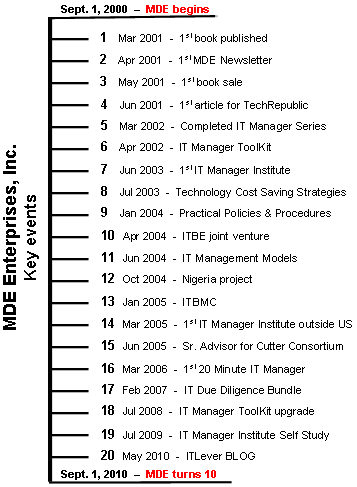
The graphic to the right highlights 20 key milestones that have occurred between our company’s inception (September 1, 2000 at the top of the chart) through today, ten years later.

Below, I discuss each milestone briefly and define the significance the event had for our company with the hope that providing this insight might be helpful to you in your business.

September 1, 2000 –  I walk into my CEO’s office to tell him I’m planning to leave the company. We work out a 6-month transition that is extended twice and ends after 13 months. My new company, MDE Enterprises, is started. MDE begins as a consulting company in a time I would soon learn to be a tough time to start a new consulting company due to the “dot.com” crash.

Lesson learned –  find ways for a “win-win” and you are likely to be more successful in a difficult situation.

1.  March 2001 – 1st book published
My first book titled What To Look For in a CIO, an e-Book actually, is completed. During the writing of this book, it hit me that I needed to write a series of “how to” books about managing IT organizations effectively. An “all nighter” and I had a set of Table of Contents for 9 more books in a series I would call the IT Manager Development Series.

Early on I determine that I don’t want to depend on consulting for my livelihood, , , I gradually conclude that I want to become a training and education company to help IT managers achieve more success.

Lesson learned – looking for answers often leads you to uncharted waters, but you can do anything you set your mind to do.

2.  April 2001 – 1st MDE Newsletter
Our first newsletter went out to 100 people, , , my immediate contact list. Today, we have almost 20,000 managers from all parts of the world who subscribe to my Practical IT Manager Newsletter.

Lesson learned – if you plan an internet business, you have to build your list. It will be a key to your success.

3.  May 2001 – 1st book sale
Working at my PC very late one night I see an email message arrive with the subject “Invoice”. It’s my first Internet sale for my first e-book. I was so excited. It’s the beginning of finding something small that works a bit that I would learn to leverage over time. The MDE internet business is launched. 🙂

Lesson learned – amazing what a $19.00 sale will do to motivate you.

4.  June 2001 – 1st article for TechRepublic
A contact is made with TechRepublic and they contract me to write an article. This leads to me writing over 100 articles for TechRepublic in the next two years. To date, I’ve written well over 300 IT manager articles for many organizations including HP, HDI, Cutter Consortium and others.

Lesson learned – there is a direct cause and effect response rate in providing material for your target market and creating significant awareness.

5.  March 2002 – Completed the IT Manager Development Series
The first ten e-books I envisioned are completed. WHEW!!! During this time, I posted the Table of Contents of all the books on my web site and started selling the full series  at a discount while I was writing them. We sold 102 sets of the full series before I had all ten books written and over 75% of all orders were for the full series. This reinforced to me that this content was really needed. Upon completing the series, I increased the price by 55% and sales actually went up.

Lesson learned – be careful what you sign up to do as it may take longer than you think.
6.  April 2002 – IT Manager ToolKit
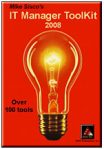
All of the books discussed management tools I had developed to do certain things like budget, manage projects, etc. As I was writing the books, I decided that a Tool Kit was needed, , , so when I finished the 10th book, I quickly focused on documenting my tools. The IT Manager ToolKit is released on “tax day” in the US (April 15th) with 80 tools and templates. This was a tough project because I had to document each tool, , , thought I would never finish it.

Because I had so many who had purchased the full series of 10 books before I had them all written (I call them “early buyers”), I decided to simply give them the ToolKit as a free gift. It felt good and was the right thing to do because they took a risk with me. My “early buyers” still receive a 40% discount on anything I develop.

Lesson learned – giving your client more than what they expect has positive ramifications.
7.  June 2003 – 1st IT Manager Institute
An early dream of providing classroom training to develop key IT management skills is finally realized. I tried to deliver a class in early 2002 but wasn’t able to fill any seats, , , lost some money and learned a hard lesson. Bottom line is that I wasn’t really positioned to deliver training in 2002 because I was still working on the books, , , needed to finish them first.

As the book sales got established in 2002, Dorine and I decided we could move “back home” to Tennessee to be closer to family so we did. Our move might not have been possible without the internet business doing so well. During the move, I was contacted by Belmont University in Nashville, Tennessee about IT manager training. Belmont would become a key partner in delivering future IT Manager Institute classes.

To date, we have delivered 40 IT Manager Institute classes in 8 countries.

Lesson learned – stay focused to your mission and persevere through the trials that ultimately try to block your success.

8.  July 2003 – Technology Cost Saving Strategies

Book #11 is completed from the training session I inserted in the IT Manager Institute to help participants of the class find ways to reduce expenses in their company and more than recoup their cost in attending the class. I learn the value of leverage.

Lesson learned – take advantage of efforts in one area of your business to help other parts of the business.

9.  January 2004 –  Practical Policies and Procedures

Book #12 is completed, , , didn’t really want to write this one but kept getting requests from my newsletter subscribers. This book became one of my better selling items.

Lesson learned – listen closely to your client.

10.  April 2004 – ITBE joint venture
A relationship is created with IT Business Edge, a young start-up company at the time who provides newsletters and other tools for IT decision makers. They are a young company but deep in experience in growing this type of business, , , it’s the same group who started TechRepublic and grew it significantly. They begin promoting the IT Manager Development Series as a premium product and it quickly becomes their top selling premium product, , , and it remains at the top today.

Lesson learned – the importance of solid joint ventures and the power good marketing skills offer your company.

11.  June 2004  –  IT Management Models

I complete my 14th book and the one I had the most fun in writing. “Models” is unique and has some humor weaved in it. The announcement and release of this book went very well as I did much more to create awareness and offered a significant “new offer discount”.

Lesson learned – the power of networking and a bit about the strategy of launching a new product.

12.  October 2004  –  Nigeria project
I agree to do a distance learning project with a company from Nigeria who discovers I’ve had many experiences in mergers and acquisitions. It seems the Nigerian banking industry is about to go through a major industry consolidation and they want to hold a seminar to place an emphasis on conducting a thorough IT due diligence to support mergers the banks will work through.  I meet Adedoyin Odunfa (by phone and email), a senior manager of the consulting company. Adedoyin and I become trusted colleagues and later great friends. Her company has hosted 9 IT Manager Institute programs in South Africa, United Arab Emirates, and Nigeria.

Lesson learned – the value of delivering more than what is required or expected and the  good things that can happen.

13.  January 2005  –  ITBMC
With Belmont University’s help, we develop the IT Business Manager Certification (ITBMC) to compliment the IT Manager Institute training. I wasn’t planning to create a certification but more and more of my students wanted it. When completed, it made a big difference in student registrations and helped us attract many who would not have been interested without the certification. The ITBMC is still (as far as we know) the only certification that emphasizes the importance of an IT organization delivering tangible and quantifiable business value for its company, , , and provides the insights and tools to help you make it happen.

Lesson learned – another reinforcement of how important it is to listen to your client.

14.  March 2005  –  1st IT Manager Institute outside the US
Our first class class outside the US was Aruba, a tropical paradise in the Caribbean. The ITBMC certification was a key part of landing this class and the start of a joint venture with e-Solutions Caribbean who would host two more classes in Aruba and Curacao.

Interestingly, my wife decided to go with me on this trip.  Smart girl. 🙂

Lesson learned – IT people want certifications, , , just because something is not that important for you doesn’t mean it isn’t for the other person.

15.  June 2005  –  Senior Adviser for Cutter Consortium

Another joint venture is created with Cutter Consortium as I develop a few articles and Executive Reports. This relationship teaches me more about the newsletter and information business I’m in, , ,  valuable insights.

Lesson learned – business relationships grow over time and add credibility to your business the more you do.

16.  March 2006  –  1st 20 Minute IT Manager
Tom Mochal and I meet one another in 2002 as we discover each other writing articles for TechRepublic. Turns out we lived just 20 miles apart in north Atlanta at the time. We start meeting quarterly with a few of my “inner circle” colleagues, my most trusted advisors, to discuss our businesses and to develop strategies for the future.

The October 2005 strategy meeting identified the possibility of us creating e-Learning modules for our audiences (project managers and IT managers). We developed a test for our January 2006 Kickoff Meeting and ran it by others including two of the principals of IT Business Edge and Dan Tankersley who had been part of my ideas from the very beginning.  The concept looked like it would be a winner so the 20 Minute IT Manager was born. Three years later, we wrapped up the program after delivering 162 weekly sessions to subscribers in many parts of the world. We now have a robust training library that provides anyone with an ability to develop their management skills.

Lesson learned – it’s extremely important to bring in more brain power to discuss possibilities of your business.

17.  February 2007  –  IT Due Diligence Bundle
Projects seem to get bigger. We release the most comprehensive set of training and tools to support IT due diligence and assimilation work that’s based on the processes and tools I developed in participating in over 40 company acquisitions. This product bundle had been a goal for several years because of the popularity of my book, Acquistion: IT Due Diligence (our best single book seller), but I couldn’t seem to get to it.

Lesson learned – tools like Articulate (www.articulate.com) can help you bring your experiences to life without having to deliver them in the classroom.

18.  July 2008  –  IT Manager ToolKit upgrade
We enhanced the IT Manager ToolKit with 22 more tools, now 102 tools in all. The launch was very successful and made the product even more beneficial for our clients.

Lesson learned – enhancing your product or services adds value for both your client and your company.

19.  July 2009  –  IT Manager Institute Self Study
A 2-year effort is finally completed with the launch of the IT manager Institute Self Study. In the course of developing the self study, I completely overhauled the class with new content, better graphics, a new format and new slides. The IT Manager Institute is better than ever and we positioned MDE to be able to deliver the Institute program and ITBMC certification to any IT manager in the world.  The launch was a huge success and I did it from our Camp Liberty on the Buffalo River. Another key step in my mission of “helping IT managers of the world achieve more success” is achieved.

In just a year, the self study program has already allowed over 100 managers from around the world take advantage of the IT Manager Institute program who probably would not have been able to before. The self study is a significant part of our company’s long term strategy.

Lesson learned – stay focused to your mission and learn alternative methods to reach your goals.

20.  May 2010  –  ITLever BLOG
A recent discovery that I’ve been avoiding for years is in incorporating a Blog in my overall strategy of providing IT manager tips and tools. Discovering the WordPress tools has been nothing short of phenomenal for me. The tools are simple, easy to use and gives me a super way to share information with my followers. I should have listened to the IT Business Edge guys when they recommended I start a Blog in 2006. Never too late to learn, I guess.

Lesson learned – investigate things your inner circle suggest to you rather than discounting the idea as “not being a fit”.

Summary
Today, we are a 10-year old company, , , a significant achievement in that there are thousands of IT managers around the world who use my practical IT management processes and tools. This feat probably amazes me more than anyone because I consider myself to be just a small town country boy at heart.

Ten years sounds like a long time but I’ve had so much fun it doesn’t seem all that long ago when I decided to branch out on my own. When you love what you do, the hard work doesn’t really seem like work. I’ve learned a lot and have so much more to learn about running a business, and I’m glad we made the investment to make MDE Enterprise, Inc. a reality.

We are optimistic about our future and believe we are better positioned than ever to achieve our mission of “helping IT managers of the world achieve more success”. New projects are underway and the future looks bright.

I hope some part of what I’ve shared in growing my company will help you in your situation.

Happy Birthday to MDE and me

Today is September 1st, 2010 and it’s my birthday, , , two times !!

My company, MDE Enterprises, Inc., turns 10 today plus I turn ___ years old , , , you don’t really need to know my age, , , doesn’t matter.

I’m very proud of the fact that my company is doing well and has made it for 10 years. Most start-ups die in the first two or three years. We have made it through two economic dips. Do you remember the 2000-2002 “dot.com” crash? And now, we have another major economic depression in much of the world, , , we are hoping we get to the other side in this one as well. It’s like life, , , you have good times and challenging times. Without the tough times, you can’t have the great times.

My company and what I do gives me the greatest satisfaction of my entire career and it has taken me to many parts of the world that I thought I would never see, , , and there is much more to come if I’m lucky.

There are a few tips I want to share with you that I believe work in my business and also for an IT manager.

  • Successful ventures often need a bit of luck to make it. I’ve certainly had my share of luck and good fortune. Another thought about this from the sports world is what Lee Trevino (famous golfer) once said, “The more I practice the luckier I get.”
  • Perseverance is key. You have to work through tough times and keep a positive outlook on the future. You become what you think, so if you think you are failing you probably will. Stay positive and keep doing the right things and success eventually comes to those who persevere.
  • Go for the opportunities that present themselves. You need to look for opportunity and then do something about it when you find it. There is usually an element of risk because there certainly aren’t any guarantees in life, especially in today’s environment. Test a concept and when you find something works, do more of it, , , take advantage of the little successes in life to create bigger successes.
  • Approach your business with a “win-win” attitude. Helping others win will also help you win in the long run.
  • Define a clear mission and then stay organized and focused on your mission.

It’s very late (2:30 am) as I write this post. Wanted to write this one and the next one tonight on my birthday, , , later today I plan to treat myself to a round of golf and share some time with Dorine and Eddie, , , today is a GREAT DAY.  🙂

Why don’t you have an IT strategy?

When I conduct an IT assessment it is usually to support a company focused on acquiring another company or to do a general IT assessment for a company’s senior management team.

During every assessment, I ask the senior IT manager for his IT strategy.

I get a couple of different reactions. The best reaction is when the CIO hands me a document and agrees to sit down with me to discuss the strategy he has in place.

Far too often, though, I get a blank stare. There is no IT strategy.

I’ve even had students in my IT Manager Institute make a comment that goes like this, “How can we develop an IT strategy when our company doesn’t even have a strategy?”

Your initial reaction is probably that this makes a whole lot of sense – right? It’s logical that if we are to be aligned with the business that to do so would require us to develop our IT strategy off the company’s overall strategy.

My answer to this question is always the same.

UNACCEPTABLE !!

Just because your company doesn’t have a strategy doesn’t eliminate the need for you to develop a strategic plan for your IT organization. In fact, developing your IT strategy and sharing it with senior management to gain agreement and commitment might even help the senior executives begin to formalize a company strategy.

If you ask senior management for their company strategy, they may not be able to give you a formal document or something that’s written down. However, I’ve rarely talked to a CEO who didn’t have a good idea about what he was trying to do with the company and what his objectives were for the next couple of years.

Your assessment needs to learn about these things whether it comes from a formal strategic plan document or simply from an interview with senior management.

If the CEO tells you he plans to grow the company by 15-20% in the next two years, you ask him how he plans to do it. These specifics that you pull from  the CEO in an IT assessment business discussion can tell you a lot about company strategy, , , again, even though it may not be formalized or written down.

Your IT strategy needs to be focused on supporting the business. Learn about the business, goals and objectives of the business, needs and issues of the business, and challenges of the business, , , and you have a lot to work with in defining what your IT organization needs to work on and the priority of these initiatives.

Don’t let anything become an excuse for not developing an IT strategy. The only way you can insure you will be in sync with your company’s objectives and have the IT organization aligned with the business is to define your strategy and gain agreement with senior management that it’s an appropriate focus. Once they commit to your vision (willing to support and fund it), there is no way for you to be out of sync with the business.

Developing your IT strategy puts you in the driver’s seat, assists in managing your client’s expectations, and helps you control your own destiny. If you don’t have an agreed upon IT strategy, it puts you at risk in being able to achieve success as an IT organization.

I’ve developed several IT strategies when the company didn’t have a corporate strategic plan. My sense is that you cannot afford to skip this. If you do, there is a very good chance your IT organization will be working on things that are not the priorities of your company. You cannot afford for this to happen.

So, the next time someone asks to see your IT strategy, I hope you can sit down with them and start discussing it immediately.

Sham Raju wins contest for week #2

Sham Raju from Bangalore, India has won an IT Manager ToolKit in the contest held for week #2 ending August 28.

We are giving away a free IT Manager ToolKit valued at $175.00 each week through the end of the year to celebrate our company turning 10 years old. Better yet, we will select a random winner from our ITLever subscribers and award a free Apple iPad on December 4th, 2010.

When asked What do you like about ITLever?, Sham replied, “It’s the best IT Information training and updates site that I have come across.”

You must be a current subscriber of ITLever to win. To subscribe, click the EMAIL SUBSCRIPTION link in the righthand panel and then select the frequency you want to receive new posts to our ITLever Blog (immediately, once a day, or once a week).

For a complete list of all winners, go to https://itlever.com/2010/08/12/subscribe-to-itlever-and-win/

Subscribe to ITLever and you may be our next big winner.

Should I ask for more money?

I received a question from one of my IT Manager Institute students that I think is worth a discussion.

The situation
“We will be conducting Business Continuity Testing in about two weeks and validating our Disaster Recovery (DR) strategy.

We will be testing the following:
Systems:
–  TPS, TDS, TPI, LSA, LPS, HBC, FPS, CRS, SCI, TSS, TPM (These are all in-house developed systems, client server)
Network:
–  HO Internet link will be brought down
–  Telcom VPN connection into HO data center will be brought down
–  International circuits for two country networks will be brought down
–  HO TEBA bank link will be brought down
–  3G link for mobile users will be brought down
Other processes & systems:
–  Active Directory to be failed over to DR (Disaster Recovery site)
–  Job Scheduler (EDI’s) to be failed over to DR
–  Internal and external mail to be failed over to DR site
–  FTP Server to be failed over to DR

It might not look like a big deal but it is one heck of a lot of work to get to the point where we can switch off our data center and within about an hour be up and running at our Disaster Recovery (DR) site, with everything working.

In my opinion the team of people that made this possible deserve a big bonus.”

The question
“My question to you is would it be unfair to ask executive management for a bonus and if so how do I approach it?”

My response
The first question that comes to mind is, “Do you have budget to cover a bonus?” If so, probably no problem; if not, it might be an issue.

2nd question, “Do you have money budgeted to do something other than a cash bonus?” If so, also probably not a problem.

Bonuses don’t have to necessarily be in cash. Could be gifts, nights on the town with their spouse, a nice dinner you host with the team and their spouse, paid time off, etc. What’s important is that you show your team you appreciate their hard work and the results they achieve.

The biggest issue is whether you have the money to pay for it in your operational budget or if you have to ask for extra money outside of your budget. Having to ask for more money is something most executives don’t like to hear, , , not to say it would be wrong to go ask for it, , , only stating what I think about what they will “hear”.

Senior management wants their IT department to be in control of their finances. What this means is that you need to plan for such things, , , even when you don’t necessarily know specifically what the money will be used for.

Do you remember the example I mentioned in the IT Manager Institute class where I put $1,000.00 in my 1987 budget for an employee event, , , not knowing at the time what the event would be? We ended up using it for the houseboat meeting and all day outing on the lake. Didn’t know we would do this when I budgeted for it, but I had the money allocated when we determined what we wanted to do for my staff 8 or 9 months later.

It’s ultimately your call, but my approach would tend to be to do something that is within your current budget without having to ask for “extra money”. If you have it covered, go for it, , , if not, you might want to do something else that’s a bit creative like “paid time off” for a job well done.

It’s worth the effort for you to show appreciation for your staff’s efforts and their results, , , I would just do it without having to go ask my company for more money, , , the company has already approved what it is willing to spend in IT for this fiscal year, , , you should try to make it happen within that commitment. Next year, , , plan to spend some money for performance excellence and make it part of next year’s operational budget.

Lastly, I’m glad to see you are testing your Disaster Recovery strategy. It’s going to help you sleep at night knowing that everything will work properly when and if the event takes place. Your company owes you a bit of appreciation for anticipating and taking care of such an issue before it happens.

Make it happen

If you are like most people, including myself, you may have what I call a “procrastination factor”.

Ugh, sounds terrible, , , what is it?

Often, it’s hard to get started on something that may not be all that fun to do. Other things just seem to take precedent and get in the way of you focusing on that special project that you know is important but may not be that exciting to work on.

Maybe it’s completing your budget, , , developing a performance plan for one of your employees, , , or dealing with a difficult employee situation. It could even be attending a seminar or taking a class that you know will help but you just can’t seem to find a good time.

Most people tend to focus on things they are really interested in doing, , , and they put things on the shelf for a later day some of the things that need to get done, , , that is, until the last minute.

I believe IT people must have developed terms like “all nighter”, “burn the midnight oil”, “just in time”. In many cases, we have to have pressure on us before we will actually put forth the effort and work on a project that may not be one of our most interesting things to work on.

Case in point: I’ve completed many projects since starting my company ten years ago. In a few cases, I had to create a self imposed deadline that put pressure on me in order to get to it and focus on the task at hand. I’m sort of in this situation now with a project, so I deal with my personal “procrastination factor” all the time.

Here is what I’ve learned to be a key in breaking through a procrastination deadlock that might be holding you up. Simply make a personal commitment to yourself, stop making excuses, and “go for it”.

Things that have helped me and might help you include:

  • Psych yourself up and think of the positive benefits that will come to you when you complete the project. Putting a positive spin on the project that motivates you can be a big help.
  • Break the project down into smaller parts. Maybe the procrastination is caused by the project being so huge that it intimidates you. Break it down into pieces so you can see some early successes that will lead to the end result you want to achieve.
  • Get started. What I’ve seen with my own situation is that most of the challenge is in getting started, , , once you start, you may find that you have all kinds of energy and growing interest to complete the project. Once I truly start on a project, I’ve worked nights and weekends to finish.
  • Stay with it. Once you start, stay with it, , , you can lose momentum and even grind to a halt if you stop and don’t get back to it soon.
  • Create a deadline. Sometimes, we simply need the pressure of a deadline to force us to get started and to finish something important. I know it has been something that I’ve had to do to complete certain projects.
  • Talk it over with someone who might provide you some insight. In my case, I run certain issues by a few colleagues who understand me. Another source that’s always helpful is my wife, , , she understand me better than anyone and often has very good input that helps me get focused better.
  • Set reasonable milestones. By setting realistic milestones, you can start seeing progress. Nothing motivates you  more than realizing that you are succeeding.

Well, I need to stop posting onto ITLever (one of the fun and interesting things I like to do), , , and get back to that project I keep putting off. It doesn’t seem to be getting done by itself!  🙂

Stop procrastinating and make it happen !!

VoIP on the road

I travel quite a bit and much of it is outside the US. When I’m away from home, I try and call my wife and son every day to stay in touch.

In 2005, I took my first overseas trip and as usual called Dorine and Eddie every day. I didn’t really think about the cost of what I was doing, , , it was just sort of a habit I’ve had while traveling throughout the  US for 30 years, , , no big deal.

What do you think was waiting for me when I got home? Yep, , , a nice little surprise came with my next phone bill, , , , an extra $400 charge for long distance “overseas” calls even though most of the calls originated from our home phone.

Unacceptable !!

Well, paying the bill was a “must do” but to incur extra phone charges like this on every trip, , , or avoid them by not calling, , , these two options are not acceptable.

My next trip was to South Africa and I took a colleague, Dan Tankersley, with me. Dan heard me describe the problem so he set out to find a solution, , , and he certainly did.

He discovered a Voice over IP (VoIP) service from Canada that provides intercontinental phone services at a fraction of the cost of what you will pay using your cell phone, calling from the hotel, or even having your wife call you from the US. Did I say a fraction of the cost?

A US to South Africa call is just 6 cents a minute on land line and 15.28 cents a minute using your cell phone. From South Africa to the US is 25.99 cents a minute, , , a bit higher but still a bargain when compared to something around $2.00 a minute using a normal approach. You can see that you save lots of money quickly.

My wife and I talk a couple times a day on most days when I travel, but we don’t feel the pinch of a huge phone bill after my trips. We also talk some 20-30 minutes at times and don’t feel rushed to finish the call due to the charges. A 30-minute call is less than $2.00, , , big difference.

There are many services like IDPhoneCard plus SKYPE is free. What I like about IDPhoneCard is that you can access it from any phone so you have plenty of flexibility and the rates are very reasonable. Quality has always been very good as well.

If you and your staff travel frequently, you may want to look into the potential cost savings you can attain using a service like this.

Details of IDPhoneCard are at www.idphonecard.com.

Publishing industry paradigm shift

I’ve been writing books and publishing them for many years and it has been apparent to me for some time that technology is changing the publishing industry in a big way just as it has changed other industries in the past.

Let me give you 3 examples of how technology has radically changed the publishing industry in just the last 5-10 years:

1.  Print on demand – It is so much easier to publish a book these days than it was before. In the old days just 20 years ago you had to find a publisher who was willing to produce your book. If you were lucky enough to secure a publishing contract for your book, the publisher had to print, distribute, and sell thousands of copies to realize a profit.
Enter Print on Demand. With technology now, a writer can publish his own book and can get as many of them printed as he wishes, , , even down to a single book if that’s what he wants.

Another example of this is when I order class materials for my IT Manager Institute. I log into my Mimeo account and order the number of sets of material I need, enter the shipping address and they are there the next day anywhere in the US or in 3 days anywhere in the world. What used to take me hours to prepare for a class now takes a few minutes.

2. e-Books –  Amazon and now Apple and Barnes & Noble have legitimized the e-book. I’ve been delivering my e-books to IT managers all over the world since 2001 so it’s not really new to me, but I saw a story on a News program the other night where one of the newscasters asked the question, “Do you think e-books will change how we read things in the future?”

It’s already happening. My wife reads all the time, but she rarely buys a paper book anymore. She just finds it on Amazon and downloads it to her Kindle. Not only is it cheaper and easier for her, , , she likes reading from the Kindle better. More and more people are moving toward technologies like this for their information (newspaper, magazines, music, TV, etc.).

The introduction of the Apple iPad will only accelerate this media migration we are watching take place before our eyes.

3. Katie’s school – My brother just told me about an interesting thing that’s happened in his daughter’s school. It’s a private school so they are a little ahead of public schools in embracing technology.

Part of Katie’s tuition for the school year includes the cost of an Apple Notebook. Every student gets one. All their books and most of their training materials are stored on the computer or accessed from the school’s network and Internet.They are also required to download specific Apps, , , most of which are free.

No heavy bags to tote around anymore!

The point is that paper books may no longer be used in the classroom of the future, , , too bulky, too expensive, and they wear out. One good laptop that’s taken care of can last you throughout high school or college.

I don’t think paper books will disappear completely, but the use of technology to read our literature is only going to expand and when it does, it whittles away at the volume of paper books that will be produced in the future.