Management requires special skills

Moving into management is tempting to many IT pros. But before jumping into a position you’re not ready for, there are a few issues you need to examine. Review these five steps and decide if you’re prepared to move successfully into management nirvana.

I’ve been fortunate to have managed thousands of employees in my 20-plus years of managing IT resources. One of the interesting things I’ve consistently noticed during that time is how many employees want to become managers.

I absolutely love managing IT organisations and the people within them, but it’s not all glory and accolades. There is also hard work, frustration, and tremendous challenges required to do the job right. So before you start applying for that open management role, you should take a closer look at the job.

Answering the “why?”
When interviewing or counseling employees, I’m often confronted with someone’s desire to become a manager, and the first question I ask is, “Why?”

The response can provide a useful perspective. Here are a few examples that I’ve gotten over the years:

  • “I want to be the boss.”
  • “I want the authority and prestige of the position.”
  • “I want to direct others on what they should do.”
  • “I don’t know; it just seems like the natural course for my career.”
  • “I want to attend management meetings and learn what the company is planning.”
  • I want to build a big organization

At the time, the staffers who provided these responses didn’t have a clue what an IT manager’s job involved. In fact, most IT professionals don’t, and too many get thrown into management positions with little or no real preparation to do the job effectively.

The answer to “Why do you want to be a manager?” reveals a great deal about what you want from a job and how you view the role of IT in the company. Many technicians see the role as one that defines the technology direction of the company and determines what tools to use. For them, the allure of a management position is the ability to make these decisions. To some extent, that’s true, but many don’t get the fact that what really drives those decisions is the company’s needs and not necessarily the technical knowledge that the manager may possess.

Current competency isn’t all that’s needed
Being good at what you do does not necessarily prepare you for a management position. Let me repeat that: Just because a person is an outstanding consultant or support pro doesn’t mean that the person will be a good, or even an average, manager.

The growth of technology in the last 20 years has created a large demand for more IT managers, and many have found themselves in the role without anything more to help them than what they knew in their former positions.

Certainly, knowing how to program can benefit you in a programming manager role, but it can also be a limiting factor. When you take the best programmers and make them managers, the company and CIO often lose their best productive resources, and a very green person is now placed in a management role that directly influences many others.

For far too many years, it was thought that the best resource in a technical area could effectively manage the rest of the team. That’s not only a false idea; it can also be a dangerous one for the company, the IT organisation, and employees touched by such a move.

The fact is that effectively managing employees and technology resources has very little to do with how technical you are and more to do with your ability to facilitate, persuade, plan, organize, motivate, and communicate. You don’t hear anything very technical in those terms.

Suddenly, what becomes more important is not what you can do yourself, but what you can get accomplished through others.

Management is like any other skill. You can learn it, but the key issue is that it’s a different skill set from what you have used as a technician. Of course, the fact that you have been successful as a technical resource does give you a head start, because it helps you relate to others who have technical roles.

When you become a manager, you have to let others do the technical part so you can focus your time and energy on doing the management part. With technology changing as rapidly as it is, you simply cannot continue to be the technical expert and expect to be an excellent manager.

If you take nothing else away from this article, take the message that when you decide to become an IT manager, you have to focus your time and full energy on issues that help you succeed as a manager. If you like solving problems, learning new technologies, and implementing new tools and technology, you may want to stay in your technical role. Managers don’t have time to become experts in the new technologies and do their management jobs well.

Positioning yourself for management
I’m not suggesting that you can’t become a manager if you truly want to. Take my insight as a message to prepare and understand what the job is really all about before taking the leap. It’s not about giving orders and telling others what to do as much as you might think. If that were the case, it would be a simple deal.

Here are five steps to take in your current role to prepare for a management position:

  • Learn how to manage projects and establish a successful track record of managing projects that are delivered on time and within budget. Developing sound project management skills is the best preparatory step, as the role requires many of the skills needed in a management position.
  • Observe successful managers managing and motivating employees. When you see something that’s effective, add it to your skills “toolkit.”
  • Find a mentor who has a successful management track record and is willing to help you develop management skills and offer you insight. Mentors are invaluable and can help you save time, avoid wasted effort, and reduce frustration because they know the shortcuts that are effective as a manager, just as you know the shortcuts in your technical role.
  • Tell your current supervisor that you’re looking to move into a management position and would like help preparing for the new challenge.
  • Ask for more responsibility so you can develop new management skills. Be sure you preface the request so that it’s clear that you want it to help you develop skills that will prepare you for a management role.

There’s no quick shortcut
Depending upon your background and experience, you may have a long road ahead in your preparation efforts. Don’t expect to be offered a management position the week after you ask for it. You need to realize that management roles require new skills, so you should be prepared to make the investment to develop those skills.

Over the years, I’ve turned down many management/promotion requests from staffers who were not ready to become managers. But for those who showed a genuine desire to become managers, I made an investment in that goal, and many turned out to be exceptional technology managers. If I had moved them into management roles, unprepared in both perspective and skill set, I would have been negligent as a manager myself and could have damaged their careers.

In every case, the first question I ask is, “Why do you want to be a manager?” In most cases, the initial answer is not the same answer given a year later when they better understand the role.

Raised floor

Be sure you know what they are asking, , ,

When I was an IBM Systems Engineer (SE) in the early 1980’s, I was asked to install a data collection system for time and attendance and other data collection activities in a large hospital.

I had installed several before so my Sales Rep partner asked me to conduct a walk through to plan for this hospital’s new technology installation.

As we enter the hospital, we head down the hallway to where the IT organization resides. We walked by one door with a ramp leading up into the room. The door had a sign that said, “IT Personnel Only” .

I guessed that this door led into the IT organization area and didn’t think too much of it. We continued down the hallway and around a corner to the CIO’s office.

We arrive at the CIO’s office and I meet him, the three of us chatted briefly, and then he asks the Sales Rep a strange question. He asked, “Jim, does Mike know?”

I had worked with Jim for two years and I always knew when he was up to something because of the mischievous chuckle and grin he made. When he laughed at the CIO’s question, I knew there was something going on.

Jim answered, “No, Mike doesn’t know.”

You guessed it, I asked both of them, “What is it that I don’t know?”

There was no response other than an indication I would find out soon enough.

The CIO asked if I wanted to take a tour for my installation planning needs, and we all set off to tour the hospital.

The first stop was to go into the Data Center which was just outside the CIO’s office. As we approach the secured door, I noticed another ramp just like the one I had seen in the hallway leading up into the Data Center.

When we entered, everything looked pretty normal, , , like many other Data Centers I had seen before. This is when the CIO proceeds to tell me , , , the rest of the story.

When the hospital purchased a new mainframe many years ago from a different company, the Sales Rep discussed the physical planning needs for the new mainframe with the former CIO who was there at the time.

One of the requirements was to install a raised floor.

The mistake he made was that he did not ask the former CIO of the hospital if he knew what a “raised floor” was.

Three weeks later the Sales Rep comes back in to check the physical planning progress as he and his company prepare to ship the new mainframe hardware to the hospital.

He was surprised at what he found. In fact, we were told that he didn’t know whether to laugh, be sorry, or disappointed in what had happened. He probably felt all three emotions.

You see, the former CIO not really knowing what a “raised floor” was, ordered a 2-foot slab of concrete to be poured into the Data Center.

He literally raised the Data Center floor, , , which is why they have to have ramps leading up and into the Data Center room.

So, what I learned about what had happened and what I was really seeing in the hospital’s Data Center was that there was a “raised floor” on top of a “raised floor”, , , a raised floor to hide the cables on top of a slab of concrete

The morale of the story, , , Be sure you confirm that the other person understands what you are asking!

a raised floor on top of a raised floor

Dead chicken award

Do you award the dumbest mistake of the month with a “dead chicken award”? This works well with a younger team.

You’ve seen the rubber chicken that’s all swiveled up and looks dead that they sell at novelty shops – right? They are inexpensive and make a great gag award to the person on your team who makes the dumbest mistake in a month.

The winner gets to hang this “dead chicken” above his cube or outside his office for all to see, , , for a month or until the award is passed onto someone else. No doubt who made the biggest blunder with this little prize floating around.

When I introduce it, I usually award it to myself first, , , for a couple of reasons:
1. I make mistakes just like everyone.
2. I’m part of the team and have to earn that membership.

I mention this award to most of my IT Manager Institute classes. So far, I’ve never had anyone tell me that they know about it.

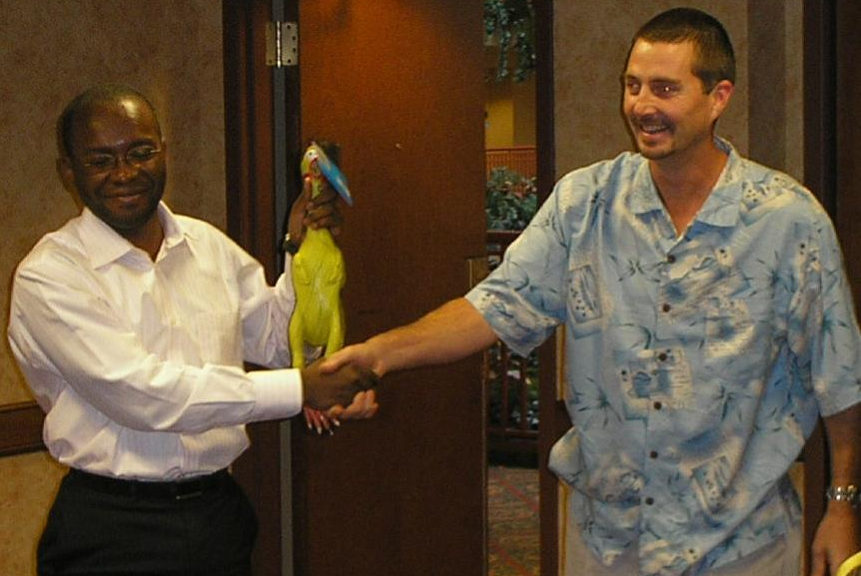
One class had a little fun with it as you can see by the picture below. Ed O’Kelley from Tennessee awards the “dead chicken award” to Heitor Miguel from Angola AFRICA because he was having trouble understanding just exactly what the “dead chicken award” was all about.

We told Heitor that he might have some explaining to do as he went through airport security.

It’s true – a picture really is worth a thousand words.

Interviewing tips

Getting ready for an interview? Here are some interviewing tips that might help.

– Identify your accomplishments before you go on an interview.Think of the company benefits and results you have achieved.
– Don’t let your guard down.
– Answer the interviewer’s questions in a direct and concise manner.
– Dress in a manner that your position calls for.
– Maintain direct eye contact with the interviewer; this shows confidence.
– Develop questions that demonstrate interest in working with the company.
– Send a thank-you letter to all individuals with whom you interviewed.
– Be aware of your language. Avoid vocal fillers such as “you know” or “um”.
– Answer questions within 60 seconds or you will lose your listener.
– Be prepared, but don’t sound rehearsed.
– Expect to answer the question, “Tell me about yourself.”
– Remember that you are interviewing the company as well.
– Be prepared to expand on the information you provided in the resume.
– Always show up on time.
– Be honest but careful of what you are saying.
– When filling out a job application, be sure to read and follow the instructions.
– Be polite and positive.
– Research interview techniques and prepare.
– Listen carefully to the questions that are asked and answer the question.
– Maintain a positive and upbeat demeanor.
– Don’t go off on tangents.
– Be aware of your tone and body language.
– Establish rapport with the interviewer.
– Don’t interrupt the interviewer when she or he is speaking.
– Expect to be nervous.
– At the end of the interview, ask the interviewer what the next step will be.
– Know the organization’s needs and culture before the interview.
– Be yourself.
– Don’t speak negatively about your present or past employer.
– Be prepared to answer, “Why did you leave your last company?”.
– Wait until you are offered a seat before you sit down.
– Interact with the interviewer; don’t react.
– Pace yourself; if you need extra time to think of an answer, take it.
– Write down your thoughts of the interview immediately after it is over.

We need well rounded professionals

I read an article yesterday that made me think. I know, , , those of you who actually know me are saying to yourselves, “It’s about time you started thinking.”

Well, anyway, , , the article was about mentoring your employees.

It made several good points, but the essence of the message was that you need to develop your people in more than one or two areas, , , not just technically. What you ultimately want in an organization is a staff of well rounded IT professionals.

What this says is that they need the following investments from their manager:
1. Technical knowledge expertise (goes without saying, I guess)
2. IT organization mission and expectations you have of them
3. Company knowledge and why our company is so good
4. Industry knowledge and the part our company plays in this industry
5. Communication skills (IT people need help here more than most)
6. Client needs and issues (after all, we have a job because clients need us)
7. Client service skills (traits that creates great client relationships)
8. Vendor insights and how to work with vendors
9. IT policies and procedures (the things that help us support the business)
10. New technology trends
11. Project management skills (successful projects lead to IT credibility)

This is just a list of 11 areas where you need to develop knowledge and understanding in your employees. Believe me, IT people are hungry for information, , , it is hard to give them too much.

Invest in your employees and develop their insights and you will see great things come from them, and remember, , , don’t just focus on one thing, , , you need well rounded professionals to be highly successful.

Teach your employees how to troubleshoot a problem

You may be surprised to learn that many of your employees may not know how to troubleshoot client problems.

Let me give you an example. Many years ago I inherited a new IT organization to manage. When I got the responsibility, I knew of one client account that apparently had problems every month, , , their problems were sort of a legend within our company.

Sure enough, at the end of my first month the client CFO calls and asks for the support manager (that’s now me). They were encountering another problem, , , something that seems to happen every month from what he told me.

I asked questions to try and understand what was happening, but couldn’t get any real insight as to what the issue was, , , so I ended the phone call and called in my senior IT people.

I asked them about the situation. In a similar fashion, I heard a lot of generalities but nothing of substance that helped me understand what the real issues were.

We visit the client and conduct a simple assessment at the end of the next month and the problems occur again, but this time we are able to see and understand the cause and effect of what is going on.

The result is that we are able to identify 4 key issues that contribute to the problems this client was having, make recommendations on how to prevent them from happening, and when the client implements these preventive measures it solves the problems from occurring in the future.

The point with this is that my staff was an experienced group of technical people, smart, and conscientious. The problem is that they weren’t using a process to troubleshoot the problems and get to the root issues.

You can’t deal with problems if you do not know what the issues are.

Once we understand the specific issues, we can usually solve or prevent the problems. So, , , observe your employees and verify if they are actually troubleshooting problems so they get to the issues. If not, you probably need to teach them how to get to the bottom of the circumstance.

Positive energy

I’m a firm believer that positive attitudes create positive energy and that those around you feel it. Likewise, I think negative attitudes create negative energy and people feel that as well.

I’ve always tried to look at the “glass half full” as opposed to “half empty”. It’s the same situation, the difference is just how you look at it.

When our son had his car accident in 1993 and we almost lost him, it was the most terrible experience a parent can go through, , , but Dorine and I kept looking and thinking about the potential, , , and not about the terrible challenges Eddie was facing.

Today, it’s 17 years after the accident and Eddie still has physical challenges and a significant short term memory loss, , , he can’t remember something that happened 30 minutes ago. But the upside is that his long term memory is intact and strong.

Eddie never has a bad day, , , something that is amazing to us considering his physical challenges and pain he deals with. But it’s true, he is the most positive person I know, , , maybe it has something to do with short term memory loss.

The point is that Dorine and I stayed positive and kept encouraging Eddie during the darkest of times. I could tell you hundreds of stories that still give me chills of joy and some that caused grave concern at the time.

We believe that our positive attitudes are what helped Eddie recover to the level he has and why he is such an inspiration to so many. Everyone who meets Eddie seems to be drawn to him because of his positive attitude, , , he truly has an aura of positive energy.

Positive attitudes really do work. We have seen it over and over again in our personal and professional lives.

As an IT manager, it’s important for you to stay positive and to encourage others. Your attitude sets the tone in your organization. If you are not positive and positive energy doesn’t come from you, it’s very hard, if not impossible, for your team to be positive.

Treat every day as a new day and a fresh start. Go into work with positive thoughts and look forward to the challenges that will come up today. Remember, if there weren’t challenges and problems, they probably wouldn’t need you and your position in the company.

Positive energy is a contagious thing, , , create positive energy and watch others respond to it.

Best of success.

Find yourself a mentor

Everyone needs a mentor, or coach, who can help you improve by sharing their experiences.

Let’s face it; it is easier to learn something when we can learn from someone who has already gone through this experience and can share what to do and what not to do.

I’ve been very lucky in my career because I’ve had some great mentors who have been instrumental in developing my management skills.

Doesn’t it make sense to minimize the pain of learning everything on your own? You need to make every effort to find a mentor or several experienced managers who can help you transition into a strong manager.

One of my earliest mentors was Bryan Hathcock, the first IBM manager I worked for. Bryan was a good bit older than me and I thought a lot of him as a manager and mentor, , , still do.

He gave me two pieces of advice that I’ve always remembered and tried to reinforce within my life and professional career:
#1  –  “Observe others around you and when you see something that works well, incorporate that trait into your way of doing things.”

I’ve been doing this for over 30 years and continue to observe, learn, and incorporate positive examples into my behavior.

#2  –  “When you take on a new responsibility, be sure to focus on the requirements of the new job and stop trying to do your last job.”

This is extremely important for IT technical people who want to transition from technical experts and become successful IT managers. You can’t continue to be the technical expert and also be a successful manager.

Managing an organization of any size is a full time job and takes considerable concentration. Letting go of the past and focusing on the new job is a difficult transition for many young managers, , , it certainly was for me, , , but you have to make it happen to be a successful IT manager.

A mentor can help you through this difficult process.

Win – Win

I was talking to one of my IT Manager Institute graduates a few weeks ago and he made an interesting comment. He said that he had never heard of the concept, “win – win”, until attending my class. He went on to say that he had incorporated this concept into his approach to things and was amazed at the difference it seemed to make as he worked with clients, vendors, even his employees.

Comments like this reinforce why I like this job so much.

If you aren’t familiar with the “win – win” concept, it means that in your dealings with other people, you need to seek ways so that both parties win, , , not just you or your IT organization.

Ultimately, if you win but the other party does not, , , then you lose. You may be able to get a one-up on your vendor for a time, for example, but in the long run you can only win if you establish a partnership where both parties win.

I approach a “win – win” even when I have to terminate an employee. You may wonder how this can be a win for the terminated employee, , , good question. Well, it’s pretty simple actually.

If you have an employee who isn’t performing and you have done everything possible to help the employee get his or her act together in order to perform effectively, but it’s just not going to happen, , , then, you owe it to the employee to get him or her out of your organization and allow them to seek employment elsewhere where they have the opportunity to be successful. In fact, I believe you have an obligation to help them in this regard, even though it means termination.

I very much look at this as doing what’s right by the employee and forcing the issue so he or she can be successful. It is unfair to allow them to continue to fail in your organization. It’s not only unfair to the employee, it’s also unfair to your other employees, your clients, and your company.

Oh yeah, don’t forget that it’s unfair to you as well.

There is a “win – win” option in almost everything you do if you look for it. What you will find is that when you start seeking ways for the other party to win in a situation (even a disgruntled client), your approach changes and people start noticing it. Before you know it, others start trying to insure that you are able to have a win, , , and that’s when it really becomes fun.

Start looking for ways to insure the other person or entity can get a win the next time you have a tough situation to handle or when negotiating with your vendor. Remember what they say, “the more you give the more you receive in return”. I can verify this to be true from my own personal experiences.

Best of success.

Business value is key

Business value is the key to job security!

In today’s economy, many of you reading this article will possibly become at risk in keeping your job over the next year. Some of you may have already heard the bad news as your company decides to reduce the number of staff.

This article is not intended to make you worry needlessly or to be a negative message. In fact, the message you should get from the content below is a very positive one.

Now, it is more important to have an IT organization that is appreciated and valued by your senior management team than ever. If you haven’t established this already, it may be too late to avoid the impending impact in your company from a souring economy. However, it’s never too late to start building a presence where you and your IT organization is appreciated and valued for what you do, , , so if it doesn’t already exist in your company, you need to get started RIGHT NOW !!

First step – understand the importance of business value.

Business managers want and need your IT help, but they do not and will not fully understand technology. There are exceptions to everything, but for the most part they don’t want to understand the technology. They just want to do their jobs and to support the company’s mission. They also want to keep their jobs as much as you do.

What business managers (senior managers and department managers of your company) do understand is business value. When you deliver business value, speak in business value terms, and do things that have business value implications, , , then, you get their attention and you gain respect and appreciation for your organization’s hard work.

However, if you cannot connect with your client (again, the senior managers and department managers of your company) on a business value level, it is difficult and potentially impossible to gain their respect and appreciation for what you and your organization do. They just don’t get it when you deliver technology.

It’s about the business. It is not about the technology.


Business value comes in many forms:
a. Increase revenue – Implementing technology that helps the company sell more of its existing products or services or sell new products or services.

b. Decrease expense – Decreasing a departmen’s expenses or avoiding costs by implementing technology.

c. Improve productivity – Improving a department’s people productivity so they can handle more work with existing employees and avoid hiring more employees or able to reduce staff.

d. Differentiate the company – Doing something that gives the company an advantage over its competition by differentiating the company’s offerings.

e. Improve client satisfaction – Retaining a client can be more cost effective than replacing a lost client with a new one. Improving client satisfaction can be valuable to a company.

In a “for-profit” company, there is a common theme in all of these elements. Each of these value propositions help the company become more profitable, , , and profitability is the name of the game in a “for-profit” company. Even in a “not-for-profit” company, increasing revenue, decreasing expense, improving productivity, etc. are important to help the company continue to operate and do the work of it’s mission more effectively. So, regardless of your situation business value is an important component in delivering technology support.

Your IT organization is the one organization in your company that can positively impact every organization or department in the company. No other organization in your company offers this much leverage to the senior management team.

The problem is that your senior managers won’t realize this much leverage is right under their noses if your organization has been delivering technology instead of business value.

Understand that most business managers see the IT managers of the company as technical managers, not business managers. You must change this perspective they have of you. And, when you do they will appreciate you for what you can do for the company and not see you as a “cost center”, or a manager who likes new toys, or an organization that simply likes to spend money.

An IT manager who delivers business value is viewed as a partner, , , a business partner to be valued for the positive contributions he has made in the past and can make to the company’s prosperity in the future.

Second step is simple: All IT initiative recommendations must be cost justified and provide tangible business value to the company.

You simply don’t work on things unless you can quantify the business value that will be gained when the project is completed and every recommendation is cost justified and easily understood by the management team.

This means you must be able to frame projects and discuss them in financial terms. Senior management won’t understand routers and switches, programming, and such technical things as you do; but they do understand revenue, expense, productivity and those type of discussions.

Your tendency is to discuss the issues in technical terms and when you do, you lose a business manager’s attention. Learn to discuss your projects in business value and benefits terms and you get their attention, , , and keep it.

When senior management has trust in you that everything you do provides business value and that you only spend money prudently (like a business owner would do), you will find they will appreciate their IT organization much more than you might imagine.

Let me give you an example, I’ve been very fortunate to have worked with some excellent senior management teams; I’ve also worked with a couple of weak teams. In my career, I’ve had two CEO’s ask me to spend more money in IT when they were cutting costs in other departments. The reason was the same in both situations, , , these CEOs understood the leverage value of an IT organization that delivers business value.

Insightful senior managers know that they can get much more cost savings from IT when we do things that reduces expenses or improves productivity in the bigger organizations. Sure, if they ask me to cut 10% from my budget in the 2nd half of a year, they will get something fairly tangible, , , but not nearly what they can get if I can implement technology that improves a much larger organization’s productivity considerably. Even better, this type of improvement is usually an ongoing benefit, not a one-time cost savings benefit.

You have to earn their confidence. To gain the trust of the business managers requires a third step:

Third step – establish a track record of success
1. All your recommendations are cost justified and have tangible business value
2. You deliver the approved projects successfully

Sounds pretty simple and it really is when you get right down to it. Business managers are looking for partners who help them achieve their goals and objectives. When you deliver what you say you will do and those deliverables include business value that helps a CEO or Department Manager achieve his/her objectives, you simply gain a lot of respect, trust, and value in their eyes.

They wouldn’t think of running the company without you when this partnership exists.