
CLICK image to subscribe and receive free IT Management-101 e-book
I received an interesting question from one of my Practical IT Manager Newsletter subscribers this morning. I get this type of question a lot so thought I would post it along with my response. It is a great question and I hope my response helps my subscriber and anyone who might read this post.
The situation and question asked
“I have been working with this organization for over 10 years now. I’m the IT manager, and initially started off with only one engineer working (permanent headcount) under me. Over the years the business grew, I now have four engineers (outsourced) reporting to me.
My bosses have informed me that I should take a step back in day to day operations, and have the senior engineer take the lead instead. They want me to focus more on aligning IT with the business, have coffee with the management team members, etc
Am sure you must have heard the above from your other students too. Its just that I am in a dilemma now, i.e., with such a small team how can I possibly restructure it to meet my bosses’ intentions?”
My response
Your management team is correct in wanting you to spend more time better understanding your client and their needs and issues and less time focusing on the technology. The fact you have been there for 10 years says they have a lot of confidence in you and that you are pretty much a permanent fixture with everyone, , , but probably more so as a technician than a true manager.
The other thing I picked up in your message is that they want you to spend more time with the other managers of the company. This is good stuff and yet another vote of confidence in you from your senior managers.
As you grow, your job must become more of a true manager role rather than a technical role. It’s understandable that you have had to be technical up until now and operate at best in a “player/coach” mode. Because of the minimal staff, you have had to handle much of the technical responsibilities yourself.
Your ability to pull away from being the technical expert should take place gradually over time. At even the small number of staff you have in place now, you need to become more of the visionary, planner and one who can delegate technology initiatives, , , not the doer.
You also need to be able to spend more time with your clients to better understand their needs and issues, , , not in keeping your technical skills at an “expert” level.
As your company grows, senior management needs you to become more of a business manager who knows how to identify appropriate technology initiatives and place the appropriate focus on them in order to support the real business, , , your senior managers and department managers and their employees.
Pulling back is not easy. In fact, it may be the hardest transition you will ever go through, , , but it truly is necessary for you to gain a higher level perspective and to become a business manager and partner of your clients.
“Having coffee with the management team” is another way of saying they need you to raise your perspective of things from a purely technical focus to more of a business minded focus and someone who can become a true business partner with the managers in the company.
If your managers are suggesting you need to spend more time to insure technology is aligned with the business, they may already feel like your focus is not 100% focused on the business, , , in other words, you are working on things and spending money in areas they don’t fully understand the reasoning for or the business value it will have.
If they feel that way, even though they may not be able to articulate the issue very well, there is a very good chance you are out of sync with the business side of your company, , , and may not realize it.
Studies and surveys suggest that over 50% of IT organizations around the world are out of sync with their business client, , , and this trend seems to remain constant year after year.
The challenge is that most IT managers who are out of sync do not realize it and senior managers aren’t really sure. Even if they were sure, they probably don’t know how to tell you because they don’t really understand technology.
Be aware that if your management team is suggesting you need to focus more on keeping the IT organization “aligned with the business”, your focus may already be out of sync. If so, it is critical that you determine if this is the case and put into motion the things that will correct it.
A big part of the transition challenge is that you will want to keep your hands in the technology. It’s something we like to do, , , but as a company grows it needs something different from the IT manager.
I would look at your situation not so much as a restructuring of the organization but more of a refocus on how you go about day to day support. The manager employee structure essentially remains the same, , , it is where you spend your time on a daily basis that’s different. A gradual shift in focus is what makes sense from what I understand of your situation.
 Here is what I would suggest you do:
1. Block out an hour or two to have some “think” time.
2. List all the responsibilities you have and also the type of work you do from day to day. You might need to create an activity log for a week or two to actually see what you do on a daily basis. I can almost guarantee you it’s a lot more technical detail than you probably think it is.
3. Take the list and determine what can be delegated to others on your team. Be specific and think about what you must do in order to transition each responsibility to someone else. This means you have to “let go” and it may require training your employees for them to take on certain responsibilities. Your focus needs to be able to develop other experts in these areas so the company can depend less and less on you personally. This might cause you concern, but if you are doing a good job in supporting your company, it will actually position you for more responsibility in the company. Remember, transitioning responsibility does not mean you are not involved or should not know what is going on, , , it simply means you have someone else doing the detail work. Part of the work should be to keep you informed.
4. Sit down with your senior management team and each department manager to determine what they think about the IT support you and your team is providing. Ask them a specific question as to whether they think your IT team is focused on the appropriate issues and needs of the company. Don’t try to justify yourself, , , listen objectively to what they have to say and put it into context with feedback from all the other managers.
A sample Client Satisfaction Survey is available at https://itlever.com/2010/05/24/are-your-clients-happy/. If you learn the answers to these questions, it will tell you quite a lot about how your clients feel about their IT support. Don’t send this survey out, , , visit your clients personally and interview them. You will get a lot more from an interview than you will from asking a survey to be filled out. Take a look at https://itlever.com/2011/01/08/dont-send-client-surveys/ to better understand this.
5. Analyze the data from the surveys and determine if there is a consistent message from your clients. If so, learn what the trends are and identify what you need to do to address their concerns.
6. Develop a transition plan that outlines your focus on transitioning specific technology responsibilities to others on your team and possibly to new hires you will add in the future. Place priority on the things that help you address client concerns from your survey.
 7. Share your transition of responsibilities plan with your senior managers so they know you are serious about taking their advice. You will also need to provide insight in how you plan to spend more time with your clients to better understand their business needs and issues. My book, Acquisition: IT Due Diligence, can help you conduct an effective IT assessment and learn whether there is a disconnect between IT and the business. See http://www.mde.net/cio/page11.html for more information.
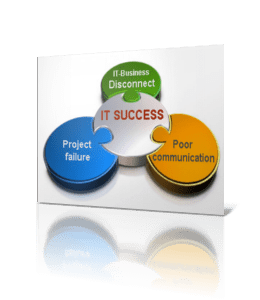 One last piece of information. In my career, I have worked with and observed hundreds of IT organizations and thousands of IT managers. In my opinion, there are three key reasons an IT organization fails, , , I call it the Triple Threat to IT Success. Take a look at a 20 Minute IT Manager session I developed on this topic and pay particular attention to slide 17. If you hear these things from your senior managers, you have a disconnect. Review the 20MITM session online at: http://www.20minuteitmanager.com/sessions/072202TRIPLETHREAT/
Summary
We see IT managers struggle to transition from the technical expert to a business manager all the time, , , it’s a truly difficult transition. Much of it is caused by our desire to focus on technology (we like it) and also our reluctance to let go and depend on others to do the job. You see, , , no one can do the work as well as we can do it or want it to be done so we tend to do things ourselves. Some call it being control oriented, , , I prefer to think of it as, “we like things done ‘our way’.”
Unless you are able to raise your perspective and back away from the technical detail, it is a recipe that will surely limit your career opportunities.













 ITLever™