Category Archives: IT Manager Tips

Helpful articles and tips

Your client is always right

Before you think I’ve lost it completely, , , let me explain.

In an IT organization, we are there to support the technology needs of people who need technology to do their jobs. In most situations, technology is not the company’s core competency. It is banking services, manufacturing widgets, selling food, clothes, or books, , , or doing something to sell products and services they provide. It is rarely developing technology.

Our IT clients are primarily two groups of people in your company:

  1. Senior managers
  2. Department managers and their employees

If your clients think you do a good job, , , great. However, if they think you are doing a poor job in supporting their business, , , guess what, , , you are.

STOP RIGHT HERE

Let me clarify just a bit.

You might actually be doing a super job with the technology. In fact, you could be the best technical organization around, , , the VERY BEST !

However, if the client thinks you are doing a lousy job in supporting them, something is askew. It could be that you are simply not managing their expectations very well. If that’s the case, then there is a problem.

Delivering technology services well is not just about doing a good “technical” job. You must also manage the client so they agree you are delivering support successfully. The flip side of this is that you could be doing a mediocre job technically, but if your client thinks you are doing a great job in supporting their business, , , guess what , , , you are.

Now, I know what the technical purists are going to say, , , something like, “Mike, that’s crazy. You should know that unless the technical part is handled well, there is no way to be successful in supporting technology.”

All I can tell you is that I’ve seen many outstanding technical organizations get low marks from their clients because they aren’t managing the client’s expectations well. They may be superior technicians but they are respected less because the client’s expectations are out of whack.

Something to think about!

Executives have selective memory

Senior managers of your company often have what you might call “selective memory“. In other words, they remember what they want to remember.

This can be a real problem if you aren’t careful. You have to manage their expectations and if they expect something to happen that won’t, , , your performance will be graded less than satisfactory.

Let me give you an example:

I joined a company as their new CIO. This company was in poor shape and needed to be turned around, , , in all areas of the company, not just in IT.

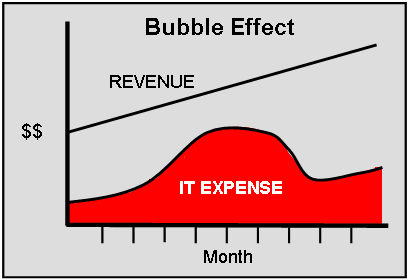
In the IT area, we were spending 7.2% of revenue in an industry where my CEO and I both knew we should spend somewhere between 2-3 % in a normal situation. After conducting my assessment, I gave him a recommendation that would cause us to spend over 9%, , , maybe as much as 10% of revenue for a period of 4 to 6 months.

The reason was to fix some serious IT issues and to position us to acquire  other companies, , , quickly. For us to acquire other companies meant we needed to be prepared to assimilate these companies into our own. If your IT organization isn’t working well, , , it’s going to slow you down and become a ball and chain around your neck, , , a very challenging issue.

Spending more money in the short run is not exactly what your CEO wants to hear. And guess what, , , he is quite likely going to want to forget some of what you say as time goes by.

In the meeting, I told him what we needed to do and what the cost should look like, , , and it meant IT expenses would increase a bit for a period of time. Once we stabilized some things and began to come out of the “turnaround” phase, IT expense as a percentage of revenue was expected to fall to a 2-3% of revenue level over time, , , where a normal IT operation should be in this industry.

I drew him a picture of what to expect and named it the “Bubble Effect”.

I wanted this image etched into his memory banks. You see, even though he heard what was going to happen, agreed to it, even supported my recommendation, , , it’s painful when he starts seeing the Profit and Loss Statement (P&L Reports) every month with more and more IT expenses.

Truly painful.

Before long, he might even forget the initiative we started to get the IT situation turned around quickly. All he will think is that “IT appears to be out of control, , , we are simply spending too much.”

Realizing senior managers can have selective memory, I managed to find a way to show my CEO this Bubble Effect graph just before he received his monthly P&L Reports, , , and I did this for three straight months. The third time he told me, “I know you are reminding me and understand why you are spending more money, , , but let’s hurry up and get this thing done so we can move forward.”

Sometimes a senior manager chooses to have selective memory, , , other times they genuinely forget things that were said or agreed to. It’s good practice to document commitments and find an easy way to remind your senior managers in situations of importance, , , it will save you the trouble of explaining yourself all over again.

It’s not bragging when, , ,

I know you’ve seen the person who likes to boast about his or her achievements all the time.

In general, I think you need to let your results do the talking.

Let me give you another scenario. I knew a guy one time who wanted everyone to think he was wealthy. He was in decent shape financially, but not what I would consider truly wealthy, , , he had a mortgage and two car loans. Someone who is truly wealthy doesn’t owe for his home or automobiles.

Something else, a truly wealthy person doesn’t try to convince you he is wealthy, , , he already knows it and probably doesn’t care what you think.

When someone tries to constantly tell me how good they are, I tend to be a bit skeptical. On the other hand, when someone shares information and speaks to the quantifiable results they are getting, , , the results tell me this person is successful.

It’s not bragging when you share results or communicate key measurements. Communicating these things is a responsibility you have. Failing to communicate your successes is actually a weakness and does not support your team the way you need to.

It’s bragging when you try to suggest you are accomplishing something you really aren’t or you are trying to one-up the next person.

No one really cares for the bragger, , , but they respect someone who gets results and can show it with specific measurements that can be validated.

Successful people don’t go around trying to convince others they are successful. They already know this and are content to let others judge them based upon the results they can show.

Employees who don’t get along

Ever had a couple of employees who don’t get along with one another? If you manage people for very long, you will encounter this at some point.

My attitude is that I don’t think people have to like one another, but they do have to respect and work with each other.

So what do you do when you have two employees who aren’t getting along?

First, try to understand the dynamics of what’s going on. If you have a work behavior or personality traits tool, it can give you quite a bit of insight. For example, I had two managers who were not getting along and could not for the life of me figure out why. They were both competent and I thought they should be doing great together, , , but not so.

Their work behavior profiles pointed out what was going on. One of the managers was significantly more detail oriented than the other and she wasn’t getting enough detail from her counterpart. When this happens, high detail people think the other person is lazy or not smart. The fact was that both were very hard workers and very smart.

When I outlined the issues for them, their attitude toward one another improved and they began working much better with one another.

Sit down with the two employees and discuss what’s going on, , , get it out in the open and create the opportunity for them to work it out. It’s also appropriate for you to expect them to work out their differences.

Another thing I do is that when we have some kind of group event or contest, , , the two people who aren’t getting along always get paired on the same team so they have an incentive to help one another.

These two people may never like one another and become best friends, but they do have to work with one another and respect each other.

Develop a quick PowerPoint presentation

Let’s say you are the senior IT manager for a small company and your CEO has asked you to present an IT update for the Board of Director’s Meeting next week.

Where to start?

If you are like me when I first encountered such an opportunity, there may be some initial shock. After the panic leaves you, it’s time to prepare, , , where do we start?

Let’s outline what I do and then I’ll explain each part:

  1. Gather information about the presentation objectives
  2. Collect the data
  3. Make a list or two
  4. Develop a draft of title slides
  5. Fill in the slide bullet points
  6. Create your PowerPoint presentation
  7. Prepare for the presentation

Developing a presentation can be fairly quick, , , or you can agonize over it for days. Use this simple approach and it might make it easier for you. Let’s take a look at each step:

1.  Gather information about the presentation objectives
First of all, you need some information from your CEO, , ,  things like:

  • Anything specific you need me to cover?
  • What’s the background of the Board Members?
  • What’s the objective or goal of the presentation?
  • How much time do I have?

You may also want to get some other quick facts, such as:

  • Board Member names and where they are from
  • Sample of past presentations that worked well
  • PowerPoint format or template to use

Once you know what the objectives are and what your CEO wants you to cover, you should be able to identify the appropriate content to develop a presentation. That’s actually the easy part.

You also now know how much time you have, , , let’s say it is 30 minutes.

You need to get a feel for the type of people on the Board. Is this a group that usually lets the presenter walk through a presentation and asks questions at the end, , , or does it have Members of the Board who ask questions every step of the way.

The latter will eat up your time quicker than a bee can dart past your nose, so you need to know that this group can only absorb a little information.

In fact, that’s an important piece of information for presenting to any Board of Directors. In general, members of the Board of Directors are high level and mostly concept people, , , not highly detail oriented people who want to get into the muck. But, there are some who like to get into the detail so learn from your CEO what type of audience to expect.

For an audience who waits to ask questions at the end, , , count on 1 -2 minutes per slide, , , that means you can deliver 10 to 12 slides at most and still have time at the end for questions and discussion.

For the interactive group who asks lots of questions, consider 3-5 minutes per slide, , , that means you can only get through 5-8 slides comfortably.

2. Collect the data
What to cover is very important to know from your CEO. He may want you to deliver a general overall view of what’s taking place in IT for the company, or he may want you to spend the majority of your time to provide an update about a specific IT initiative the Board is interested in.

Once you know what the presentation objectives are and the subject, collect the data you need to develop a presentation. It might include recent management reports, cost justification analysis, project status updates, etc., , , whatever data you have that supports your topic and allows you to develop a few PowerPoint slides to discuss the subject.

It is also reasonable that every bit of the material could come out of your head, , , read on.

3.  Make a list or two
At this point, step back and put yourself into the mindset of your audience. In this case, the Board of Directors represent the owners of the company, , , so what would a company owner want to hear about this subject you are about to present?

Make a quick list of what you think they would want to know about. Ask your CEO or the meeting sponsor the question and gain their insight, , , always helpful.

When completed, think about key points you think are important to share. Make another list.

Now, you have a list of what the audience wants to hear and important points you believe need to be presented about your subject, , , plus you have supporting material by which to start developing slides.

4.  Develop a draft of title slides
Each of your slides needs a title, , , this is sort of like an outline of a book if you were writing a book. What I do when I plan to write a book is start by developing the Table of Contents, , , this is my book outline. A PowerPoint presentation works the same way, , , each slide is a key point you want to make as you walk through your subject, so create a title for each slide.

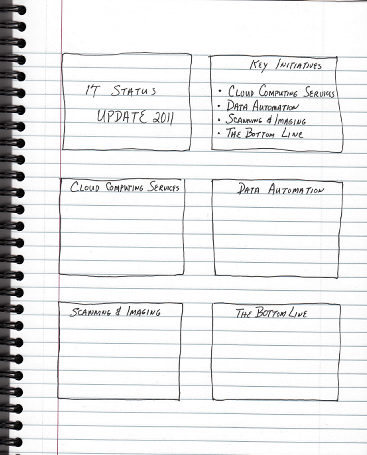
A quick and easy way to do this is to take a blank sheet of paper and draw a set of rectangle squares , , , I usually put 6 to 8 boxes on a sheet of paper. Each box represents a slide in your presentation.

Now, put the title of each of your slides in the top part of the boxes. I work left to right and to the bottom in the sequence I want my presentation.

Going into this process, you may not know how many slides your presentation will be or in exactly what order. Creating a paper draft makes it easy and creates thought as you work through the process.

When finished with identifying your title slides, check the number of slides and be sure you have ample time to present the content you are going to end up with based upon the guidelines I discussed earlier.

Once you get the slide titles defined, the rest is fairly easy, , , creating bullet points for each slide based upon its title.

When you start developing the detail of the slides, you may identify new slides you need to add or possibly slides that can be better discussed by combining them. The point is that the finished presentation will be slightly different from what you think it will be as you start working on it in the beginning.

5.  Fill in the slide bullet points
Next, put in the bullet points for each slide on the paper to complete the draft of your presentation.
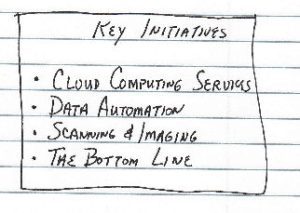
A couple of key things to remember. First, you need to resist your urge to provide too much detail. In a slide presentation, too much detail makes it difficult for people to follow. Use short and crisp bullet points that you can talk about.

Next, keep the number of bullet points on a slide to a reasonable list, , , no more than 4 to 6 points on a slide. Anything over that is too much detail.

Finally, a single point and graphic on a slide can be a powerful message so focus on highlights, , , not detail, unless of course your CEO says he wants you to discuss the detail.

6.  Create your PowerPoint presentation
When you are comfortable with the presentation “draft”, create the PowerPoint slides using the presentation template needed to make it consistent with your CEO’s presentations look and feel.

As you build each slide from your paper draft, think about graphics that add value to the presentation or make your points easy to follow. Don’t be too cutesy, , , but good graphics can add a lot. As you build the slides, you will also make adjustments to your bullet points because you will think of things that need to be in the presentation.

Another point about graphics, , , senior executives love charts and graphs that make your message visible. A good chart showing positive progress can add tremendous value to your presentation.

By drafting the presentation on paper first and then building the PowerPoint slides from the draft, it allows you to walk through the presentation a couple of times, , , and this is always helpful for your thought process and will ultimately make the presentation better.

Let me repeat something here. Fight your tendency to provide too much detail, , , we want the major points, , , just the major points.

Fewer bullet points is better than lots of bullet points. Remember, these guys are high level, , , they want the answer, not all the detail. If they need detail, they will ask you questions and you can fill in the blanks.

IT people think everyone needs all the information possible. Just the opposite is the case, so keep your presentation at a high level, , , and use graphics to enhance the message.

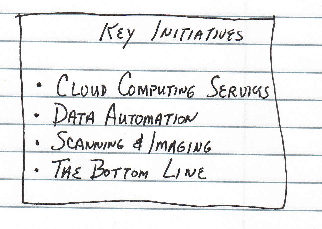
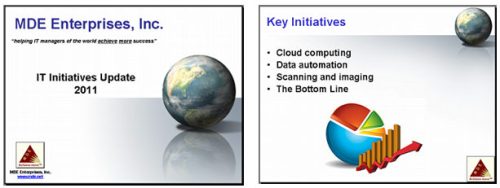
Here are the first two slides of my presentation:
7.  Prepare for the presentation
Before the presentation, do a few things:

  1. Prepare a good opening to get things started smoothly, , , it will help calm your nerves.
  2. Rehearse what you plan to say and become intimately familiar with every slide you present.
  3. Anticipate questions you may be asked and come up with appropriate answers.
  4. Develop a list of key message points you want to make for each slide. This can help you stay on message and insure you emphasize each key point.

Prepare and you will come across knowledgeable and on top of your game. Go in there unprepared and they may rip you apart, , , so be prepared.

How do you change the perception of people in order to take on more responsibility?

People’s perceptions, especially senior management’s perceptions, are made up by the results we achieve, how we achieve them, and how we conduct ourselves. It really is a combination of each of these things, , , not just a matter of getting the job done.

Don’t underestimate the significance of “how you go about your work” and “how you conduct yourself with others” plays when senior management starts looking to promote someone.

If you aren’t getting assigned additional responsibilities and you think you should be, take a step back and try to objectively assess what the manager sees in your performance.

You may be getting results but possibly the manner in which you are getting your results is not quite what senior management wants to see. It may also be that you aren’t getting the results they expect.

Are you setting the right tone in terms of teamwork?

Are you creating positive energy for those around you or is it negative energy?

Are you creating the right role model image senior management wants?

All of these questions are worth asking yourself, , , and when you answer them, , , be objective and honest with yourself.

Ask your senior management why you are being passed over and ask in a non-confronting way. Be open to what they have to say and listen objectively. You may not like what you hear, but it is their perception that you have to deal with just like dealing with an unhappy client.

Don’t try to rationalize or defend yourself, just listen!

Don’t talk, , , LISTEN !!

Listen to what they have to say and incorporate their input into your approach to do a better job, whether doing a better job is getting better results or changing how you go about getting the results.

Personal story
My career took off when I stopped pushing senior management to give me more responsibility and to do more for me. Up until November 1986, my approach was all about me. I couldn’t understand why I wasn’t getting more promotions, more money, more responsibility, , , all the things I thought I had earned.

Then, in November 1986 our company had a major reorganization. I was assigned a management responsibility for a small technical support group of 22 people supporting 23 clients.

My focus changed almost overnight although I didn’t realize it until much later. I started focusing on our clients and my employees to achieve some specific company objectives, and I was working so hard on this and having so much fun, , , I forgot about “me”.

When I truly focused on doing a great job for our clients and the company and started getting results in those areas, more responsibility just started coming my way. I suddenly became promotion material and was getting more and more responsibility when it seemed that I wasn’t even trying to get more responsibility. Sometimes, you just have to “let it happen”. It seems to happen easier when you aren’t pushing so hard.

In hindsight, it was about results and also about how I approached my responsibility.

My perception of myself before the reorganization was very different from my senior manager’s perception of me. I thought I was getting great results, but the reality was I was probably getting meager results at best. And I was always pushing for more every chance I got, , , and this created a negative vibe that I didn’t realize.

After the reorganization, the results were specific, quantifiable and matched up with what senior management wanted. It also helped that these results were visible, , , they have to know about it to appreciate the effort. Our monthly reporting processes communicated the results in an objective fashion and it made a difference.

Two more tips that may be worthwhile
First, raise your perspective to a senior manager level. They want managers to be mature and to think in terms of the client and in providing tangible business value. Being proactive in developing a strategy that’s in sync with the client and business owner’s needs is critical. Do things that reduces cost or improves productivity of groups of people and you endear yourself to senior management, especially if it helps achieve business financial goals.

Second, I can’t tell you how many times I have sat in senior management meetings to discuss the need to fill a senior management position and we had to turn potential candidates down because they didn’t have anyone in their organization who could step up and fill their management position if we promoted them.

To move up, you have to be able to fill your position with as little ripple as possible.

When we make management changes or promote someone, we look closely at the impact it’s going to have, both positive and negative. Management Rule #1 is to identify and develop your replacement.

Many managers tend to avoid doing this because they are concerned it makes them vulnerable. That’s completely wrong in my mind. Getting your replacement in position actually shows us you can develop a strong organization and it positions you to take on more responsibility.

Focus on positive results and how you go about getting those results. Both are important.

Square peg in a round hole

We all know how difficult it can be to drive a square peg into a round hole. The image on the right shows it best, , , driving a square peg into a round hole can break some things.

It’s exactly the case when dealing with people, , , specifically your staff.

When focusing an employee you want to take advantage of his or her strengths and interests as much as possible. It makes their development easier and you will get more from the employee because they are working on things they like, , , it’s sort of like swimming downstream versus trying to swim upstream against the current.

Make it a point to learn about your employee and to discover these strengths, likes and dislikes. When you tap into the strength and interest of an individual, they will work harder to learn something new and to do their job well, , , because they like it and it’s a good fit for them. It’s a common trait we all have.

Things to consider are the technologies you have them focus on, the area of responsibilities you give them, the type of projects you assign them, even the people you assign them to work with.

Try to make life better for people when you push them into certain areas of work. If they love what they do and have the tools to do the job, you can get powerful results, , , and that’s what we all want to achieve.


Preparing for an IT Manager role

I receive quite a few inquiries about how to prepare for an IT manager role.  Often, these inquiries come from a parent who wants to help a son or daughter position themselves for a successful career.

Here is a message I received just this week from a supportive parent:  “My son is studying computers and he is in his early year of computer engineering and later on he will decide which branch of IT to specialize in. I want your help to give him tips and a head start to become an IT manager one day.”

In many cases, the parent has little or no knowledge of technology or how to prepare for IT management. What they do have is concern for their child’s future and a strong  interest in helping them prepare for the future. Often I will hear, “When he (or she) gets the opportunity to manage, I want him to be prepared so he will be successful.”

It’s something anyone who wants to be an IT manager one day should think about and devise a plan to prepare for.

My response:

——————————————-

Here is the path I would suggest:

1.  Read the free book you receive when signing up for my Practical IT Manager Newsletter – IT Management-101: fundamentals to achieve more. This book is a good foundational starting point. Sign up at www.mde.net/free

2.  Have him subscribe to my ITLever Blog at www.itlever.com so he receives free weekly tips and tools directed to helping IT managers achieve more success. There are hundreds of free articles, tools to download and other items to help an IT manager and I add new content every week.

A recent ITLever post will be of particular help titled, Solve the IT Management Maze with an IT Management Process. CLICK HERE to see it.

3.  Watch the 20 Minute IT Manager session titled Fast Start for a New IT Manager  at  http://www.20minuteitmanager.com/sessions/060602FASTSTART

There are 162 sessions in the 20 Minute IT Manager series, , , purchase all for $249.00 or $9.99 each. Details at www.20minuteitmanager.com
CLICK HERE for a special 50% discount offer for ITLever Blog readers – only $249.00. Included in this bundle are 12 sessions of a series titled, “12 Secrets to IT Success” that outlines the IT management process I use in managing technology resources.

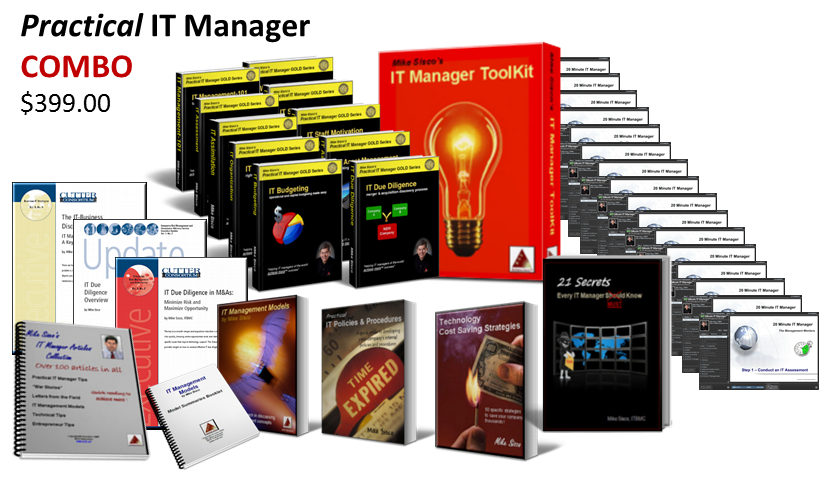
4.  He will need to establish a positive record of delivering projects successfully in his technical role. My IT Project Management: a practical approach book is a simplified methodology that can help. There are 14 books in my library, , , available for $29.95 each or $279.00 for the first ten, , , $399.00 for the entire library that includes my IT Manager ToolKit.  Details are at www.mde.net/cio

5.  If and when he truly decides to position himself for a manager role, he should attend the IT Manager Institute. It is available in classroom and online self study and includes Bonus items of all my books and tools.

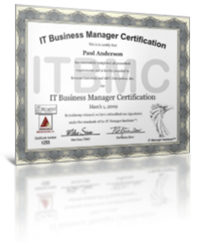
This class will do more for his preparation in becoming an effective IT manager than anything he will find. Both the classroom version and the self study are exactly the same material and lead to an IT Business Manager Certification (ITBMC) that was co-developed by Belmont University and my company to focus on the importance of IT organizations to provide tangible business value for their company.
    Self Study  –  www.mde.net/selfstudy
    Class schedule   –  www.mde.net/institute 

6.  Find an IT manager mentor, , , someone who is interested in helping your son learn about aspects of managing technology resources and a resource to go to for questions and discussions of interest. It is helpful to work with someone local who is willing to be a mentor at no cost, , , as long as the “mentor” knows what he is doing and has a successful track record. Poor or weak resources can actually damage your son’s career.

I have plans to provide a monthly IT manager membership program to provide mentoring services and IT manager development training because of the need we have seen. Watch my ITLever Blog or Practical IT Manager Tips Newsletter for a future announcement. Contact me at info@mde.net if you are potentially interested in a monthly IT manager mentoring program. I must warn you beforehand, , , it will not be cheap due to the effort required to set it up and it will be limited to a designated number of members.

7.  Your son can gain a sense of management by managing a project. In doing this he will be exposed to people management, managing client expectations, and budgeting. If he learns to manage projects well, it is good development for future IT management roles.

I hope this is of help and wish your son the best of success in his young career.

——————————————

The important thing to do when preparing for an IT manager role is to start learning from someone who knows how to manage technology resources, , , and to learn about what a successful IT manager really does, , , it is not all about technology actually. Focus only on technology and not the business and you will have major difficulty in becoming a successful IT manager.

One last piece of advice is to observe others and incorporate the best of what you see into how you go about doing things. I’ve done this throughout my career and know it has made a big difference in my management career. It’s another reason why having a good mentor is so important.

“The more I practice the luckier I get.”

Lee Trevino was a great golfer and one of the best iron players and drivers of the ball ever. He came from meager beginnings and really honed his golf skills while in the Marine Corps. He was known to play for more money than he had in his pockets, , , and told people, “This is real pressure and much tougher than the tour.”

It’s said that he won a golf bet one time playing with a wrapped Dr. Pepper bottle as his only club.

The point with this article is that the reason he was so good and played so well under pressure was because he practiced for it. He beat Jack Nicklaus in an 18-hole playoff to win the US Open when Jack was in his prime.

Some called him lucky when he holed out from off the green on one of the final holes of the British open to win that one. I can tell you for certain that it was not luck. Lee Trevino’s short game was unparallelled at the time, , , he was just as likely to hole a chip from off the edge of the green as he was to make a putt of the same distance.

“The more I practice the luckier I get.”

Managing an organization works the same way. The more you work on your skills the better they become, , , whether it be developing a presentation, delivering the presentation, budgeting, coaching employees for improvement, , , any aspect of management.

You don’t just wake up one day and decide you will be good at something, , , and there you are. To be good at anything takes some work, focus and determination, , , and you guessed it, , , practice.

Practice and you will improve, , , and maybe “get lucky”. The reality is that it is not “luck”, , , you succeed because you prepare to succeed.

Manage your manager

One of the things you must learn in order to become a great manager is how to “manage your manager”.

I can tell you I was not very good at this early in my career, , , primarily because I didn’t understand it, both from the point of needing to do it and also in understanding how to go about it.

Managing your manager’s expectations is just as important as managing client expectations. As with a client, you want to try and position your manager so you and your team always over deliver what the manager expects from you. No one gets upset when you over deliver, , , it’s certainly not the case when you deliver less than what is expected.

Managing your manager means you do things that shows you are:

  1. Organized
  2. Have a vision of what you are trying to accomplish
  3. Predictable and reliable
  4. Have a successful track record of delivering what you say
  5. On time
  6. Understand the financial consequences of your actions
  7. Support and develop your employees
  8. Meet your budget forecasts
  9. Support your clients effectively
  10. Role model for others to follow

When your manager brings you a more urgent project, you know how to balance this new initiative with the other projects already committed to. Something has to give so you manage your manager’s expectations so he expects one of the older projects will be delayed or maybe even canceled in order to focus on the new initiative.

Managing your manager also means you are proactive in developing a strategy for your organization and getting it approved. It means working on things proactively that are understood and agreed upon by your senior management team, , , no way to be out of sync when you do.

Managing your manager means you provide your manager material that helps him understand your organization’s accomplishments and essentially “wind him up” with information he can share with other senior managers of the company.

The bottom line is that managing your manager means you constantly position yourself and your team to be able to deliver what you say you will do and when you say it will be completed. When you establish a predictable track record, you will find a huge amount of trust develops between you and your manager, , , and with trust becomes “partnership” status.

Learn to manage your manager well and it will help your career.