Category Archives: IT Manager Tips

Helpful articles and tips

6 Reasons Some Managers Get Promoted Over Others

arrowsupI’m sure you’ve seen it, maybe even experienced it yourself.  Some managers seem to get the promotions and others do not, even though those who are not promoted work very hard and are extremely conscientious about managing technology resources effectively.

This happens for technology employees as well, not just managers, , ,  some get the nod and others do not.

If you are interested in what’s going on read the rest of the article. I’m going to give you a senior management perspective that can help you in your management career.

As a CIO or executive of a company, we want to promote from within as much as possible. Promotions encourage our employees and to be quite frank, we like taking care of our own when they do a good job for us.

Unfortunately, we can’t always promote from within our company and must go outside to find the resource required to do a certain job.

There are several important issues that position you for a promotion no matter what your current position happens to be.

blue ribbon1.  You must be promotion material
You have to be doing a good job in the position you are in and we must be able to back fill your position when you are promoted.

In addition, you need to be right for the job in question. Let’s break each of these aspects down a bit and explain.

Job performance – This is a “no brainer”. To be promotion material, you need to be excellent at what you are doing.

As a senior manager, I want to promote the top 10 to 20 percent who I think will be able to rise to the occasion when confronted to the bigger challenges and issues of the new position.

Job performance is a key factor we look for when determining whether someone should be promoted and who can handle the challenges of the higher position.

Simply put, we promote the best we have, not average or poor performers.

Back fill your position – Being promoted is going to create a gap in your current area of responsibility.  Your position will most likely need to be filled.

I can’t tell you how many times I’ve sat in senior management meetings to discuss the needs of a new position of a growth company and not be able to promote from within.

When looking through our organization, we had people who had shown the performance to make them a good candidate for the higher role but when looking at how we would fill the gap created by promoting them, we had to back off making them the offer because there was no one to fill their position.

Many times we had to go outside when we had a great internal candidate, but losing them in their current position was too big a risk.

A management-101 principle is that you need to find a way to position someone to take your place.

Having the skill and experience isn’t enough; you need to be able to fill your position so business continues to run smoothly, , , so start investing in someone to take your place one day.

Right for the position – I had a great employee in my Help Desk organization many years ago. Our company grew very fast and we soon had the need for a Help Desk Manager.

My employee had very good management potential but because we were growing so fast I decided to hire someone from outside the company who already had management experience and in scaling up a Help Desk organization of a fast growth company.

My employee was pretty upset initially, but I explained to him that promoting him to this particular management position without being able to be there to support him could be overwhelming as fast as we were growing and potentially damage his career.

I convinced him that he would become a much stronger manager by learning from a seasoned Help Desk Manager who had already experienced what our company was going through.

I also committed to invest in developing his management skills to position him for a management role in the future. This employee became a very strong IT manager and CIO in his own right in later years.

Had I put him into a situation that he was not ready for and not support him properly, I could have ruined his management career.

success on target2.  Proven track record
You have to have a proven track record of success. As a manager, you have to deliver tangible results. The same is true as an IT employee.

Not only is it important that you achieve quantifiable results, much of whether you are promotion material is about how you go about getting the results.

For example, as an IT manager your efforts need to be in sync with your client and they agree that you have done a good job for them. “Client” being represented here by senior managers of the company and department managers.

For IT employees and IT managers, it’s imperative that you exhibit strong teamwork as you work with your peers and others in accomplishing your job.

We don’t just look at your technical skills when determining if you should be promoted or not.

People who work well with others in a cooperative spirit and foster a win-win environment are those we want in senior level leadership positions.

So, what this means is that regardless of your position you should pay attention to the track record you are creating and how you are getting the job done.

IT has a poor reputation for delivering projects with some studies suggesting that a very high percentage of all IT projects fail. Put yourself in the success group and keep track of your successes.

You may find that people, especially senior managers start looking at you differently.

We promote the people who we trust will be able to do the job, , ,  and your past track record is a good indicator of what the future should look like.

1803.  Deliver what you say you will deliver
Sounds pretty simple, but you might be surprised at how many people promise something but don’t come close to delivering it.

One very simple aspect of this is to follow-up on your commitments. Whether you are the CIO or a Desktop Support Technician, it’s imperative that you follow-up on any commitment to someone.

What often happens is that we see something that will improve a client’s situation so we make a promise to do something for them later. Before we get back to our desk, we are hit with five more issues that need attention and as a result we forget our promise.

Well, I can assure you that the person you promised something to does not forget. It may be a very minimal thing that doesn’t even have any real importance, but the fact that we forget tells the person we do not follow-up or take our promises seriously.

Nothing increases your value as much as when people view you as, “the person I can count on to do what he says he will do”.

phone4.  Strong communication skills
This one is significant. People who have strong communication skills have a real edge on those who don’t.

I encourage anyone who is reading this article to make an effort to develop your communication skills. There are training programs everywhere to help you develop effective communication skills.

Skills in public speaking, negotiation techniques, organizing and holding productive meetings, presentation techniques, etc. are all important investments you need to make in yourself, , , and don’t forget basics like good writing skills – also very important.

Make a commitment to speak in public, make stand up presentations, hold meetings, etc. to develop and improve your communication skills. I cannot emphasize enough how much solid communication skills can mean to you. In many cases, the person who gets the promotion over others is the one who can communicate effectively. Effective communication skills are career differentiators.

webinar5.  Business minded
Being business oriented and focusing your resources on issues that provide tangible business value to your company is key, especially for IT managers.

Too often, our managers are focused on the technology and not what the business needs. In management roles, this is a very important issue when looking to determine who should be promoted.

I’ll always opt for the manager who knows how to build strong client relationships and has a track record of delivering business value to our business operation clients over the strong technical manager who doesn’t know how to foster strong client relationships.

Managers are not good promotion candidates if their focus is out of sync with our business partner’s needs and issues. Many studies suggest that over 50% of all IT organizations are out of sync with the business so this is not a small issue.

Senior managers promote those who show they can focus resources on the right issues for the company and don’t get sidetracked into doing things for technology sake.

foundation blocks6.  Prepared for the next level of responsibility
This final point is similar to what we covered in the first point in being “promotion material”, but I think it goes beyond that.

If you want the next level of responsibility, then you should try to understand what the new job entails and prepare for it.

Maybe this requires additional education, , , maybe you need to gain new experiences or even accomplish certain things that are related to the new job’s responsibilities.

The point here is that you need to try and understand what is required of the new position and prepare yourself as best you can to be ready for such responsibilities.

What I have found in my career is that promotions tend to come to people who are prepared and ready for the next level. We don’t just give out promotions and hope the candidate will be able to succeed.

The need must exist
We can do a lot to help prepare an employee or an IT manager for the next level promotion, but at the end of the day the need must exist for such a promotion to occur, , , and the person must be a good candidate for the specific position.

In a small company with very few technology employees, promotions don’t happen quickly. In high growth companies that grow 20-30% every year, promotions tend to happen more often simply because the organization is growing in numbers.

When counseling your employees and discussing the idea of preparing and positioning them for the next level, be sure you make it clear that our company has to have the need and the candidate must be a good fit before such a promotion will occur.

Otherwise, you will set an expectation that when certain things occur in the employee’s development, the promotion will follow. Again, we have to have the need and a good fit before a promotion will actually occur.

I hope this gives you some things to think about as you make efforts to enhance your career and move to the next level.

Getting a promotion usually means you are ready for the role so take a look at what is required in the next position and be sure to develop the skills necessary to be successful in the position.

Good luck and best of success.

69th IT Manager Institute

The week is almost over. I’ll be delivering the 4th day of the 69th IT Manager Institute today, , , right now it is 5:30am in lovely downtown Dubai.

It’s my 15th trip to Dubai and has become a central point to deliver the program in this part of the world.

Meet IT Manager Institute Class #69

Institute69-4IT Manager Institute #69 – Dubai, UAE – March 2015

Only 8 managers in this one. I like small classes because we can get to know one another better than when we have 20 or more managers. This group of managers is a lot of fun to work with, , , I’m enjoying this class a lot and the week is flying by.

This may be the earliest I have ever posted a class photo of a class, , , normally it is the week after the program. Hmmmm, , , maybe I’m becoming more proactive.

You can do anything

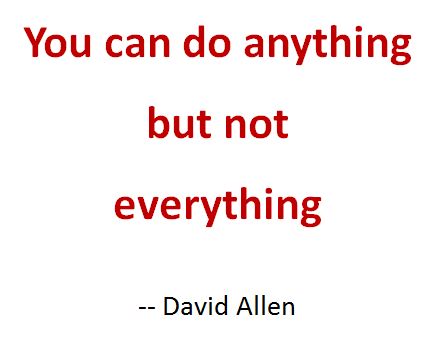
There is a great quote I like. It has meaning in most things and goes like this, , ,

Do anything quote I didn’t know who David Allen was when I first came across this quote years ago, so I looked him up. I still don’t really know him but he appears to have done some things in personal organization and productivity areas, something I’m always interested in. He has written several books including his best seller titled, Getting Things Done. It is worth reading.

I’ve used a similar quote in my IT organizations for as long as I can remember, so this “hit home” when I first saw it. Let me give you a couple of examples.

First, IT organizations usually have more demand for support work than they can deliver. This is a normal occurrence and something that is probably not going to go away, , , sorry about that, but it’s not.

What I explain to my staff and to my business clients is that, “We have to manage the business of IT support.” Having more need than capability and capacity to deliver is normal and occurs in almost every IT support organization in the world.

We will never get everything done as quickly as our client wants it completed.

Given the manpower and money, we can do virtually anything, , , yes, anything if we have the resources and money.

But, , , and this is a BIG BUT, , , our companies can’t afford to write IT a “blank check”. Companies don’t have endless amounts of capital to spend on IT. So, what this says is that we have to prioritize and manage the business of IT support, , , not just assume we can do anything and everything.

questionThere is another analogy I use, and it is a personal one.

My company is a small company, , , essentially it is “me”. My biggest challenge is deciding “what I will do” and “what I won’t do”. My natural desire is to do everything, , , that’s right, to tackle every opportunity that comes along.

The problem is that when you are a small company like mine, time is your single limiting factor. Capital can be as well, , , of course, , , but the biggest bottleneck for a small company is available time to do all that you want to do.

So what this says is that you need to be selective in what you decide to work on. In a small company, you aren’t afforded too many mistakes, , , even little mistakes can have major consequences. This is especially true if you target an “opportunity” and spend lots of time and it turns into a “bust”.

Using up valuable time for something that does not provide a good return on your investment will put you out of business, so you have to weigh the risks associated with every new project. What looks like an opportunity can be misleading at times, , , the same is true in your IT support function.

It is imperative that you manage your client’s expectations and help them realize that, “even if you could do everything, , , the company can’t afford it and the users probably couldn’t absorb that much change so quickly”, , , so even though certain requests are not delivered as quickly as the client would like, there are legitimate reasons why this occurs.

In fact, this little quote applies to most things in life if you think about it, , , you may have to manage your own expectations a little.

Do anything quote

Step up and take responsibility

not meI’m sure you have seen a situation when a problem occurs, , , no one seems to know how or why it occurred.

You hear things like:
“It wasn’t me.”, , , “They must have caused it.”, , , “I don’t know .”

No one wants to fault others for problems that occur. But a small fact exists, , , strong leaders take responsibility and hold themselves accountable, , , weak leaders pass the buck.

When a problem occurs, I look at myself or my organization first and ask, “Is there anything we (or I) did or possibly something we didn’t do that created this problem?”

On the other hand, a transparent manager will always deflect a problem to someone else, even his own staff. Transparent managers take credit for good things and pass the blame for problems.

Guess how much credibility transparent managers have with their clients and more importantly their staff, , , little to no credibility.

Strong managers take the hit when problems occur and they go further by identifying what they are doing to get the train back on the track and to prevent similar problems in the future.

trainManagers who “own the responsibility” instill confidence and respect plus the all important credibility because they hold themselves and their organizations accountable, , , then they do things to improve.

Bottom line: Give your people credit for successes and take the responsibility yourself for failures, , , it will reward you with trust and loyalty over time.

IT Manager Institute #59

We just finished the 59th IT Manager Institute in Dubai, UAE that included 14 IT managers from 6 countries – UAE, Saudi Arabia, Bahrain, Oman, Kuwait, and Nigeria. This was a special group that did extremely well on the ITBMC exam.

ITBMC_Dubai_March2014IT Manager Institute #59 – March 2014 – Dubai, UAE

Coping with STRESS

stressIT managers have difficult and challenging management responsibilities. In fact, you have arguably the toughest management role in your company because:

  • Technology is changing so fast
  • Users are demanding more from IT
  • IT employees are challenging to manage
  • Usually no one is around who can help a struggling IT manager

With these challenges comes stress which can be both costly and bad for your health.

Here are a few numbers from 2012 and 2013 studies worth considering:

  • In 2012 the World Health Organization estimated that stress cost the US over $300 billion in lost productivity.
  • UK workers lose 105 million days a year due to stress related issues and costs the UK over 1.2 million pounds a year
  • 40% of job turnover is attributed to stress by some studies.
  • Australia loses about $10 billion a year in lost productivity due to stress.

stress_1Stress is real and creates expensive health costs, periods of disability, absenteeism, job turnover, and poor productivity.

I know how real it is because I’ve seen stress take it’s toll on workers and I’ve even experienced it myself. Stress can be debilitating to a point it becomes hard to get out of bed in the morning. It can literally “lock you up” to the point it is difficult to function.

Left unchecked stress can be dangerous to your health, , , even to a point of life threatening from some of the health problems it can create such as high blood pressure, heart attack and stroke.

Warning signs
Stress indicators show up in several ways including:

  1. Cognitive – memory problems, difficulty in concentrating, poor judgment, and focusing on the negative
  2. Emotional – moody, short temper and feeling overwhelmed
  3. Physical – headaches, backaches, frequent colds, and can’t sleep
  4. Behavioral – change of eating or sleep patterns, isolation, increase in drug or alcohol use

I don’t know about you but I don’t see anything positive in these elements, , , it’s all negative.

What causes stress?
IT employees can tend to cause their own stress. You will see what I mean when you read the list below:

  • IT employees are high detail people who can be perfectionists. This need to be “perfect” creates stress.
  • Uncertainty abounds in IT with technology changing rapidly and users wanting flexibility and needing more technology.
  • Perfectionists are “their own worst critic” so they sometimes put unrealistic pressures on themselves.
  • You can’t control everything like IT people want and need to. Networks and systems will break at some point and any type of downtime creates stress for IT workers.
  • Technology users sometimes have unrealistic expectations of IT.

Reducing stress
There are ways to reduce stress, but it takes a concentrated effort. Here are a few ideas:

  • Avoid unnecessary stress – learn to use your senior management team and avoid battles that can be avoided.
  • Alter the situation – Compromise where you can, manage your time better, or express yourself and “get things off your chest”
  • Accept things you can’t change – Let go, , , you can’t control everything. Talk about it and look for positives in stressful situations.
  • Try to avoid your tendency to procrastinate on important work; be proactive and get ahead of the game as opposed to waiting to the last minute.

One of the things I do when stress hits is find a time where I can go to a quiet space and free up my mind.

stress_2I let my mind go to a special place in my life that helps me calm down, , , for me, this is the 6th hole of the Kaneohe Marine Base Golf Course. It’s a perfect 6-iron shot into the wind, my favorite shot.

I play this par-3 hole in my mind and when completed I go to the first tee and play a whole round of golf, , , in my mind. Before you know it, a lot of the stress has dissipated, , , believe me, it actually helps.

Your enjoyable space may be looking at a sunset, listening to the ocean breeze, or that special time you spent on one of your favorite vacations. Whatever it is, the point is to allow your mind the opportunity to “free itself up” from the pressures you are experiencing.

Be aware that your people experience stressful times as well so be on the alert for stress signs and do things that helps them feel appreciated, to eliminate uncertainty and reinforce the positives of what your IT organization is accomplishing. Appreciation does much more than you probably think.

Pay attention to stress, , , left unattended it can be destructive to your progress.

15 Leadership Traits from the Gladiator

gladiatorOne of my favorite movies is Gladiator starring Russell Crowe. It’s not for the fighting and action, , , it is for the first five minutes that lead up to the battle scene.

Let’s step back a moment and I’ll explain why I’m writing this article.

One of my first managers was an IBM Systems Engineering manager early in my career. Bryan gave me some excellent guidance and recommended one thing the very first week I met him that I’ve always remembered.

He suggested that I should, “observe others and incorporate the good things into my own approach to doing things and avoid the bad things”.

In other words, take the best of the best as you develop your own style and way of doing things. It was a powerful piece of advice that has helped me throughout my career.

I observe management techniques and leadership skills in all walks of life.

For example, one of the best managers I know is George Ippolito, an Italian restaurant owner. George does such a good job that he has tremendous repeat business and staff that stays with him for years, something that’s rare in the restaurant business. He is successful because he earns it every day and he coaches his employees how to deliver excellent service.

The movie Gladiator got my attention immediately. It was the first five minutes that gave me chills as I recognized leadership skill after leadership skill. Much of it is subtle, but I can assure you the leadership and management traits are there and they are great examples that can be applied in your IT world.

The movie is a fictional piece of work, but there are valuable insights that come from what you see in the first five minutes.

In this first scene Maximus Meridius, General and Commander of the Northern Legions of the Roman Army, is taking a moment to reflect and prepare for one final battle after years of war. He returns to his army to meet briefly with other generals to finalize the coordination of the Roman cavalry and infantry attack on the German warriors.

As he walks through the ranks of his infantry, you see something very powerful.

What you see is admiration and respect, , , not just from the soldiers, but from both soldiers and from the General. He even stops to speak with one of the soldiers who has a head wound and taps him on the shoulder. You see mutual respect for one another and you get a real sense that both men would do anything to help the other be successful.

In the first five minutes of the movie there are at least 15 examples of leadership and management, , , if you are looking for them.

Whenever I need a morale boost, I pop Gladiator into the DVD player and watch the first five minutes. It’s all I need for a “pick me up”.

Leaders don’t always set out to become leaders. In fact, many leaders probably don’t even realize they are leading when in fact they are having enormous impact upon those around them.

Leaders are developed over time and by consistently doing things that causes others to look at them as leaders. Here are five examples of what creates a leader:

1.  They do the right thing.

2.  They step up and make tough decisions.

3.  They lead by example.

4.  They respect and appreciate the effort of others (managers, peers, and subordinates).

5.  They learn what works and implement replicable processes to succeed.

In the movie Gladiator, I picked up on several leadership and management examples worth noting:

1.  Organization  –  Every part of the army is organized with leadership within each sub-organization to see that the job gets accomplished successfully. A certain amount of structure is needed in any organization to succeed

2.  Process  –  There is a specific process used and replicated to achieve success. Each soldier knows his duties and is trained to handle them.

3.  Supervision  –  Soldiers and the processes are supervised to insure things are carried out appropriately.

4.  Motivation  –  The soldiers are motivated by having achieved success in the past and the goals that lie ahead with one final success in battle. Maximus also delivers a motivational pitch to his cavalry just before the attack to motivate his men.

5.  Inspection  –  Generals inspect components of the plan and processes underway, , , they know that inspection is a key for success.

6.  Strategy  –  The Roman Legions have a simple, coordinated battle strategy that’s very effective. It takes advantage of each element of the army’s strengths and capabilities and attacks the vulnerabilities of the opposing force.

7.  Planning  –  Planning is obvious as you see the battle unfold. Everything works like clockwork. A great strategy won’t work unless you are able to plan and implement effectively.

8.  Providing tools and equipment for the job  –  The soldiers are well equipped and have the support they need to succeed.

9.  Trained employees  –  Action is methodical and coordinated, a sign the soldiers are trained to do their job.

10.  Backup  –  Maximus loses his sword as he enters the battle. A backup sword prevents downtime or loss. I’m pretty sure the General must have been a very early “IT guy”.

11.  Delegation  –  Responsibilities are delegated to competent leaders within the army. One guy can’t do it all.

12.  Communication  –  Communication is key, from discussions with other officers, motivational acknowledgements to the foot soldiers, to the rally delivered to the cavalry. Even the fire arrow signal sent to start the battle is an example of communicating effectively.

13.  Leadership by example – Maximus doesn’t just bark out orders, , , he leads his cavalry into battle. The reason he has so much respect from all levels of the army is that he is willing to do what he asks of his men. He leads by example.

14.  Treating others with respect – You can see mutual respect between the General and the men, , , it starts by the General sincerely respecting what his men do to win battles, , , even the lowest paid soldier in the army.

15.  Teamwork – Soldiers of each component of the army work together as a team and all teams work in a coordinated fashion so the army as a whole can be effective in winning battles.

Who would have guessed that so many leadership skills could be exhibited in the first 5 minutes of a movie?

I encourage you to observe others and incorporate the positives you see into your management style. It can help you achieve more success and promote your career over time.

Best of success,

signature_mike sisco

3-day training this weekend for only $27.00

I normally would not share this, but I plan to attend Armand Morin’s 3-day WebCamp program on October 4-6, 2013, , , this weekend.

The $27.00 registration is almost ridiculous for 3 full days of training. A recording will be made available to all who register if you can’t attend or miss part of the training.

Armand will deliver WebCamp live from Las Vegas and will stream it out to those who register and attend from home (like me).

Check out the 3-day agenda and watch the promotion video at http://webcamp.cc/x.php?af=905629

I attended two of Armand’s WebCamps this year that he streamed from his home. What I can tell you is that he educates you by showing exactly what to do, , , step by step.

If you or your company need to discover ways to promote your products or services, you owe it to yourself to attend or tell someone in the marketing or sales organization of your company. One tip could be highly valuable for your company.

I highly recommend Armand. I’ve invested quite a bit in this area over the years and he is by far the best I’ve seen, , , and mainly because he teaches you what to do and how.

What does this have to do with IT management?

Good question. What a resource like this offers is to develop your ability to help your company promote its business by potentially introducing innovative internet marketing techniques. We need to discover ways to help our company succeed and introducing new approaches that use technology fits into this category.

I’m constantly surprised at how many companies do not know about Internet marketing and the cost effectiveness it offers a company. For example, traditional mass mail costs about $15.00 per visitor to your web site, , , Google “pay per click” costs me about $ .26 per visitor, , , significantly more cost effective.

Another example, , , a training technique I introduced to a hospital this year came from what I learned in one of Armand’s classes last year, , , and I use it for my own training program development.

Learning how to promote things via the Internet, social media, using Google ads and other innovative techniques makes you more valuable to your company plus it gives your IT organization an edge in supporting your company.

I can assure you that it will be worth many times your $27.00 investment and thought I should share it with you.

Learn more at http://webcamp.cc/x.php?af=905629

Project success is the path to IT credibility

arrowsupDelivering projects successfully creates IT credibility. Project failure causes you and your IT organization to lose credibility.

You must establish credibility to achieve IT success!

So, if project success is so critical to your success, what do you need to insure project success?

Well, it’s a little more than simply delivering a project successfully, , , there are other things to consider.

There are three key components to get the credibility you need. I’ll outline them for you in this article and we will follow-up with articles that dive into each to give you the substance you need.

3 Key components in managing projects successfully

First, you must be able to build an appropriate project schedule and manage a project to deliver it on time, within budget and meet your client’s expectations. To do this, you need a project management methodology and a few simple tools.

There are dozens of project management methodologies and thousands of tools and templates, even PM certifications to help you schedule and manage projects.

I use a simple spreadsheet to develop most of my project schedules unless a company requires me to use something like Microsoft Project. The tools are not nearly as important as how you go about the process of managing projects. I’ll show you my process in the next ITLever post.

Second, you need to communicate the status of active projects. At any given time, your IT organization will have several projects underway. Your ability to communicate the status and key issues associated with each project will help you deliver projects successfully as well as contribute to your credibility.

blindfoldedRecently, I provided management consulting services for an organization. When I got there they were in the midst of running many projects. I could tell there were a lot of projects underway or in the stages of getting started, , , but there was nothing in place so we could see what was going on. In fact, we couldn’t tell how many projects we had.

It’s sort of like driving blindfolded!

Understanding the importance of communicating project status effectively, I quickly developed a simple monthly report that showed the status and key issues of each project.

I’ll give you all the details in a future post in this PM series.

Third, you need to demonstrate your organization’s project success rate and the benefits derived from your efforts.

This is key. Your clients (senior managers, department managers and their employees) have short term memory, , , or no memory at all. They quickly forget what you and the IT organization have done for them.

You must keep a positive message of “IT value” in front of your clients. Otherwise, they don’t know what you are accomplishing for them or they quickly forget.

Again, I use a simple spreadsheet to track IT projects and to show the track record of our project success. In this simple tool, you will show how effective you are in delivering projects on time, within budget, and meeting client expectations, , , plus the benefits that were achieved.

I’ll talk more on this in the 3rd post to follow this one.

Summary
There will be three posts written this week that explains each of these three important components of gaining IT credibility with project success. In the posts, I’ll explain what you need to do and provide tools or templates to help you make it happen.

The additional articles follow this post or can be located at the links below:
Project success is path to IT credibility – Step 1
Project success is path to IT credibility – Step 2
Project success is path to IT credibility – Step 3

it project management ebookMore details of the entire project management process and customizable tools I use are available in my book, IT Project Management: a practical approach

10 Types of IT Managers

I’ve been fortunate to work with hundreds of IT and operational managers around the world, and I have observed many types so thought I would have a little fun and share my version of the typical groups managers fall into.

bully manager 21.  The Bully – This manager operates through intimidation. Bully managers have to have things “their way” and will push people around to get what they want and don’t really care if they hurt anyone who gets in their way.

manager_invisible man2.  Invisible Man (or Woman) – Invisible managers are no where to be found because they seem to never really be “on the job”. You wonder what these managers do with their time because they don’t get much accomplished. Department managers and users rarely hear from them and neither do their own people.

manager_micromanager3.  Mother Hen – These managers are often thought of as “micro managers”. They hover over you like a “mother hen” to be sure you do things exactly the way they think things should be done. They simply can’t let go of the detail. Mother Hens have good intentions but they limit the capabilities of their people.

manager_cheerleader4.  Cheerleader – Great motivators fall into this group. They tend to be upbeat and are always promoting the good things about their team and individuals on the team. Cheerleader managers know how to bring fun into their environment and consistently get things accomplished by providing positive reinforcement to everyone around them.

manager_chicken little5.  Chicken Little – “The sky is falling, , , the sky is falling!!” You guessed it, these managers make much to do about nothing it seems. Every issue is blown out of proportion and they are “nervous willies”. When a problem arises they tend to add gasoline to the flame instead of settling things down and working through a logical resolution to the problem.


manager_supermanager6.  SUPER MANager – We all want to be the super manager, , , faster than a speeding bullet, stronger than a locomotive and able to leap tall buildings. Super managers are on top of things, lead by example, and develop strong teams of people who are capable of running on their own because super managers are confident in themselves and seek to make everyone successful.

manager_coach7.  Coach – We all need to be a coach to be effective IT managers. A good coach puts solid processes in place and teaches his people the fundamentals to succeed in their positions. Great coaches know that when everyone plays their position well and does their job that’s assigned to them, the team will win.

pass the blame8.  Transparent Manager – This is a manager who takes credit for anything good the team does and passes the blame for everything that’s not good. This is counter to what a manager should do which is, “give credit to others for success and take responsibility for failure”. Transparent managers have very little respect.

manager_reluctant manager9.  The Reluctant Manager – Some become managers because a management position opens up and they are one of the senior people on the team. They are asked if they want the job and the answer is quite often, “Yes.” The reality is that they don’t really want to be the manager but they decide to accept the position to support the team or because they fear declining it will damage their career.

manager_closed door10.  Closed Door Manager – These managers are too busy working on things to be available. You know where they are because they are always sitting in their office (usually with the door shut) so they can focus on their current project. Closed Door Managers tend to lack effective communication skills because they are very shy and introverted.

Do you see yourself in one or more of these manager types?

Do you run across other types in your company?

Take the poll below and let us know which type(s) you think most IT managers fall into or add to “Other” if you think of another type.

Learning who you are and how you operate as a manager is important because the more you understand yourself and what it takes to succeed as a manager the more success you and your team will achieve.