How to prioritize IT projects

First of all, there is no perfect way to prioritize the work you have your IT organization focus on.

If we were to conduct an IT assessment and 20 IT managers all came up with exactly the same findings, , , i.e., the business needs and issues and the capability and capacity of our IT organization, , , and then we ask them to prioritize the work, , , guess what!

There would be 20 different sets of priorities.

Prioritizing work is a bit more art than science.

That’s actually perfectly OK, , , every one of the 20 managers could have an appropriate strategy for the company. We just all see things a bit differently. The key is to develop a strategy, present it to management and gain their approval, , , do this and you are in sync with the business.

A prioritizing approach
I use a simple approach to prioritize the work I determine is needed for us to focus on. Let me repeat something before I give them to you, , , every situation is different so this list is a general guideline I use. There are always exceptions and variables you must consider, , , your final set of priorities will be somewhat subjective, not totally objective.

I use the following as a general guideline to follow when I prioritize projects.

•  High risk with stability implications at the very top  (One exception: The cost is too much)
•  High risk, low cost
•  Client service “pops” with low effort and low cost
•  Big opportunity with low cost and low effort
•  Other high risk issues
•  Other opportunities
•  Issues that need to be addressed

PC aches and pains

It doesn’t happen very often but when it does, what a PAIN !!

My Desktop PC is having a bad couple of days, , , and that means, “I’m having a bad day.” Troubleshooting PC issues is not what we are supposed to spend our time on as managers, , , but when you are a small business like me, , , I’m the one who usually must troubleshoot technical issues.

When I have PC problems, they always seem to occur when updating software. In this case, I updated my virus and spyware prevention software with new definitions and I discover there is now a conflict with a sound card driver on my old but proven XP system. I finally learn what the issue is  after several reboots, , , Google searches, , , and vendor software support research to narrow down and isolate the issue.

Initially, you aren’t sure what’s going on, so you start back tracking to try and identify “What has changed?”

Yep, , , it apparently a software update. Interesting, , , I’ve made these same type of updates many times before with no problem, , , but all of a sudden my system is partially paralyzed. The good news is that I can do some things like get to the Internet and send email but not the things I really need to do to troubleshoot this issue further like opening Windows Explorer, , , removing a piece of software, etc. These tasks lock up my system.

OK, I think I’ve resolved the issue, , , but now I need to replace my virus software, , , or fix the incompatibility issue I learned about with the problematic software, , , but now I’m a bit reluctant to continue using it.

You see, they have lost my confidence. What worked so well for several years has cost me time and money, , , and I don’t like it.

An important lesson here
The reason I bring this problem up is that when your IT team releases software and you have compatibility issues or something doesn’t work quite right, , , it causes a lot of frustration for your users.

A LOT of frustration!!!

Don’t lose your client’s confidence in you by releasing software changes that don’t work. Test, test, and re-test, , , and if possible get the client to participate in the testing so they have some skin in the game. Reducing problems saves everyone a lot of pain and makes life better.

Back to my PC situation. I know, , , it’s time for me to trade this one in, but I hate to spend the time and effort required to reload all my software and update a new system. Still, , , a newer system will be more up to date, faster, , , and offer some advantages over what I have today. It would also have probably avoided yesterday’s problem so no one to blame but me.

I can’t complain really. This Dell system I have is 10 years old and it has been a true workhorse because I work all hours of the day and night and this system is constantly running.

Guess I need to start looking to see what options I have for replacing this one, , , need to give it some thought so it’s a good long term solution.

2011 IT Manager Institute programs – early registration discounts

Register by February 15, 2011 and receive a substantial discount on your IT Manager Institute registration fee.

Details at www.mde.net/institute

Make others the hero

Wow, this is a tough one, , , or at least it was for me for many, many years. It’s also one of the more important lessons you can learn.

As a high achiever, you are mentally “programmed” to strive for success and to be the “hero”. We like to succeed, and there is certainly nothing wrong with this. In fact, you should be proud of being a high achiever and always want to accomplish great things.

That’s certainly the type of people we want on our team – right?

A challenge many of us have when we transition from technical expert to manager is that we tend to want to continue being the hero.

Key point of the article
If you don’t pick up anything from this article but the following point, it will be worthwhile. The key point is, “The manager is the hero when and only when your employees are successful and they are heroes.” As a manager, it becomes more important for you to help others become the hero.

Let’s take some examples:

A.  Make your employees the hero
In late 1999, I joined a small company as their new CIO and quickly identified a few key needs for the business. One of the projects was implementing e-mail services across the company if you can believe it. I made these projects a priority, got them approved and funded, and made it happen. In a national manager’s meeting the next year, I received a standing ovation when I announced the delivery of these key projects, , , something the former CIO had promised but never delivered.

Instead of taking credit for this effort myself, I gave credit to two of my IT employees and asked the managers (about 100 of them) to tell my employees how much they appreciated their effort, , , or maybe even send them an email message.

The point, , , yes, I made it happen by going after the money and placing a priority on the work, , , but the real work was done by my employees. They are the ones who really deserved the credit.

“the real work was done by my employees

Do you think these two employees appreciated me passing the credit to them? ABSOLUTELY,  and they worked even harder for me in the months to follow.

B.  Make your customer the hero
In another company, I identified some tangible cost savings that could be achieved by simply making a management decision.

Our postage cost was significantly higher than it should be because we were sending FEDEX packages to every office every day of the week. By making a management decision to limit overnight deliveries to twice a week and for emergencies, we cut out $15,000 a month in postage cost in a company that was challenged by poor cash flow.

As a young manager, I would have gone to my boss, the CEO, and become a hero in identifying this easy cost savings opportunity. We’re talking about some very low hanging fruit here, , , literally no effort to get the savings, , , in fact, it also reduced significant effort in our Mail Room.

The problem with this is that if you go to the CEO and become the hero, you alienate the CFO. He should be all over this issue but he wasn’t because he wasn’t doing his job. Now talk about something hard to do, , , help someone be a hero who isn’t doing his job.

I can tell you it is extremely hard to do this, but you need to make yourself approach a situation like this by giving the CFO the information and let him be the hero with the CEO, our boss.

The reason is because you need the CFO on your side and will need his help often in future situations. It is better to build these alliances than to try and be the hero and end up making enemies. You need to evaluate the cause and effect of how you handle things, and make a situation like this a win-win because it truly is.

C.  Make your vendor the hero
Give your vendor credit as much as you can. When your Vendor knows you are supporting him, he will work harder to support your efforts.

Summary
It’s all about building good teamwork around you. You never have too many allies and partners. When you build a culture where people are looking for ways to give others credit where credit is due, it’s a very positive and healthy work environment.

As I mentioned before, some parts of this are NOT easy. Giving someone opportunity to be a hero when they aren’t doing their job is difficult, , , truly difficult. The key thing to remember is that your gift can come back many times over and if you create a “giving” environment, you will have many people in the company trying to make you the hero over time.

Always try to be aware of the support you need within your company and make conscious efforts to develop and reinforce them.

Fly with eagles

This one is Just for Fun.

A young Philadelphian rides an eagle

My last post discussed “Project management lessons from sidewalk art”. I try to observe and learn from most of the things I see and do. When watching a TV show depicting Julian Beever and his 3D sidewalk art, there were definite signs of good project management as noted in the ITLever post.

Another project he did in Philadelphia helped celebrate the 4th of July, , , our Independence Day. This one is amazing, , , looks like a young girl is riding an eagle that is standing over the American flag. The flag looks so real, but it’s just chalk art. Look closely and you can see the sidewalk cracks in the entire drawing.

Watch the YouTube video of Concrete Canvas and see if you can pick up the project elements as Julian goes about developing this one in 3 days. CLICK HERE to watch the video.

But before we leave, there is a message with this article’s title, “Fly with eagles”. Eagles soar high above all other birds. They are stronger and rule the skies. Are you preparing your team to soar with the eagles or to simply get by as an average manager like all the rest do?

Make a decision to develop your management skills and soar with eagles and find out for yourself how much better the view is from above the pack.

Project management lessons from sidewalk art

I’m constantly amazed when I run across Julian Beever’s 3D sidewalk art. He is probably the best known of the sidewalk artists out there and even has a TV  series titled Concrete Canvas. I accidentally came across a couple of them over the weekend while working very late one night.

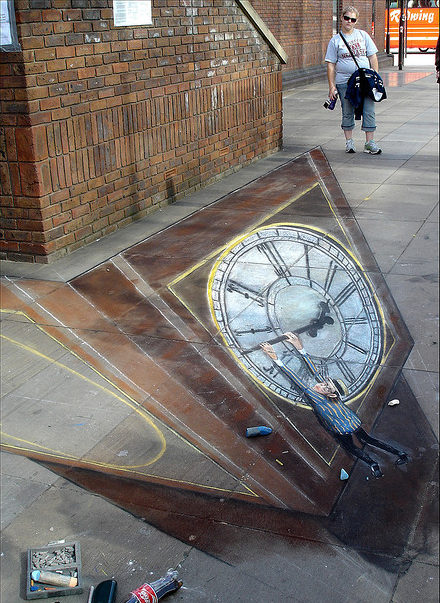
Below are photos taken during and after Julian’s 3-day creation of Big Ben on a London sidewalk, , , all done with chalk, a good sidewalk location, , , and lots of imagination and creativity.

Julian at work leaning on his flat chair to draw so he doesn’t damage any of his previous work

The piece is coming along, , , one face of the clock is finished

The finished drawing with Julian hanging perilously on the edge of Big Ben

It took Julian 3 days to complete Big Ben and it’s gone as soon as a good rain comes. His take on the issue is “As long as I have the photo, we are good.”

The project management lessons

What can you learn as an IT manager? The 30-minute TV program actually gives you quite a bit to learn from, , , if you are looking for it. Here is what I picked up on with Julian’s project:

1.  Prepares for the project and develops a plan – He checks the weather, insures he has permission to draw on the sidewalk, creates a mock-up on paper, checks all of his equipment and materials and determines exactly what he has to accomplish each day to complete the project in 3 days. In other words, he puts a plan together just like you should with any project.

2.  Anticipates problems – When it rains, he can’t work so he carries a tarp and masking tape to cover his work so it won’t be destroyed by rain drops. Remember, he uses chalk.

3.  Checks and rechecks the status of the project – By using a camera, he looks through the lens to determine if he is getting the 3D effect he is looking for every step of the way. He is also aware of where he is and how much time remains to complete his drawing, , , good time management.

4.  Knows where the bottlenecks are – Julian knows exactly what he has to do and he knows where the parts of the drawing are that will take more time. He also knows where he can take a shortcut if necessary to gain some time.

5.  Uses tools – Julian uses a special folding stool with flat seat and lays on it as he draws. It allows him to hover over his masterpiece without damaging his work. It improves his productivity and saves his knees, , , but most importantly makes the work easier for him to do. He began using this tool to address several issues he faced when working on sidewalk art projects.

So, the question is, “Do you have tools you need to help you and your staff complete your projects more productively and effectively?”

Find more sidewalk art posted in ITLever by doing a search on “sidewalk”.

Setting expectations

Great news!! Our broken heater I talked about in my last post is now fixed, , , and what a pleasant experience.

There are valuable lessons in this one that apply to managing your IT organization.

First of all, a question for you, “Don’t you just hate it when everything a vendor tells you turns out exactly as they say it will?”

No, we don’t hate it, , , of course not, , ,  we LOVE IT !!

My heating guy is “Mike”, same name as I have. We had never met him but he was referred to us by a close friend. We called Mike last Thursday to come take a look at our downstairs heating unit that had gone out, , , and it was very, very cold with a forecast of lower temperatures coming.

First of all, he says he will be right there and he arrives within 30 minutes, , , pretty quick, , , we are off to a good start.

He analyzes the situation and calls me out to “take a look”. Anytime, you have to go “take a look”, there are problems in my experience. Sure enough, the heating elements are cracked and the motor had burned itself out.

Good news and not so good news
The good news is that he has already checked with the manufacturer and learned that the unit is still under its 10-year warranty, , , for 2 more months. WOW, what a lucky break.

The “not so good news” is that he has to order the parts and it will be next week before they will arrive so he can make the repairs.

When asked about what the cost will be, he explains briefly what has to be done and estimates the total cost will probably be somewhere around $500 to $700. If it had not been in warranty, we would be looking at several thousand dollars.

Before he leaves and this is important, Mike has set my expectations on when the unit will be fixed and how much it will cost – sometime next week as soon as the replacement parts arrive and around $500 to $700.

Tonight is going to be down to 12°F, , , so we do what we need to do to stay warm downstairs by using our fireplace and running the water slightly to keep the pipes from freezing. We have prepared ourselves to manage without the heating unit for a few days.

—> Flash forward 3 days to Monday (today)

The very good news
This morning, Mike calls to tell me they have the parts and can come by to make the repairs. WOW, it’s only Monday morning and I’m thinking it could be Wednesday or Thursday before he gets the parts. Great news.

After he completes the work, I inspect the repairs and we run a good test of the unit. He points out a couple of additional things they took care of that would make the heating and air unit more effective. It was small things that most people would not have addressed and something they certainly didn’t have to do. He took care of it because he cared. I later learned that he didn’t charge me for these two little fixes although I would have been totally fine if he had.

When presented his invoice, the cost was under his estimate, , , more GREAT NEWS.

Do you think I’m a happy client? You better believe I am, , , in fact, I plan to tell several more people about the good work Mike’s company does.

And who do you think I call the next time we have heating or cooling issues?

You got it, , , Mike is the only person I would think of calling.

Let’ summarize what happened here

  • He arrived on time
  • He was courteous, straightforward and answered my questions
  • He was proactive in checking on the warranty
  • He set my expectations on fixing the unit:
    • What was needed
    • Time frame
    • Cost
  • Completed the job earlier than expected
  • Completed the job at less cost than estimated
  • Took care of other issues he found, , , i.e., he over delivered

Mike’s company exceeded my expectations!

Your IT organization should provide service at this level. If you do, I can assure you there will be lots of happy clients who like to talk about how great your team performs. Those are the best salesmen you have, but you know what, , , you earn their positive comments and remarks when you provide excellent support.

No wonder my friend Terry is so positive about recommending Mike. Well, Mike now has another promoter in me; I plan to tell everyone I know who might need his services one day.

Consider the alternative for a moment. If Mike had done a poor job in any area of time frame, cost, not keeping me informed, , , do you think I would be so positive in telling others?

Absolutely NOT.

If you analyze the situation just a little, you can see that Mike positioned himself to over deliver. I’m sure he had a good idea when the parts would arrive and how much his labor cost would be.  His time estimate was “sometime next week”. I would have been happy with Thursday or Friday, , , I’m ecstatic about the job being done today (Monday).

The fact the cost came in 10% under his lower estimate of $500 also makes me very happy, , , I fully expected the cost would be somewhere around his upper estimate of $700.

I’m always impressed with good support and good service. It could be as in this situation with Mike, getting support from a hotel IT technician (click here to read the post), or even in a restaurant. Good service creates positive energy around your organization.

Guess what, most people are impressed with excellent client service, , , because that’s not what you usually receive. Focus your team and teach them how to set expectations so you can deliver excellent client service, , , then note the positive difference in working with your clients.

Who do you call ?

Two nights ago our downstairs heater went out. It was not a good time. It has been very cold, in the 20° to low 30° Fahrenheit range all week. Last night got as low as 12° F , , , that’s  -11° Centigrade, , , very cold.

That’s our son, Eddie, , , waving “Hello” to you

What’s the first thing you do when one of your systems goes down, , , like your e-mail server or one of your mission critical business applications? Do you know what to do?

Well, if you are capable, you might try to troubleshoot the problem. That’s what we did, , , the blower wasn’t operating and we smelled something like burnt plastic around the vents. That’s the extent of our troubleshooting ability in this case.

I’m not very knowledgeable about heating furnaces and air conditioning units, , , in fact I would say I have zero knowledge about them other than basic operation of the unit.

So, the next thing you do is call someone for help – right?

That’s exactly what we thought, but we had a problem. It was already 10:00pm Wednesday evening and we weren’t going to get someone out this late. Fortunately we didn’t have an emergency, , , just a problem we needed to resolve in a reasonable time. Our upstairs heater is working fine and our fireplace keeps it warm enough in our main living area so we are good. We just need to keep the water running a little at night so the pipes won’t freeze, , , that would create a much bigger problem.

Our heat situation is just like what an IT manager faces when your e-mail server goes down or some other key component of your operation stops working.

To resolve the heater issue, we know exactly who to call even though we don’t make a call like this very often, , , only once before in the eight years we have lived here.

You have the same situation in finding support for your servers, network components, and other systems when something breaks. You don’t call for support that often but when something breaks and you need help, you really do need to know how to get hold of the support you need.

What used to really irritate me as a young IT manager was when we would have a problem like a down system. No one seemed to know who to call for help, , , so we had to scramble and figure it out in the midst of a crisis. That’s not when you need to identify who to call.

A quick and easy recommendation for you is to make a quick list of all your critical systems and operational components that you might need support for. Then identify the support vendor name, contact name, and phone number.

This will probably only take you ten to fifteen minutes to list the dozen or so mission critical vendors. Add additional support vendors that are less critical as you feel is needed.

You might even want to include a manager’s name and phone number in case you need to escalate an issue. I would even recommend going to lunch with this manager and get to know him or her, , , and allow them to get to know you. If you do need to escalate an issue, it always helps when they know you.

Personally, I like to put this information in a spreadsheet that I’ll always have close by. You may want to print a copy and put it in your manager notebook, , , give a copy to your managers and to your Help Desk, , , anyone who might need it in the future.

When a problem happens, , , and it will, , , you have a quick reference and know exactly who to call.

I promise you, it will take some of the stress out of the situation when you are able to identify and contact your support resources quickly in order to respond to a broken or inoperable system.

Another good lesson learned this week
Be sure to stay on top of your warranties. In our heating situation, we really got lucky. The heating units and motor have to be replaced, but it’s still in its 10-year warranty for two more months. We were actually  lucky the problem occurred when it did.

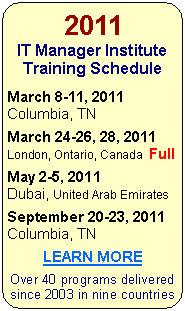
IT Manager Institute – 2011 class schedule

I have scheduled 4 IT Manager Institute classes for 2011. One of them will be a closed event just for the host company.

  • March 8-11, 2011  –  Columbia, TN
  • March 24-26, 28, 2011  –  London, Ontario Canada  (CLOSED)
  • May 2-5, 2011  –  Dubai, United Arab Emirates
  • September 20-23, 2011  –  Columbia, TN

Early registration discount if you register by February 15, 2011

Additional information and registration details at www.mde.net/institute

Can’t attend one of these classes? You should consider our Self Study – same material in an online “learn at your own pace” format. Comes with all the BONUS items and ability to take the ITBMC exam as the classroom version offers. Details at www.mde.net/selfstudy

Snow day

We have a major snow here today and when that happens in these parts, lots of things come to a standstill.

Here are a couple of photos from my house.

You probably can’t see it in the top photo, but there is a car stuck on the road because it can’t get up the hill. The county Department of Transportation has been working for 30 minutes trying to get them going but they aren’t making much progress from the looks of things. For us, we will stay in today.

Last night the storm hit Atlanta and having lived there for 20 years I know what kind of headache snow and ice can create for your IT department. Hearing about it brought back some “not so fond” memories.

It’s not a big deal if everyone can get to work but when people can’t get out of their hilly neighborhoods because of snow and ice, , , you better have a special support strategy for “snow day”.

The problem in Atlanta and here in middle Tennessee is that we don’t have snow tires, studded tires, snow chains, , , the types of things you need to get around when the roads are covered with ice and snow.

The Department of Transportation does a good job of clearing the main roads, but it’s the neighborhood streets that cause the problems.

It’s nice when it is just snow, but most of our conditions begin with rain, turn to ice, and then snow. What this creates is a nice layer of ice on bottom that makes driving conditions extremely difficult.

We always hear what you “Northerners” say when you hear about Atlanta coming to a standstill, , , “Those Southern people just can’t drive in the snow.” Well, all I can say to that is, “You need to come and give it a try with no snow tires and lots of ice in hilly neighborhoods.” I believe you will understand the issue quickly.

Back to my point. In Atlanta, I always had a “snow day” escalation procedure to notify all our remote business units of the impending difficulties we were expecting in the Atlanta office when we knew snow was coming, , , after all, it’s still warm and sunny in Miami. The communication explained we would be working with minimal on-site resources when the storm hits us, , , and maybe for a few days until it melts off the neighborhood streets.

Today, it is easier to work from home, , , a good thing; but there are some jobs that must be done on-site and in the office. For this reason, you need to develop a “minimal support plan” that spells out what you can do and how your team will respond to issues during the bad weather timeframe.

Your clients will understand and appreciate it, , , well, all but that one irritable client from Michigan who thinks Southerners can’t drive in the snow.

Before I leave this, let me explain why Atlanta gets so paranoid when a snow storm is headed their way. In 1982, there was a big ice and snow storm that hit the entire Southeastern United States. It literally caused people in Atlanta to be stranded in hotels, in their offices, or in local homes or shopping malls where they sought refuge for 3 days because it was impossible to get home by car. Truly impossible.

Hotels ran out of food, , , company vending machines were emptied, , , people slept on office desks and in chairs, , , even in hotel lobbies.

It was bad.

I was lucky because I didn’t live in Atlanta at that time, but a business colleague and I were trying to make a flight connection from Philadelphia to our home in Jackson, Mississippi. All the Atlanta airport hotels were booked solid so it looked like we were stuck in the airport.

Fortunately, we learned one flight to New Orleans was going to get out. We decided to take it because we knew it wouldn’t be snowing there, , , and worst case, we could take the train to Jackson and get back home if we couldn’t fly into the airport. Jackson airport was also closed due to the heavy snow.

All ended well for us even though it took us two more days to get home. New Orleans is a fun place to spend a weekend and much better than being stranded in any airport I’ve ever been in.

The point to my message, , ,  identify where your weak areas are and develop a support plan to address them ahead of time, , , your clients need you to, and your employees will appreciate your leadership.