Phil Sargeant wins Contest #5

Phil Sargeant of Alexandria, Virginia wins our 5th weekly contest and is awarded a free IT Manager ToolKit valued at $175.00. Our tools and templates are used by thousands of IT managers around the world and are simple to use in helping you organize, manage, and monitor your IT business. Over 100 tools and templates.

When asked about ITLever.com, Phil made these comments, “Each post in the blog deals concisely with one subject, giving actions that the reader can put to use right away.  There is value for the learner without needing to devote a lot of time to reading a long commentary.  You present your material in kind and gracious ways that help readers not only with the technical information but also as examples of how to interact with other people.”

Go to https://itlever.com/2010/08/12/subscribe-to-itlever-and-win/ to learn more and to see a list of all winners.

Are you a “Giver” or a “Taker” ?

There are two types of people in the world in my opinion. There are “givers” and there are “takers”. This article explores the issue and emphasizes the importance in becoming a “giver”. I’ll also give you some personal examples where “giving” has rewarded me over and over.

This article is taken from my article archives and offers a timeless lesson worth remembering.

It’s 4:30am here as I write this article. I just finished a Question and Answer conference call with a seminar group in Nigeria about a PowerPoint presentation they just saw me deliver on IT due diligence in a merger and acquisition environment. I wasn’t there but they watched my slides and heard me speak in a flash presentation. It’s 11:30am their time and the second time I’ve done this to support the Nigerian company hosting the seminar.

When you work with people all over the world like I do, your hours can be a bit out of the ordinary, but I love it. The reason I bring this up will be clear later in the article as it is a prime example of what “giving” can do for you.

Look around. If you observe people closely, you will find that people tend to fall into one of two categories. A person tends to be someone who “gives” or will tend to be someone who “takes”.

“Givers” are willing people who truly want to help others. I think nurses and teachers are some of the best examples of this. Teachers are not as concerned about what they can receive as much as what they can do to help others. Nurses have similar characteristics.

In my own family, I believe most of my relatives are more “giving” in that they don’t really ask a lot of others and aren’t always looking for “what’s can you do for me”. On the other hand, I have a couple relatives who are really interested in only doing things that will do something to promote their agenda.

In management, “takers” can be detrimental to the IT organization’s success, especially when the “taker” is an IT manager or CIO. In an IT management role, you always get a more positive acceptance with clients, employees, and senior management when they view you as one who “gives” versus one who always wants to “take”.

What does this mean?

“Givers” go the extra mile. They don’t just do the job, they work hard to ensure that when they do a job it is thorough and complete. They make certain the quality is there and they want people to know, “my name is on this project”. They “give” when they aren’t necessarily asked to “give”. It’s second nature to them because they inherently understand that, “it’s better to give than to receive”.

We have all heard this phrase. Well, I can tell you from personal experience that it is truer than you might ever believe possible. I have many examples in my personal and professional life where my family and I have reaped huge benefits because of a simple “giving” gesture, even when I wasn’t expecting anything in return.

A challenge in our world of technology is that supporting technology is a dynamic and ever changing business. Because of the amount of change that occurs we constantly need things from others. We need our employees to do their jobs, to do it in a quality manner, and to pay attention to the details.

We need assistance from our clients as we implement new technologies or support the technologies of their business environment. The point to this is that to be successful IT managers and CIO’s, we are highly dependent upon others.

If you are predominately a “taker”, someone who only deals with others when you need something, it becomes more challenging for you to approach others and ask for their help. Actually the difficulty is not in asking for the help (“takers” have that game down very well).

The difficulty lies in getting the help or getting help in a quality, committed effort that is going to make your project a real success.

Put yourself in the other person’s shoes. Let’s say that person is your client, a Department Manager in your company. A Department manager is extremely busy with issues in his department and is challenged to make improvements that help him achieve department objectives. When the CIO or IT Manager approaches him and asks for help by allocating department resources to work on an IT project, who do you think he is going to help?

You got it; the Department manager will eagerly seek a way to help the IT manager who has been “giving” and helping him attain department objectives much more quickly than he will to help the IT manager who always “takes” more then he “gives back”.

It’s a simple issue really; we all want to help those who have shown they truly want to help us.

Managing employees works the same way. Our ability to exhibit to our employees that we are genuinely interested in their success and that we do things to help them succeed is key. When we do these things we are “giving”. In my mind, “giving” is a key responsibility of an IT manager, not an option.

Some examples of “giving” to employees are:
–  establishing processes to help employees succeed
–  developing employee performance plans that include training and education investments that grow their skills
–  rewarding individuals and teams for excellent performance
–  telling your employees you appreciate their commitment to the job and focusing on the quality of their work
–  working with an individual to develop his/her career plan
–  even coaching an employee on improving his/her performance

Back to my Nigeria example:
In my business, I’m able to “give” quite a lot, and it always seems to return tenfold. I may not realize it immediately, but I receive much more back in the long run than what I believe I “give out”.

A perfect example is the Nigerian project. It all started in 2004 when I was asked to travel to Nigeria to make a presentation about the importance of IT due diligence in a company acquisition. Unfortunately, there was no way to make this happen in the timeframe needed, , , so I declined the invitation.

In an email message I received back, it was obvious that the group needed help, , ,  the message was professional, sincere, and heartfelt.

What I agreed to do was to put an online PowerPoint presentation together that would address their business objective and that they could present to their audience. They agreed and paid me for the project.

Here is a key part of the story, , ,

  • All I was required to do was to develop a 1-hour PowerPoint presentation on a topic that I’m very familiar with – IT Due Diligence.
  • I was already paid so there was no tangible incentive for me to do more than what was requested to fulfill the project commitment.
  • I had never worked with this group before so there were no personal ties to motivate me to do more than what was minimally required.
  • I was very busy at the time so I didn’t have a lot of extra time to do more.

The bottom line is that I could have provided the minimal requirements of our agreement and the client would have been very satisfied with the project.


Here is the distinction of “giving” versus “taking”.

I decided to do more than what was minimally required!

Why?

Simple, I genuinely wanted to help the Nigerian company make their conference a success. So, I made suggestions of things we could add that I thought would help improve the experience of attending the conference for their clients.

The end result is that in addition to the 1-hour PowerPoint presentation I developed for them to deliver, I added several things to make their conference a real success:

  • A second 45- minute presentation on Key Considerations in Conducting IT Due Diligence in a Company Acquisition
  • A Case Study that could be used as an exercise to point out issues associated with conducting an IT due diligence
  • Two e-books and due diligence tools I sell that discuss the process of IT due diligence and assimilating the technology resources of acquired companies
  • The right to make CD copies to give to each conference participant containing the presentations, e-books, Case Study and tools, , ,  a fairly comprehensive IT due diligence package for an IT manager.
  • Time for me to sit in on a Q&A conference call that would be conducted immediately after showing my first presentation. This meant being available at 3:30am my time.

The Nigerian company was more than pleased as you might expect by the “extra’s”. Some of these “extra’s” were already produced so it took me no additional time or effort, , , but I also didn’t have to offer them.

The key here is that I was automatically looking for ways to help make their project a success as soon as I got involved and committed to the project. I wanted to “give” versus “take”.

I was not looking for anything above the initial payment made for the single presentation we had agreed upon; in fact it never entered my mind.

Well, good things happen to those who “give”. The reason I’m taking a second Q&A call this morning is because the Nigeria company was asked to hold a 2nd conference, , , the first one was such a big success that many who couldn’t attend wanted the information and requested a repeat conference.

The company paid me a second time to replicate what we did in the first conference. All I had to do for this second conference project was be available for the 3:30am phone call.

My objective was not to “take” or “get” more; it was simply to do what I could do to help them succeed in their project. The result was getting paid twice for essentially fulfilling one consulting engagement, , , but guess what, , , it was a win-win for the Nigeria company as well as for me.

UPDATE – September 2010

This little Nigeria conference project and the business relationship we developed has led to significant business ventures. First, there was the 2nd conference. Then we delivered a trial IT Manager Institute training program in Johannesburg, South Africa in 2005. This has led to joint ventures in delivering 8 IT Manager Institutes in South Africa, Nigeria, and United Arab Emirates in the last 6 years. I might not have delivered any of these classes if this relationship had not been created, , , and I had not “over delivered” what was expected.

My point: “when you give, you get back much more”.

“Giving” is part of my basic nature and it has been developed over time. I didn’t always understand this issue early in my career, , , for a long time I was a “taker”. I can tell you that I believe I started being more of a “giver” in 1986 and when I did my career literally took off.  This is material for another day, but suffice it to say that I believe there is a direct cause and effect in “giving” and career growth.

I highly recommend you begin seeking ways to start “giving” to others and go out of your way to help others be successful. You will be surprised at how successful it helps you become in return.

Plus, it’s a lot of fun helping others.

IT Manager Institute planned for Dar es Salaam, Tanzania

To say I get to travel to some exciting places is putting it mildly.

We announced today plans to deliver the IT Manager Institute in Dar es Salaam, Tanzania, , , that’s East Africa for those unfamiliar with Tanzania.

This is a special treat for me as I’ve had several from Dar attend past Institutes. In fact, the reason I’ve been invited is because Kenneth Wakati attended the 4th Institute in 2004 and wants the program delivered to his management team, , , IT managers of the Tanzania Revenue Authority (TRA) in the Government of Tanzania.

Kenneth has seen a positive difference in his career and has sent others to the program. He understands the value and benefits of our training. We have been working on making this event happen for several years, and now it’s becoming a reality.

When:   December 13-17, 2010
Where:  Dar es Salaam, Tanzania

Nine TRA managers are already enrolled and we have a few more seats available for managers from other companies.

Details and registration information are at www.mde.net/institute

Jim Biggins wins Contest #4

Every week we give away a free IT Manager ToolKit to celebrate our company getting to be 10 years old, , , a major milestone for us.

Jim Biggins from Torrance, California won last week’s drawing. Here is what he had to say when asked what he likes about ITLever: “It’s personalized.  So, I can tell you are a real person. It’s concise and gets to the point with links or observations. It’s a useful learning experience and a good free resource.”

You must be a current subscriber of ITLever to win.

To subscribe, click the EMAIL SUBSCRIPTION link in the righthand panel and then select the frequency you want to receive new posts to our ITLever Blog (immediately, once a day, or once a week).

For a complete list of all winners, go to https://itlever.com/2010/08/12/subscribe-to-itlever-and-win/

Subscribe to ITLever and you may be our next big winner.

Warn all users

One of the things you need to do in your company is  educate your users about the danger and risk associated with improper use of e-mail and the Internet.

The Internet is great but it’s also full of land mines sitting there waiting for an unsuspected user to come walking by, , , and BOOM, , , we all know what can happen to the network.

An Internet Usage Policy is great, , , but I don’t know that it always helps your users fully appreciate the situation.

I just read a great article on CNET News that I would highly recommend you share with your users about phishing sites. It’s titled, A flood of phishing sites and how to avoid them by Elinor Mills. Her discussion is high level and discusses the issue in easy to understand terms, , , perfect for the technology users in your company you are supporting.

Elinor includes a statistic that should scare the daylights out of all users and get their attention as to how rampant this issue is and the danger lurking for the unsuspected user:  “During a three-month study of its global malware database, Panda Security found on average 57,000 new Web sites created each week with the aim of exploiting a brand name in order to steal information that can be used to drain peoples’ bank accounts.”

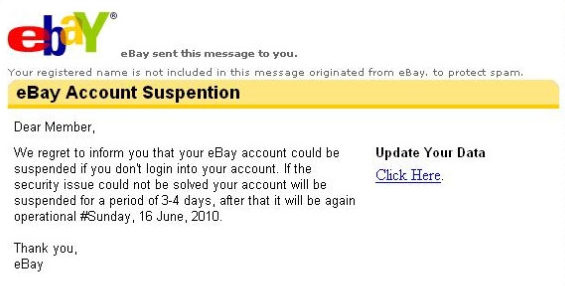
Below is a sample of a fake EBAY message.

I see these bogus messages all the time and simply ignore them, , , but they sure look real and can tempt you to “take a look”. You will be doing your colleagues a great service in helping them avoid these pitfalls in your company and even more so on their home PC by helping them better understand what’s taking place.

Elinor’s article is a MUST READ and SHARE ARTICLE !!

Read the article at:  http://news.cnet.com/8301-27080_3-20016026-245.html?tag=nl.e703

A sad day

Yesterday was a tough day for us, , , we had to let Corky go after 14 years. If you have every owned a dog, you know how close you get and how special a good one is, , , Corky was one of our best and will be missed a great deal.

My favorite photo of Corky and Boo (our Security Officer and Social Director after partying all night).

As an IT manager, it’s important to focus on the positives and avoid dwelling on the negatives. Yesterday was certainly a tough day for us but what we remember most are the fun times we had with Corky.

You are going to have some tough days as you manage an IT organization. Just remember, today may be difficult and even make you want to question what you are doing with your life, , , while tomorrow may become one of the best days ever. Be positive and optimistic about your future and it often turns out that way.

WordPress tutor

Over the long weekend I gave two WordPress tutorials to a couple of my friends who need to develop new web sites.

First there is Kenny Graves, my wife’s cousin and a good friend of mine since high school. I’ve known Kenny most of my life and have learned a lot from him, , , he was my high school band director and became “part of my family” when Dorine and I got married.

Kenny has a small photography business and does volunteer work for the City of Hohenwald, our home town. He just completed revamping a section of the old Strand Theater in Hohenwald to display the work of local artists. This new section is called the Strand Art Gallery. Kenny wants to develop a web site to promote awareness of the art  gallery, the artists it represents, and to promote tourist activities and events for the city of Hohenwald.

Next there is Dan Tankersley who I first met in 1994 when my company purchased his company. Our families have become great friends and Dan has even accompanied me on two trips to South Africa because of the generous assistance he has given my company over the years. When Dan and Judy visited us this weekend, I gave Dan a quick lesson on WordPress as well.

Dan has written a book called, The Rain, and sells it from Amazon.com and a web site that he’s been wanting to rebuild for several months. He also has other work and a new book coming that he wants to promote online. After a short tutorial on WordPress, he is ready to go. Dan seems as impressed as I was at the simplicity and productivity of WordPress.

Kenny and Dan’s web sites are now under construction and will soon be available.

What’s my point?
In your company, you want to be able to communicate in many different ways, , , and WordPress or tools like it give you a lot of power and capability to do just that, , , plus it is free and easy to use:

Here are some examples of typical company needs that WordPress and similar tools can help you with:

  • Company client updates and announcements
  • Company newsletter to all employees
  • A weekly “Message from the President” blog
  • IT status updates to internal company managers
  • Human Resources department updates
  • Sales organization announcements
  • Any department manager’s communication with employees

If I were a CIO today, I would use the WordPress blog and web page development tools to help me communicate from our IT organization and would also make other department managers aware of the capability and benefits these tools can give them.

Now, these tools don’t eliminate the need to communicate with people in traditional ways, , , they just help you communicate more effectively overall.

Things that are easy for us are not always easy for others simply because they haven’t been exposed to it. I’m confident that Kenny and Dan will make quick progress in developing the web presence they are looking for.

Learn more about WordPress at www.wordpress.com.

Invest in yourself

It’s important to continue investing in yourself, , , just as you need to invest in your employees. Every year, you should develop an employee training and education plan and invest in developing the skills of each and every employee on your staff. Doesn’t have to be all formal education, , , much of it can be internal training held by yourself or others on your staff.

The point is that you need to be developing the skills of each and every employee on your staff. It will pay big dividends over time.

Don’t forget yourself, , , it can be easy to forget about developing your own skills, , , and you need this investment as much as anyone. The challenge is that you may not have anyone in your company looking out for “you” unless you personally are taking the time to focus on your development.

Just as every employee on your staff should have a personal training and education development plan each year, so should you.

Identify what you need to improve key skills and carve out budget and time to make it happen, , , it won’t otherwise.

I’m doing this for myself this coming weekend. I’m investing in developing my marketing skills, , , something I need as a small business, , , but not something that I necessarily like to focus on. This is a key point!!!!

I don’t really like to spend time in marketing, but if my company is to grow, I have to do some things (or hire it done) that I may not be all that excited about. Even if I hire out our marketing efforts, I still need to understand things about marketing to be able to make prudent business decisions about where we spend marketing dollars.

I would rather spend my time teaching IT management classes, developing new training materials, writing articles, , , or playing golf :). But I can’t get around the fact that marketing is a key to any small business so I need to make the investment in time and money to improve my marketing knowledge and capabilities.

On Thursday I leave for Atlanta to attend a 3-day Internet marketing program. I’m excited about what I might learn but not so much about the networking during lunch and breaks, , , you see, I’m shy and more introverted like most people in IT. Still, , , got to do it and make the investment in myself.

I decided to take my wife’s 1st cousin with me. Kenny is more like a big brother to her. He was also my band director in high school so we have been good friends for over 30 years. Kenny knows very little about internet marketing but needs to learn about it for his photography business and the community volunteer work he does. It should be a fun weekend and beneficial for both of us.

Attending the class with a friend will allow us to discuss questions or points of interest and will help us network with others, , , it also gives us someone to have dinner with. More importantly, it may help each of us implement some of the concepts we learn about and to support one another later on. I see this quite often when managers of the same company attend my IT Manager Institute, , , I always hear about how much more it means to them when they are able to share the experience with someone they work with.

It is easy to just do the work day after day after day, , , but if you are going to become more strategic about your work and continue to grow, , , you need to invest in your knowledge and professional skills. Make an investment in your staff and don’t forget to invest in yourself.

Jorge Murillo wins ITLever ToolKit give away contest

Jorge Murillo from Costa Rica won a free IT Manager ToolKit for last week’s contest ending September 4, 2010, , , our third contest in as many weeks.

We are giving away a free IT Manager ToolKit valued at $175.00 each week through the end of the year to celebrate our company turning 10 years old. Better yet, we will select a random winner from our ITLever subscribers and award a free Apple iPad on December 4th, 2010.

When asked What do you like about ITLever?,  Jorge said, “It’s absolutely one of the best sites for the IT community. What ITLever is for me: a very good framework with super updated set of Best Practices to be considered.  Nothing to Lose and a lot to Gain.”

You must be a current subscriber of ITLever to win. To subscribe, click the EMAIL SUBSCRIPTION link in the righthand panel and then select the frequency you want to receive new posts to our ITLever Blog (immediately, once a day, or once a week).

For a complete list of all winners, go to https://itlever.com/2010/08/12/subscribe-to-itlever-and-win/

Subscribe to ITLever and you may be our next big winner.

Need help in planning for promotion interview

I received a request for help this week from an IT manager who is about to be considered for the top IT manager position in his area of the company as his manager is promoted to a more senior position. He asked for my input to be sure he is prepared for the senior level evaluation he may go through.

The question:

Hi Mike,
I need your urgent assistance. I am due for an interview for the position of Head of IT in my organization.

Could you kindly recommend some  materials to prepare me for this interview. I already have some advantage as I happen to act in this position when my boss is not available. However, there is a colleague of mine who is also interested and as a result an internal advertisement has been placed to all interested staff. I don’t want to take anything for granted. I need your assistance urgently.

My immediate boss is taking a regional IT position. The panel is likely to be high level.

Regards.

My response:

Hello _________,
I think one of the best resources might be my ITLever Blog at www.itlever.com.  If you go to the home page and do a search using the search function on the right-hand panel, you will find articles that can be helpful. I would search “business value” and you will find several articles. Business value is the key to an IT organization’s success, , , if your organization only focuses on technology and does not deliver business value, your clients (senior managers and department managers of the company) will not view IT as successful and certainly not as a partner.

I just did a search on the blog using “business value” and one of the first articles I posted in it is key:  https://itlever.com/2010/05/25/business-value-is-key/

Two other posts that I think will give you good insight are:

https://itlever.com/2010/08/10/transition-from-technical-expert-to-business-manager/

https://itlever.com/2010/08/24/are-you-presenting-at-the-right-level/

There are about 100 articles posted on the ITLever Blog and many tools you may download. I would suggest looking through all the posts, , , you never know what might be helpful to you.

Also, a 20 Minute IT Manager session or two may be helpful as well.

I believe there are three key reasons why an IT organization fails, , , I call it the Triple Threat to IT Success. Take a look at my e-Learning session on this topic, , , we have a library of 162 of these at www.20minuteitmanager.com.

http://www.20minuteitmanager.com/sessions/072202TRIPLETHREAT/

A good reporting tool for you to use for your boss and also for senior management of the company is an IT Initiatives Portfolio. Check out this training session at:  http://www.20minuteitmanager.com/sessions/062402INITPORT/

Another 20 Minute IT Manager session helps you understand the dynamics of IT people’s work behavior, might be a real eye-opener for you:  http://www.20minuteitmanager.com/sessions/061202WORKBEHAV

Hope this helps,

Conclusion
I receive many questions like this one and hope that by sharing some of them from time to time they are helpful to you. Best of success.