Great day at Graymere

Today was a blast at Graymere CC, , , it was the annual Tillman Knox Invitational Golf Tournament. The tournament was named after Tillman Knox, one of the best golfers in middle Tennessee for many years. He is 84 now and has been a great ambassador for the game of golf in this area.

Didn’t play all that great but had a super time. Shot 84 and there will probably be days ahead when I wish I could shoot an 84.

More on this later.

Sidewalk art

It’s Friday and time for a break!!

Here are some of my favorite sidewalk art photos. All of these images are paintings on sidewalks in New York, , , the 3D effects are unbelievable. ENJOY!!

One of my favorites

Looks like a real pool, doesn’t it?

Just a painting on a flat sidewalk surface

No hole, , , just art that looks very real, , , see them avoid the hole?

No water, , , all artwork, , , even the hose and reel

Develop a career plan

It’s never too late to step back and take a look at your career, where you have come from, where you are, and especially where you want to be in five years.

I have always had a question that I ask my employees in a career discussion, “What do you want to be when you grow up?”

I still ask myself this question every year and I’m an “old guy”, or “over half a century” as my son puts it. It doesn’t mean that I’m still looking for a career; it just means that I analyze where I am from time to time and whether I am living up to my potential.

That’s a key point:  career planning is an ongoing process, not an event.

I have been very fortunate in my career in that I have had many excellent mentors and role models. The years I was with IBM taught me the importance of performance planning and reviews. It also gave me a keen sense of the importance of providing excellent client service and having fun at what you do.

Another company that helped me a lot was HBO & Company, now part of McKesson. I worked with great people and achieved some major career growth at this company. I still have many close friends who are still there.

Being associated with quality people helps mold your management philosophy and character in the right direction. I owe a lot to many that I’ve been associated with throughout my career.

If you have never been part of developing a career plan, now is the time to start. You can use the following steps to develop a plan for yourself or for an employee.

Step 1 – Take an introspective look.

Before you put a plan together, step back and take a close look at what makes you happy. In other words, what type of work makes you want to “jump out of bed” in the morning and get to your work as quickly as you can every day because you love what you do.

Too often, people settle into types of work or roles that are not that interesting or fun for them but they do it “for the money” or for some other reason. Many times a person can get “stuck” in a job that he or she literally hates, , , but will stay in it to avoid making a change.

My sincere belief is that when you find your life’s passion, the money will come. In fact, you may make more than you ever did in an unfulfilling job, , , I’ve seen it happen many times.

Money is not everything, certainly. My Dad never made a lot of money but he was one of the happiest people I know and truly enjoyed his life as anyone that knew him will attest. When you look at yourself, focus in on the type of work or the lifestyle that makes you happy. Loving your work and the people you work with makes life so much more enjoyable.

In coaching others about career planning, I always try to get them to focus on the type of work they like, , , not the position or title. Many employees will say, “I want to be a manager.”, when they do not have the slightest clue about what being a manager really entails. Too many people take jobs because they believe that’s what others expect of them. Career planning is very much about choosing the direction that you want to take in your life, , , it’s about making choices.


Step 2 – “What do you want to be when you grow up?”

To create a career plan, you have to look into the future. It’s hard for some of us to do this; it’s much easier to just sit back and take whatever comes available. You can get ahead that way but it’s similar to floating a canoe down the river without a paddle. I prefer to set a goal, build a plan, and then “go for it”, , , in other words, put a paddle in the water and row to the exact destination you want to go to.

Another thing that you need to contemplate is that once you determine what it is you really want, you will need to develop a plan to get there. For example, if you are a network administrator today and you believe that you would make a good CIO some day and really want the opportunity to manage an organization, there are many paths that will get you there. There are also paths that will block the entrance to the CIO door.

When you determine the type of work that you really want, talk to someone that’s already doing this type of work. Ask very specific questions to learn all that you can about the nice parts of the work and the issues and problems. Remember, any type of work that you choose has challenges; otherwise, everyone might be doing it.

Be honest with yourself. Visualize what your days will be like and what you have to do to be successful at this type of work. Evaluate honestly with yourself whether you have the initiative and perseverance to do this type of work with real passion. Wanting to be a CIO and liking to deal with the issues that a CIO must deal with are two separate issues. It’s not all glory and the phrase, “It’s lonely at the top.” was coined for a reason.

Determine the type of skills needed to succeed in your future career work. If strong communication skills are needed, but you are shy and more introverted, , , then you have to develop these skills. Not impossible by any stretch, but still a challenge that must be overcome.

Take the time and make the effort to look several years out. Simply looking at the next job is not really creating a career plan. You don’t have to figure it all out today, but if you are truly interested in developing a real career plan, you have to start looking further into the future.

Part of the reason for this is that when you begin to develop your plan, you want to take steps that keep doors open for future positions or roles that lead to your ultimate goal. Just taking the next job that materializes can actually limit or block access to the career work that you want.

The sooner you decide what you want, the easier it will be to develop a realistic plan to get there. And remember, just because you decide on one direction today does not mean that you can’t change it later. You may decide that you want nothing to do with a management role after experiencing your first management responsibility, , , that’s perfectly fine, , , after all, it’s your career.

The best example I can give you was when I was an IBM Systems Engineer (SE) early in my career. My manager convinced me to become a salesman rather than move toward an SE Manager path because he knew that it would develop new skills and open additional doors that would position me for greater management roles in the future.

The bottom line here is that he helped me realize the need to look at two or three positions into the future, not just the next one. I discovered that I didn’t want to be a salesman, but I’m convinced that what I learned as an IBM Marketing Rep helped me in my management career later on.

Step 3 – Create a plan.

To develop a career plan, you need three components:

  1. Where you are
  2. Career objective
  3. Paths to get there

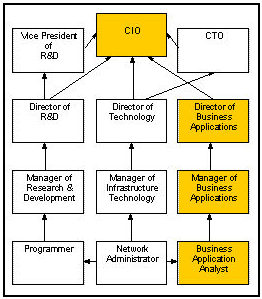
It’s always been easier for me to look at a picture or to take a 20,000-foot view of a situation. You can do the same thing in developing a career plan. Start by drawing yourself a series of three boxes in four rows and describe your current position in the middle box of the bottom row as shown in Figure 1.
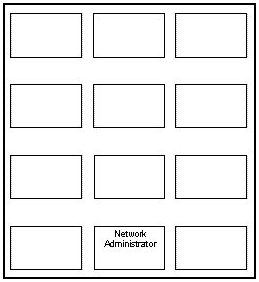
Figure 1

Let’s use an example to illustrate. Assume you are currently a network administrator and that you aspire to become a CIO. This is a bit of an extreme example but will help you visualize what we are discussing.

When you take a close look at the paths that normally lead to the CIO position, you will discover that more CIO’s come from IT managers of the business applications side of IT rather than the infrastructure side. On the other hand, CTO’s tend to come from the infrastructure side.

Several possible paths can be viable paths, but a CIO must be able to relate business issues with technology solutions. Managing business applications development and support tend to prepare you more for that requirement.

Using the template in Figure 1, I fill in typical technical and management positions in the boxes that will prepare one for the CIO position, ultimately getting to what you see in Figure-2. Please note that this is an example; there may be additional steps required to reach a CIO level in your company situation.

Figure 2

If you know that 70% or more CIO positions are filled from the Business Applications side, it’s logical to pursue the path of the boxes that are filled in. Another route is to follow a vertical path that leads to Manager of Infrastructure and then to Director of Technology. At this position, the possibility of filling a CIO role is doable but possibly more remote. The CTO position is a strong logical next step from the Director of Technology position. From the CTO position, you can position yourself for the CIO role.

Nothing is cast in stone and qualified individuals will always break the norm. The example intends to show that there are many paths that lead to the CIO position but one path usually gets the desired promotion more than the others. The trick is to move into positions that keep your options open.

Career planning is similar to when you started college. Some Freshmen know exactly what they want to be when they finish college and can plan their curriculum exactly. Other Freshmen don’t really know what they want to be so they take a general studies curriculum until it begins to become more clear for them.

Career planning requires you to stop and think about your career and to work out a plan that will work. Planning comes more difficult for some.

If you are developing a plan for yourself, always seek the advice of your manager and others who would know about how to reach your desired goal, , , or who have the experience and can discuss your career options with you.

Not all managers are comfortable in developing a career plan for their employees. Don’t let that prevent you from creating one yourself. What I’ve seen throughout my career is that those who decide what they want and put a plan in motion tend to achieve their objectives.

Go for it !!

Are you missing the point?

Here is a key question for you.

Are you wearing your “business owner” hat or your “technology” hat?

Maybe you wear some other type of hat, , , or no hat at all.

Something you may want to consider is what your clients think who use technology and that your IT organization supports (company senior managers, department managers, and users). They wear “business” hats.

There is a natural conflict between business managers and IT managers. Business people don’t tend to see the IT organization as part of the core business, , , after all, IT doesn’t generate any revenue in most cases.

Plus, IT people speak a techy language full of acronyms that business people do not understand, , , nor care to. Things like, , ,  SAP, USB, ITIL, VoIP, WAN, Cloud, POD, WiFi, PMP, , , etc.

Granted, many of these have become common terms, but IT people have hundreds if not thousands of acronyms we use, and business people don’t understand what we are talking about half the time. This is not good for your client nor for you.

This language difference helps create a gap between business people and IT.  Most managers of the company are thinking “business” and IT managers are thinking, , , yes, you guessed it, , , “technology”.

Business managers in general don’t profess to understand the technology, , , they focus on their areas of responsibility, , , and that’s either operating a part of the business or supporting the business.

For a business manager, it’s all about the financials. 
IT organizations sometimes get a bit confused. The desire to work with technology and a lack of desire to become strong communicators who invest in understanding the business causes them to drift away from their business clients.

If you wear a “technology” hat, your business clients don’t hear you let alone understand you. To them, you are simply a lost soul trying to force your technology on them, , , and they don’t like it very much.

They view IT as the organization that’s always changing the technology they have become accustomed to and causing havoc within their operations.

They don’t understand the changes IT dictates nor the reasoning behind most of it, , , they simply want to do their job with as little interruption as possible, , , and they don’t like IT getting in their way.
So what’s the point?

The point is that I see many IT managers who “miss the point”!

To gain partnership status in your company along with respect and appreciation for what you do, , , you have to meet the business on their ground, , , not on yours, , , not half way, , , on their turf. And their arena is all about financial aspects, budgets, and business value.

The bottom line is that if you can’t hold your own in a financial benefits discussion when recommending a technology initiative, your requests are probably not going to go anywhere.  Best case is that you get approval but the business manager doesn’t fully understand it, , , not a good scenario and opens the window for your IT organization to be considered out of sync with the business.

When you make any recommendation that requires spending money (and most of our IT initiatives definitely require money), always put yourself in the person’s shoes that you are making the recommendation to, , , and ask yourself one simple question that your client is asking himself,  “What’s in it for me?”

Business owners only want to spend money that provides some tangible value, , , so put your “business owner” hat on in all aspects of managing your IT organization.

One of the best IT situations I’ve observed in over 40 company acquisition assessments was the one where the CIO was a 50% owner of the company. He and the business were 1,000% (that’s 10 times more than 100%, you know) in sync with one another, , , it still gives me chills when I think about it because it was so good to see.

When your senior manager sees consistency in what you recommend, , , that there is tangible and quantifiable business value that truly cost justifies your recommendation, he or she listens.

When you deliver the goods, , , the benefits you expected and a project delivered on time and within budget, , , your credibility rises quickly.

Consistent high value recommendations and a track record of delivering your projects successfully sets you apart from your counterparts. All of a sudden, you will find senior management wanting to hear what you have to say, , , not avoid your conversations.

Wear your “business hat” and you will see a difference in how your clients appreciate and respect what you are doing.

Camp Liberty at its finest

We have one of the best views of any camp on the Buffalo River. Being an “IT Guy”, I rationalized that the reason for the Statue of Liberty in the yard is to prevent the barge ships from running aground as they make the turn at our spot on the river. 🙂

The view

The cabin

Our 100-year old log cabin has lots of character.  What that means is that there are no level floors or square joints to be found, , , old and rustic, , , we love it.

Miss Liberty

Miss Liberty at dawn

Miss Liberty at night

The Point

The Point is one of my favorite places to read, work, eat or to just watch the river.

At work on The Point

Friends and family enjoy The Point

Eddie at Camp Liberty

We enjoy our weekends at Camp Liberty and the time we have with family and friends chilling out. Downtime is good for you from time to time, , , it was far too many years before I realized it.

Are you helping your company save money?

Received an email message this morning from one of my IT Manager Institute students, David Dilday. His comments and others like it are what motivate me to do what I do, , , “help IT managers of the world achieve more success”.

Here is what David had to say, “Just checking in here, and letting you know of my progress thus far “post class”.  One of the action items I put down in my notes (and something that you mentioned specifically I believe) was to come back from the class and find ways to save the company money.  The goal for me was to not necessarily make the savings in my IT department alone, but just put my ideas for cost savings/avoidance out there and do the work on the back office side with number crunching.  Well I did that, proposed developing and using e-forms instead of our traditional paper forms to the appropriate department and let it go.  I didn’t do any of the creation of these forms at all, I just created the documentation for cost savings and made a recommendation.  The department manager implemented the e-forms and gave me credit.

By the way…these e-forms will save the company $30,000 a year.  Thanks to your inspiration and the content of your class, I’m continuing to reach new heights in my career.”

I’ve received other messages from David since he attended the Institute program. He is taking the things we teach in the Institute to heart and making real progress in delivering more than just technology support, , , he is recommending and doing things that provide real business value for his clients.

Things like this get noticed and make a difference for your IT organization and for your career. It always gives me a personal boost when I hear from our students about their successes, , , hope you like reading about it too.

A CIO’s first priority

In today’s business environment, it is vitally important for the CIO to become a true business partner of the company’s CEO and CFO. Together, these three executives can drive significant strategies that benefit their company.

If the CIO is to gain real “partnership status” with these two company execs, there are a couple of things he or she must do. Becoming a “partner” with your CEO and CFO is not necessarily an easy thing to do, but it’s vital if the company is to achieve its full potential.

The CEO and CFO are the two people looked to most to see that the company performs as expected. They are ultimately responsible to the Board of Directors and stockholders for company performance.

For the most part, company performance is measured in terms of financial performance. Their ability to achieve “the numbers” is enhanced exponentially when they have a CIO who understands the business and operates in “partnership” mode with them.

CEO types often come from the sales or operations side of companies in the same industry. CFO’s often have accounting experience in the industry as well. Industry experience is a critical factor in “operating” a company.

Conversely, CIO’s can come from virtually any industry. Our skills as an IT manager or CIO are actually very transferable across any industry.

Key contributions of an effective CIO

If you look at what strong CIO’s do for a company, it makes a lot of sense that a good CIO can be effective in virtually any company and in any industry.

  • assesses business issues and needs
  • identifies technology issues, capability and capacity
  • defines IT initiatives that address these business needs and issues
  • develops strategic IT plans for the company and anticipates need
  • builds an IT organization that provides systems stability and security
  • positions scalable technology resources to support company growth
  • provides responsive support to technology user needs
  • implements IT initiatives that deliver tangible business value
  • budgets and manages the IT operation to be cost effective
  • implements change through technology to improve profitability, productivity, and other business value results

Sounds sort of like Superman, , , or Wonder Woman doesn’t it?

A CIO wears many hats to be sure. Effective CIO’s take care of business methodically and use proven formulas of success to generate positive results for their company. They can use these processes in any company or industry.

Remember me mentioning earlier that to become the CEO and CFO’s partner there were a couple of things the CIO must do?

First, a CIO must be acutely aware of company financial challenges the CEO and CFO have to deal with. Achieving targeted financial numbers is well over 50% of the executive wing’s mindset and what absorbs much of their time. All you have to do is to watch the anticipation every month when it’s time to produce the company’s monthly financial reports to realize this is the case.

To be able to relate well with the CEO and CFO in financial terms is extremely important. It’s not something you can fake. To gain “full partnership” status, you have to be able to communicate in such financial terms as “earnings per share”, “expense as a percent of revenue”, “ROI” or “Return on Investment”, “EBITDA” or “Earnings before interest, tax, depreciation & amortization”. You also need to have solid understanding of company P&L’s, the budgeting process, and the issues that can effect earnings, especially as it relates to technology.

Discussing issues in business value terms must become the norm for a CIO to achieve partnership. Every initiative you recommend must be cost justified and provide tangible and quantifiable business value, , , otherwise, it likely won’t be heard by your CEO and CFO.

Too many IT managers reach a senior management position in smaller and mid-size companies without ever budgeting or having responsibility for a P&L. Lacking an understanding of how the financial engine of a company works makes it very difficult to become an integral partner with the senior management team.

Second, a CIO must understand the business. I stated that strong CIO’s can move from company to company or from industry to industry and be very effective. They can only do that if they learn the business of the company and the industry it is in. Sharp CIO’s make it a priority to “get under the hood” to discover what drives the company and how it is successful. In other words, they learn the business and what makes this type of business “tick” quickly.

Every industry has leverage points where technology can improve profitability, improve productivity, create a competitive edge, or provide other value that’s important for a company’s success in that industry.

For example, in healthcare, there tend to be three major drivers that contribute to operational success beyond the actual medical services provided:

  1. Regulatory compliance
  2. Billing for services provided as accurately and as quickly as possible
  3. Collecting the cash for services rendered

If a healthcare company is heavily paper oriented with little automation, it’s a virtual gold mine for a savvy CIO. Believe it or not, the healthcare industry is still a heavily paper intensive industry.

Every industry has levers like these that can be capitalized on when the CEO, CFO, and CIO combine forces. Within an industry, companies have unique business issues and “one size will certainly not fit all”. What I mean by this is that once you know where the industry leverage points are, assessing a company situation may identify more basic technology issues for a given company. For example, as late as 1999 I was still running into companies without email services. These basic services need to be addressed just like the potential company leverage opportunities that may exist.

Astute CIO’s try not to take anything for granted when learning about a new company. They assess globally and begin “peeling layers of the onion away” as they drill down to identify the specific issues that the company is dealing with.

CEO’s and CFO’s need partners who can help them solve the company’s financial challenge riddle and the only way to do that is by understanding the business. Having a CIO that can speak the financial lingo and who spends money on real issues that makes a tangible difference for the company are valued assets and treasured “partners”.

The CIO is in a unique position in that he or she can facilitate change through technology that can improve the company in so many ways. Your ability to integrate business issues and financial insight into managing the technology resources operation of your company can have the most dramatic and positive effect.

Gaining an executive level perspective in the financial and business needs arena of your company is the first step in gaining two new partners at the top of your company. With partners at the top, your career can really go places, , , without that partnership, you won’t go very far.

Memorial Day

Today is Memorial Day in the US, one of our major holidays. We celebrate and honor those who have fought for our country in this holiday. We have many friends and family who have served in the Armed Forces, , , including me.

I served in the US Marine Corps for 4 years and it was where I got introduced to the world of computer technology. The Marine Corps was also where I got my first taste of management responsibility. I’m convinced it is where I transformed my basic management approach from “authoritative” to “persuasive”. Most of us in IT have authoritative personalities – over 70% of us. This approach works fine when we are responsible only for ourselves in a technical role. It can get in our way and becomes a big obstacle when we become managers.

In the Marine Corps, I can give an order and it has to be carried out, , , there is a very strong structure of discipline. No time for “I don’f feel like it” or “I don’t think that’s a good idea”. Orders are given and they are carried out – very simple.

Well, I didn’t know much about personality types and things of that nature early in my career, especially not when I was in the Marine Corps, , , but I’m convinced upon looking back that it must have been in this first IT management role that I began intuitively becoming a more persuasive manager.

For one reason!!

You get better results when you explain to your technical team the need to do something, why it’s important, and what’s in it for them. In other words, you communicate and sell the idea. When you do, I’ve found you get much better results and more commitment to the work.
What is an authoritative management personality?

Good question. In a nutshell, an authoritative manager’s approach is like this:

  • Let’s go do the work
  • Do it now
  • Do it my way
  • I don’t want to discuss it

This last part, “I don’t want to discuss it” is what can create problems for you, , , unless you are in the Marine Corps. Most people do not mind doing the work when they understand the importance and why the work needs to be done. If the work turns out to be good for them, that’s icing on the cake.

Over 70% of us in IT are shy and introverted, , , meaning we do not like to discuss these issues, , , we prefer to give the order , , , and for people who work for us to “just do their jobs”! In some work environments like the Marine Corps this works well, but in most it doesn’t.

My basic personality is an authoritative manager style just like most in IT, but I change when I go to work and transform my approach to a persuasive management style. I’ve learned the value in communicating what, why, and the benefits of doing things, , , i.e., I force myself to communicate. It’s not something I necessarily want to do, but I’ve learned that it’s a requirement for me to succeed in an IT manager role.

One last thought, , , today is a holiday for us in the US. You need to take time for yourself and do things with your family and friends – away from work. Many of us in IT can be somewhat workaholic types, , , work is good but you also need some downtime to re-energize and recharge the batteries, , , you will be more effective when you do.

I know, because I have a serious workaholic personality, , , but I’ve learned to take more time for myself. I planned to do a lot of writing over this long 3-day weekend, but I never got to it. Part of me wants to kick myself, but another part realizes it will help me be more productive in the days ahead.

Take care of yourself and spend some quality downtime from time to time – holidays, weekends, vacation, etc. Your family will appreciate it and so will those who work with you – you will find that you become a fresher person able to look at the positive things easier and more often.

Weekend fun

We jumped into the weekend in full force yesterday by making us up a picnic lunch and heading to Amber Falls Winery, , , about 10 miles from our Camp Liberty.

Jazz musicians sparked up the evening along with dance, good food, and some Amber Falls wine. We learned Judy and Tim (two of the owners who have become friends) were celebrating their 39th wedding anniversary, , , the same number of years Dorine and I have been married, , , we hit 39 years this past December. Dorine went up front and made a public announcement so Tim and Judy could celebrate with a 39th anniversary dance.

Met a couple who were making their first visit to Amber Falls. They are still trying to adjust after 11 years to living in middle Tennessee. When we moved “back home” in 2003, there was no real adjustment, , , we love it here.

The music was ok but not what I would call great. Good musicians, just no real personality to the group.

We had a good time.

Memorial Day weekend

This coming Monday is Memorial Day where we celebrate the commitments of those who have fought for our country’s freedom and liberty. Dorine, Eddie, and I will spend it on the Buffalo River at our Camp Liberty, , , appropriately named because we have a 9-foot Statue of Liberty in the yard looking up the river.

When we bought the camp, we initially thought the statue was, , , well, different. Very quickly she started to grow on us and now we wouldn’t move her for anything – part of the character of our camp.

See more photos of Camp Liberty at www.mde.net/liberty

In America, this is one of our major holiday weekends and the launch of summer time, , , swimming pools open, , , vacations begin, , , graduations, , , weddings, , , you name it.

We are thinking we will go have a picnic at Amber Falls, our favorite little winery nearby. If so, I’ll take a photo or two and post onto the BLOG.

Planning to do some work this weekend, , , in the middle of a major writing project and also planning to release an option for my self study program that many have been asking for. The nice thing about Camp Liberty is having wireless through satellite so I can work.

Looking forward to a great weekend with my family and a few friends. Started out right last night with a catfish dinner with Dorine, Eddie, and my 2nd Mom – Miss Sue. Great time.