Tag Archives: it management

Solve the IT management maze with an IT Management Process

Does this look like what you found when you first became an IT manager?

If so, it’s not really surprising, , , it’s what I discovered and millions of managers around the world discover when they first get their BIG OPPORTUNITY.

Managing an IT organization can seem like one big complicated maze.

Well, it really is unless you have a process to follow and tools to help you achieve the things that are necessary for IT management success.

In my case, I had to learn the hard way about many things, , , but I was also fortunate to have some very strong managers around me to learn from. Not all of them were IT managers, , , some had very little knowledge of technology or in understanding IT employees, , , but they possessed excellent management skills and were good resources to learn from.

Don’t limit yourself to learning from only IT managers, , , it limits your possibilities. It’s going to be helpful to your career to learn things from company executives, sales and marketing, , , Human Resources, , , your client department managers, , , even vendor managers.

What you also need is a proven management process, , , a path to follow that will help you find your way through the maze. There are obstacles at every turn in an IT manager role, , , some can even be deadly impediments to your career.

Here is the management process I use in managing an IT organization.
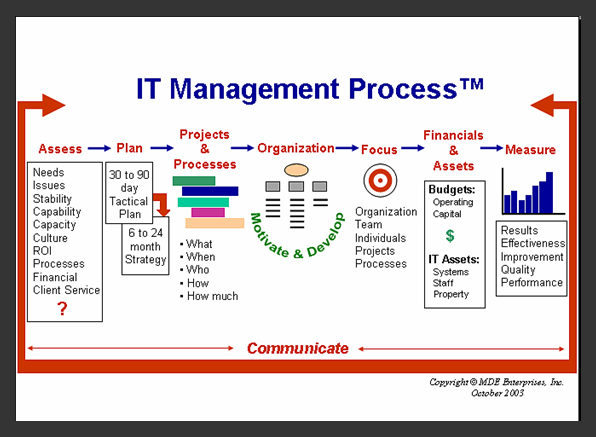
There are 8 key components:

1.  Assess – Conduct an IT assessment to determine what the business needs and issues are plus what your IT organization’s capabilities and capacity is. Once you understand the “demand and supply”, you can develop a plan of attack.

2.  Plan – Develop an immediate 30-90 day tactical strategy and once you get your people focused on it you can start working on developing your long term strategy.

3.  Projects and Processes –  Delivering projects successfully is the key to credibility and there are key support processes you must put into place in order to support your clients effectively.

4.  Organization – You must build an appropriate IT organization and when you have people, you need to motivate them and develop their skills to create a world class support organization.

5.  Focus –  Evert aspect of your organization needs clear focus, from the individual employee to the entire organization.

6.  Financials and Assets –  Managing the financial side of your business and keeping track of technology assets becomes a key part of managing a successful IT operation.

7.  Measure –  To improve, it is important to know where you are and whether you are making positive strides, , , practical measurements will spell it out for you.

8.  Communicate –  What ties it all together and makes such a powerful difference is being able to communicate well.

CLICK HERE to purchase the 20 Minute IT Manager video for only $9.99 to learn more.

Or, purchase the entire library of 162 sessions of the 20 Minute IT Manager
CLICK HERE for a special 50% discount offer for ITLever Blog readers – only $249.00.

Attend an IT Manager Institute class or access the Self Study program to learn step by step how to become a successful IT manager.

IT Manager Institute classes — www.mde.net/institute

IT Manager Institute Self Study  — www.mde.net/selfstudy

Manage your manager

One of the things you must learn in order to become a great manager is how to “manage your manager”.

I can tell you I was not very good at this early in my career, , , primarily because I didn’t understand it, both from the point of needing to do it and also in understanding how to go about it.

Managing your manager’s expectations is just as important as managing client expectations. As with a client, you want to try and position your manager so you and your team always over deliver what the manager expects from you. No one gets upset when you over deliver, , , it’s certainly not the case when you deliver less than what is expected.

Managing your manager means you do things that shows you are:

  1. Organized
  2. Have a vision of what you are trying to accomplish
  3. Predictable and reliable
  4. Have a successful track record of delivering what you say
  5. On time
  6. Understand the financial consequences of your actions
  7. Support and develop your employees
  8. Meet your budget forecasts
  9. Support your clients effectively
  10. Role model for others to follow

When your manager brings you a more urgent project, you know how to balance this new initiative with the other projects already committed to. Something has to give so you manage your manager’s expectations so he expects one of the older projects will be delayed or maybe even canceled in order to focus on the new initiative.

Managing your manager also means you are proactive in developing a strategy for your organization and getting it approved. It means working on things proactively that are understood and agreed upon by your senior management team, , , no way to be out of sync when you do.

Managing your manager means you provide your manager material that helps him understand your organization’s accomplishments and essentially “wind him up” with information he can share with other senior managers of the company.

The bottom line is that managing your manager means you constantly position yourself and your team to be able to deliver what you say you will do and when you say it will be completed. When you establish a predictable track record, you will find a huge amount of trust develops between you and your manager, , , and with trust becomes “partnership” status.

Learn to manage your manager well and it will help your career.

“You really know how to work with an Administrative Assistant”

In yesterday’s post I mentioned that a senior Administrative Assistant I worked with in a consulting engagement told me, “You really know how to work with an Administrative Assistant.”

My answer was something to the effect of, “I’ve worked with and have been trained by some very capable Administrative Assistants.”

I didn’t tell you in yesterday’s ITLever post why I think some believe I know how to work well with Administrative Assistant professionals, , , so here are some thoughts that may explain.

First, I respect what they do and understand how important their role is for an IT organization. An Administrative Assistant can literally make or break your organization.

Respect is a two-way experience. You won’t get respect unless you respect the other person and genuinely appreciate what they do for your team.

Second, what a good Administrative Assistant does will boost your productivity and with that in mind, you want to do everything you can that helps your assistant do their work well.

What this means is that managers need to follow a few guidelines:

  • Give clear definition of what you expect when making an assignment.
  • Provide simple and straightforward instructions.
  • Give your assistant examples if it helps her, or him, understand what you are looking for.
  • Don’t assume your assistant knows what you want, , , explain it.
  • Provide feedback and coach your assistant on what should have been handled differently or what can make the end product of the work better, , , coach.
  • Be supportive and give your assistant the tools to do the job.
  • Provide training and education to boost your assistant’s skills.
  • Ask your assistant for recommendations to improve your IT processes.
  • Ask your assistant what you can do to help her do a better job.
  • Give your assistant ownership of certain areas of work such as developing monthly reports, maintaining asset inventories, etc.

I guess my real message is that it helps when you “work with” someone and treat them like a partner rather than looking at your assistant as someone who “works for” you. Obviously, the reporting relationship is that she or he does work for you, but when you treat them like a “partner”, it affects how you work with the person, how you communicate with them, and even how much effort you place into providing instructions about a new project.

Take the time and make the extra effort like you would with a partner and you will probably see much better results from your assistant’s efforts.

IT managers can put a cost on anything

One of the difficulties we have as IT managers is in communicating with business managers.

–  We are technical, , ,  they are not.
–  We speak in technical terms, , , they do not.
–  We understand the technology, , , they do not.
–  They discuss things in financial terms, , , we do not.
–  They understand their business, , , we do not.

It’s material for a big gap to develop and prevent us from getting on the same page with our client.

One of the things we can do is learn to discuss things in financial terms. Are you aware, it’s possible for you to put a cost on virtually anything? Well you can, , , and you need to. Here’s why.

Business managers speak in financial terms, , , especially senior managers like your CEO and CFO. They mentally convert most things they hear into either business value, business cost, or business risk. All three of these have financial implications.

Let’s look at typical examples:

  1. Cost of downtime  –  Downtime is certainly a risk and a cost to your company. Are you aware you can literally identify the cost impact of a printer going down, a router failing, or a server crashing? Need to upgrade your infrastructure? Conveying your strategy in “cost of downtime” can be a big help when you discuss this with your senior manager. CLICK HERE to learn how easy this is and use a tool I developed for this purpose.
  2. Cost of losing a client  –  Here, I’m talking about your company losing a paying client, , , someone who buys your company’s products or services. Any good marketing or sales manager can tell you what losing a client is worth, , , in financial terms. If you have an IT initiative targeted to help your internal marketing or sales client improve client satisfaction, , , they should be able to help you identify what your work value will be in helping “keep clients”. It’s always cheaper to keep a client than to lose one and have to replace him.
  3. Business opportunities – Projects that help the company sell more widgets or services, , , or add clients have a definite financial value. Your marketing and sales teams always forecasts future sales, , , seek their help in identifying worthwhile projects that help them succeed and in outlining the opportunity value your IT project work adds to the mix.
  4. Cost avoidance  –  Doing a project now can avoid costs down the road. Don’t forget to include this aspect when looking at the financial value of your project.
  5. Productivity savings  –  Improving productivity of the company’s workforce can be a big financial value. Improved productivity lets a department do more work without hiring more staff or the ability to reduce staff to do the same amount of work. The department managers and their bosses can help you determine the financial value of improving productivity. For example, in one company every time we developed a data interface from a hospital system into our systems we knew it would be the equivalent of one full-time equivalent (FTE). As a result, our operations people wanted as many interfaces programmed as possible because it eliminated clerical workers having to key in data and handle paper, , ,  big help in improving their financial position. Identifying the financial value in this case is simply the cost of a clerical worker in salary and benefits.

Talk in financial terms and business managers hear you, , , speak in technical terms and use all the acronyms we like to throw around in the IT world and they not only do not hear you, , , they don’t want to meet with you because they simply can’t understand what you are saying.

Make your discussions conversational and put things into financial perspectives and see what a difference it makes with senior managers.

Super Bowl preparations

Today is the 45th Super Bowl and the preparation is completed. Now, it’s time to execute. The team that has prepared best and goes out and executes the best will be the winner, , , maybe.

Another factor is going to be which team can react to the other team’s game plan the best and what happens during the game. Often, the team that gets the fastest start is not the ultimate winner, , , it happened last year when the New Orleans Saints came from behind to beat the Indianapolis Colts.

You can draw a parallel between your IT organization and a Super Bowl football team. You prepare your team and you execute well, , , but are you adjusting in a timely manner when game changing events occur in your company?

An IT organization has to be somewhat flexible. Business needs change, and at times they can change quite often due to real issues that come up and affect the company. Some of these issues may be negative impacts, , , others can be unforeseen opportunities.

In either case, your company may need to react to surprise situations, , , and when they do, IT support is often needed.

It’s important for you to develop an IT strategy to support your business. I emphasize this in many of my works. At the same time, be careful not to put a strategy in stone where you can’t adjust to new things that come up and impact your business.

Openly discuss these things with your senior management team. Ask them how rigid or how flexible you need to be when developing your IT strategy. Building your strategy in partnership with your senior management team is much more beneficial for everyone than developing it alone.

Senior management probably doesn’t want to be involved in the details, but they will normally be more than willing to provide guidance and advice about how flexible the plan needs to be.

Once the strategy is agreed upon and you are executing the plan, , , be observant and watch for things that occur in the business that may need you to adjust your focus. When you do, be sure you pull some things off the list so you are still working within your organization’s capabilities and capacity.

Today’s game should be a good one, , , at least on paper. I like both teams so it doesn’t really matter to me who wins, but I need to make a choice so I’ll go with the Green Bay Packers over the Pittsburgh Steelers  —  27 – 20.

Make others the hero

Wow, this is a tough one, , , or at least it was for me for many, many years. It’s also one of the more important lessons you can learn.

As a high achiever, you are mentally “programmed” to strive for success and to be the “hero”. We like to succeed, and there is certainly nothing wrong with this. In fact, you should be proud of being a high achiever and always want to accomplish great things.

That’s certainly the type of people we want on our team – right?

A challenge many of us have when we transition from technical expert to manager is that we tend to want to continue being the hero.

Key point of the article
If you don’t pick up anything from this article but the following point, it will be worthwhile. The key point is, “The manager is the hero when and only when your employees are successful and they are heroes.” As a manager, it becomes more important for you to help others become the hero.

Let’s take some examples:

A.  Make your employees the hero
In late 1999, I joined a small company as their new CIO and quickly identified a few key needs for the business. One of the projects was implementing e-mail services across the company if you can believe it. I made these projects a priority, got them approved and funded, and made it happen. In a national manager’s meeting the next year, I received a standing ovation when I announced the delivery of these key projects, , , something the former CIO had promised but never delivered.

Instead of taking credit for this effort myself, I gave credit to two of my IT employees and asked the managers (about 100 of them) to tell my employees how much they appreciated their effort, , , or maybe even send them an email message.

The point, , , yes, I made it happen by going after the money and placing a priority on the work, , , but the real work was done by my employees. They are the ones who really deserved the credit.

“the real work was done by my employees

Do you think these two employees appreciated me passing the credit to them? ABSOLUTELY,  and they worked even harder for me in the months to follow.

B.  Make your customer the hero
In another company, I identified some tangible cost savings that could be achieved by simply making a management decision.

Our postage cost was significantly higher than it should be because we were sending FEDEX packages to every office every day of the week. By making a management decision to limit overnight deliveries to twice a week and for emergencies, we cut out $15,000 a month in postage cost in a company that was challenged by poor cash flow.

As a young manager, I would have gone to my boss, the CEO, and become a hero in identifying this easy cost savings opportunity. We’re talking about some very low hanging fruit here, , , literally no effort to get the savings, , , in fact, it also reduced significant effort in our Mail Room.

The problem with this is that if you go to the CEO and become the hero, you alienate the CFO. He should be all over this issue but he wasn’t because he wasn’t doing his job. Now talk about something hard to do, , , help someone be a hero who isn’t doing his job.

I can tell you it is extremely hard to do this, but you need to make yourself approach a situation like this by giving the CFO the information and let him be the hero with the CEO, our boss.

The reason is because you need the CFO on your side and will need his help often in future situations. It is better to build these alliances than to try and be the hero and end up making enemies. You need to evaluate the cause and effect of how you handle things, and make a situation like this a win-win because it truly is.

C.  Make your vendor the hero
Give your vendor credit as much as you can. When your Vendor knows you are supporting him, he will work harder to support your efforts.

Summary
It’s all about building good teamwork around you. You never have too many allies and partners. When you build a culture where people are looking for ways to give others credit where credit is due, it’s a very positive and healthy work environment.

As I mentioned before, some parts of this are NOT easy. Giving someone opportunity to be a hero when they aren’t doing their job is difficult, , , truly difficult. The key thing to remember is that your gift can come back many times over and if you create a “giving” environment, you will have many people in the company trying to make you the hero over time.

Always try to be aware of the support you need within your company and make conscious efforts to develop and reinforce them.

Are you a good boss or a great one?

I just read an excellent article in the Harvard Business Review titled, Are You a Good Boss – or a Great One?

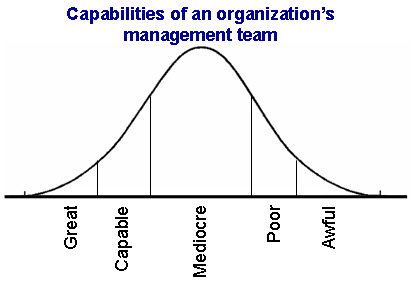
The research behind this article suggests most organizations have a group of managers of different levels of competency:

  • a few great managers
  • some capable managers
  • most are mediocre
  • poor managers
  • some awful managers

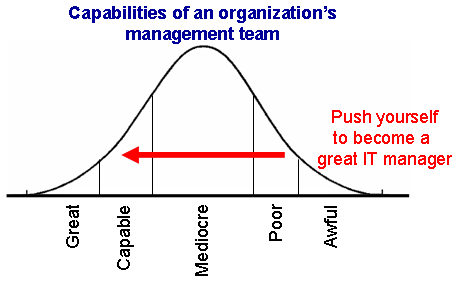
It’s a classic bell curve as you might expect.

Authors Linda A. Hill and Kent Lineback suggest that the primary reason the vast majority of managers becomes “stuck” at levels below GREAT is because they stop working on themselves.

I have to agree with their conclusions because I have seen the same thing in my career in working with thousands of managers. But, I think there is more to the issue:

  • In an IT manager’s case, we often do not know how to develop our management skills
  • In addition, most companies do not have anyone in the company who knows how to develop an IT manager’s management skills
  • If you look for training for an IT manager, good luck in finding something practical that works in a true operational management situation

Let me comment on this final point. In every IT Manager Institute program I deliver, I continue to hear managers say they have been looking for help but could not find anything until they stumbled upon my information.

It’s a big reason I devoted my life to developing practical tools and training to help IT managers achieve more success ten years ago.

How can a manager become “Good” or “Great”?

First of all, your objective should be to become a GREAT manager. The authors of the HBR article suggest you need to ask yourself, “How good am I?” or “Do I need to be better?”

Take a look at the bell curve above. Where would you place yourself? Most would rate themselves a bit better than their actual performance would indicate.

A better question, “Where would your clients (senior managers and Department managers of your company) rate your performance as a manager?”

The good news is that there is a path to becoming a GREAT IT manager. It’s available to you if you choose to invest in yourself, , , and investing in yourself and your career is something we should all be doing for our entire career. For example, I try to invest in at least two training programs a year that will help me become a better small business owner.

CLICK HERE to read the rest of the HBR article, , , it is well worth your time.

Model #63 – Escalation

One of the models in my IT Management Models book is about escalating critical support issues.

Description:
Escalation steps should take place automatically for certain circumstances. Develop processes and teach your IT staff how and when issues should be escalated and to whom the escalation needs to go.

Every type of business has circumstances that justify escalation to higher level managers. Establish your IT escalation procedures to protect the business and to help your team be successful.

There are times when issues need to be escalated to more experienced people in your organization. Sometimes, the information may need to be escalated to senior management outside of your organization. It is important to establish clear escalation procedures in your organization so critical business issues get the proper amount of attention at the earliest possible moment.

Escalating when appropriate should be automatic and simply part of the process of supporting the technology.

Define escalation procedures: What, when, and to whom – When defining the escalation procedures you need in your IT operation, you must be specific as to what requires an escalation act. Define clearly to whom the escalated message should go to or what does one do in the escalation procedure. You also should define when an issue gets escalated. In my IT operations, I will set up escalation procedures for all types of business situations when I believe it will improve our support operation. In a few cases, I want to be notified immediately so I can be sure we are looking at the problem with a management perspective as well as a technical one.

Build escalation procedures that help your team succeed – Escalation procedures can help your team be more successful because they position the team to be more responsive to problem issues that can occur. Getting stronger skills on a “down system” issue quickly in order to minimize the downtime you might incur is a positive thing for all involved.

Escalation procedures protect the business – Protecting the business is our job when it comes to managing technology. Responding quickly and if necessary with an “all hands on deck” response to a critical issue is appropriate when we are talking about mitigating business continuity risk.

Coach your team so they are “automatic”
– You want your escalation procedures to take place automatically. Coach employees, inspect the process with simulated drills, and do what is necessary to get them handling escalation steps automatically; you will be glad you did when they have to escalate an issue.

Click here to learn more about IT Management Models.

Dress for success

One of the things that helped me early in my career was advice and a gift from my manager at a small company. He simply gave me a book titled, Dress for Success by John T. Molloy and suggested I read it.

I had just come from IBM so it wasn’t like I didn’t know how to wear a nice suit in those days. I actually had some very nice suits, lots of white shirts (obviously), and some really great ties. I like nice ties, , , but my wife says I tend to buy ties that look the same all the time. I don’t really agree but I guess many of them do have a similar “power look” with some red in the tie. Oh well.

The point this CEO was making in giving me the book was that you need to be conscious of how you look in your professional life. To get ahead, senior management needs to see you as professional, polished, a good example and role model, , , especially when you are managing and leading other people. How you dress has some things to do with all of that.

It’s a misconception that IBM required you to wear a white shirt and pin-stripe suit. Not true, at least not so when I was with IBM in the late 70’s and early 80’s. However, most of us wore white shirts and conservative suits because it did not create any issues with our customers, , , it was just a cultural thing that “this is what we wear to work”. Pink, yellow, even blue shirts at the time were considered to cause some level of discussion so we avoided all of this by wearing a white shirt and conservative suit. No issue to get in our way of working with our client.

Today, dress is far more relaxed, , , and I love it. Many companies, even IBM has gone to “business casual” versus requiring you to wear a suit and tie. On the flip side, some companies are now going back to the suit and tie because they feel it makes their staff more professional and possibly the relaxed dress code has made the work a bit too relaxed, , , or they have lost some productivity.

Personally, I like the business casual code – nice trousers and a nice shirt (dress shirt or a polo golf shirt with collar), and a nice pair of shoes.

The challenge is that some of your employees are not as professional as they might need to be. If you want to maintain a professional atmosphere, especially important if your staff meets with clients, it is important that you set a positive example and reinforce appropriate dress in your company.

Senior management looks at you and inspects you every day:

  • How you dress
  • Are your shoes polished
  • Is your haircut nice and neat
  • How you handle yourself in meetings
  • What does your staff look like
  • etc., etc., etc.

Believe me, , , your senior management team is sizing you up a lot to determine if you are material for a bigger role at some point. Your image and how you present yourself day to day is an important part of their inventory of your work, , , not just the results you attain, , ,  so don’t limit yourself by being slack when it comes to putting yourself together in the morning.

Take advantage of the opportunity “dressing for success” gives you, , , we all need every advantage we can get to reach our full potential.

The book I mentioned, Dress for Success, has been written and revised many times, , , it continues to be a big seller. There is also a book for women, , , both can be found on Amazon.com.

One final comment. Many companies go with “casual day” on Fridays or the end of the work week where you can wear blue jeans and tennis shoes. I like these days too, but be sure you wear nice jeans and nice shoes, not raggedy jeans or dirty tennis shoes.

Even though it’s “casual Friday”, you are setting the tone with your staff and if you wear grubby jeans and shoes, , , they will take it a lot farther and before you know it the company needs to back off of their casual dress days because it doesn’t reflect a professional image with clients and one another.

Obviously, companies are different. Small start-up companies are often much more relaxed than larger financial institutions. Regardless of how lax your company is, I would recommend you always do your best to present a professional image, , , it is to your benefit in the long run.

Be careful when cutting IT expenses you don’t cut “muscle”

The big movement in companies for well over a year now has been to cut expenses and reduce the cost of operations. The IT department has not been immune to this push from the top of companies nor should it be.

When revenues decline, stockholders still expect the companies they invest in to operate profitably and to keep the stock price up. What this means is that we have to find cost savings.

I’m a strong proponent of managing company expenses in line with revenues. I’m also a supporter of understanding the IT expense as a percent of company revenue and using it as a measurement guideline.

The problem comes into play when cost cutting initiatives cut into “muscle” as opposed to eliminating “fat”.  There are critical resource requirements to provide basic levels of technology support. In normal cases, a few areas need to have some amount of backup or depth in case a key member of the team leaves for some reason.

When you begin any cost cutting initiative, you should take a very close look at the support needs of the company and how you are organized to provide that support. Identify critical support requirements that must be in place to support core competencies of the company, i.e. the IT “muscle” that’s required.

You want to try to eliminate these key resources and expenses related to the support they provide from your list of potential cost cuts. By identifying the true “muscle” of your IT organization, you help ensure that the primary business support need will be taken care of. Be objective with this exercise and validate with senior management.

If you have “star” staff members in areas that are being looked at to be eliminated, consider shifting them to your core competency support areas, , , but when you do, you may still have to cut staff somewhere in the organization. The point is that the team you want to end up with should be the very best of the staff you have today and when you have to eliminate staff, you owe it to your team and the company to lose the weakest of the bunch.

You must stay objective when doing this – it is a tough assignment.

Always try to find business opportunities that allow you to make IT investments that will save the company much more than what will be saved by cutting IT expense. Most companies have these opportunities but if you wait until the “cost cutting” message comes down, it is too late.

One of your best assets is a track record of success and one that shows you constantly focus on things that provide business value to your company. The more you work in IT the more you will discover that the biggest cost saving opportunities are things you can do to help other departments in the company, , , not usually what you can save in IT. Don’t rule out technology cost savings, , , just be aware there may be bigger fish elsewhere in your company.