Tag Archives: it manager

Why I became a believer in IT work behavior tendencies

Have you ever had two employees who didn’t get along?

Do you wonder why some people can’t seem to do certain types of work?

Do you wonder why you struggle in communicating with your clients and employees?

Are you aware technology attracts a certain type of personality and 90% in your organization have three of the four traits in that personality type. That’s right – 90%!!

There are very specific reasons in what makes an IT employee “tick”. It doesn’t matter if you are the CIO, a Programmer, or a Desktop Technician, , , if you are part of an IT organization there is a high probability your work behavior tendencies are similar to all of us.

Every IT manager needs to understand the dynamics of IT employee work behavior!

Our personality traits help us as technicians but hinder us as IT managers!
I didn’t know much about all of this until 1990 when I joined a new company as their CIO. This company used tools to measure the work behavior tendencies of its employees.

At first, I didn’t believe in any of this “hocus pocus”, , , it was a bit far-fetched for me.

Then, three things happened that locked me into the value of this forever.

First, I shared my work behavior profile summary with my wife of 20 years at the time, , , someone who knows me better than I know myself. I asked her to read the profile and tell me who she thought it described of the people we know. Her answer, “It is you, Mike.”

My response was to point out phrases in the summary and told her that I wasn’t like that.

Her response was quick, “Yes you are, , , you just don’t admit it.”

I still had a lot of doubts about all of this.

Second, I went to a class to learn about using the tools as a manager a week later. At the class the Instructor had us take the 10-minute survey again and taught us how to grade it. My results were very different from when I took the survey during my interview. In fact, two of the four measurements were almost opposite of what they were before.

Not only that, the Instructor showed an example of what my results looked like and made the comment, “If you have a manager with these indicators, , , he needs serious help.”

This caused me a lot of concern, , , I’m a manager who needs lots of help?

I pulled the Instructor aside during the break and asked him about what was going on with me. “Why has my profile changed so much and help me understand what you mean by giving this person help?”

His answer, “Aren’t you the new guy at Medaphis?”

My response, “Yes, but what does that have to do with this?”

He posed another question, “Do you have everything figured out about what you and your team need to work on?”

My answer, “No, not at all, , , I’ve been there a week so I’m still trying to learn the names of people and what the issues are, , , I’m several weeks away from this.”

You see, I was a little disappointed I had to attend a 3-day class when I knew I needed to be in heavy assessment mode to get to where he was asking me about.

Then he gave me information that clicked. He said, “This is exactly what your profile says. When you interviewed, you were in another company and had been managing several years there, , , you knew what the issues were and what your team needed to do to be successful. It’s what your interview profile pointed out.” He had already seen my interview profile.

He added, “Today’s profile reflects you being in a new company and you don’t yet know who all the players are, let alone the issues and what you need to work on. What it says to me is that you are telling yourself to slow down until you get more information, , , it says you are communicating much more than you normally would probably because you are meeting so many new people and discovering what the issues are. It also says you are depending more on others right now than you normally would, , , all of this is normal in a new management job and in a new company.”

His last comment was big, “Once you know what the issues are and what you and your team needs to focus on, this profile will snap back to what it was when you took the survey in your interview.”

He was right, , , even the managers who worked for me at the time can tell you when my work behavior “snapped back” to my normal management approach. Once I knew what the IT support issues were and understood my organization’s capabilities, , , we started pushing forward as opposed to treading water while I was in assessment mode.

This opened my eyes and I began to think there might be something to it.

Third, and this was a clincher that happened about a year later. I had two managers who reported to me who could not seem to get along. I had worked with both of them in a previous company and knew they were both strong managers. They should have been doing amazing work together but they were fighting one another.

I couldn’t figure out why these two managers could not get along so I called the Instructor of the training program I attended for his help.

I provided the profiles of each manager and explained the situation. Without hesitation he said, “The reason is very obvious, , , it is right here on their profiles”.

Well, it certainly wasn’t to me but he was right on the mark in what he told me. I sat down with the two managers and explained the dynamics of what was going on and it resolved their differences once and for all. They were amazing managers and worked very well together and were supportive of one another after our discussion.

Startling similarities
I’ve studied and measured IT employee work behavior over ten years and discovered startling similarities in almost everyone who works in IT.

In fact it is so predictable that if you put me in a room of 20 IT managers or 20 programmers, I can confidently tell you what the profile make-up will be of the group, , , even before talking with anyone or determining each person’s work behavior profile.

More validation occurred in my IT Manager Institute
I was able to measure the work behavior tendencies of over 200 IT managers from all parts of the world. Every class had exactly the same make-up with 90% the same in three of the four measurement categories, , , exactly the same results I saw as a CIO for the 8 years I used similar tools.

Initially, I thought it was an anomaly, , , I concluded over time that certain personality types are drawn to work with technology. These employees become IT managers, , , and this is where the challenge presents itself.

What helps us succeed as technicians actually hinders our success as managers. 

The point and benefits
Every IT manager needs to understand IT employee work behavior, , , it is the underlying reason why people do things the way they do, , , and IT employees have very similar traits.

Knowing what makes your people and yourself “tick” is important because it helps you  several ways:

  • understand why things happen
  • resolving employee conflicts
  • assigning responsibilities that aligns with an employee’s work behavior tendencies
  • understand why some things are difficult and others are easy for you

I developed a 4-part series of articles for my ITLever Blog that explains this.

Two ways to learn more about IT employee work behavior
1)  Online training session, , , an excerpt from my IT Manager Institute Self Study.  Learn why the two managers were fighting and what I did to resolve the conflict.

http://itmanagement.articulate-online.com/2015518424


2)  4-part article series

Part 1    IT Employee Work Behavior

https://itlever.com/2011/06/06/it-employee-work-behavior-part-1-of-4/

Part 2    Who we are

https://itlever.com/2011/06/07/it-employee-work-behavior-part-2-of-4/

Part 3    Challenges in who we are

https://itlever.com/2011/06/07/it-employee-work-behavior-part-3-of-4/

Part 4    70% in IT have authoritative management style

https://itlever.com/2011/06/08/it-employee-work-behavior-part-4-of-4/

I hope you watch the 30-minute video and read the articles, , ,  this information will probably be an eye-opener for you just as it was for me.

Understanding work behavior tendencies of your people and yourself gives you an edge in managing better and will help you achieve more success.

Best of success!

An IT manager must be a teacher

Let me share a personal story that goes far back into the dark  ages of time, , , the mid-1980’s.

I was with a company and we reorganized the company to place more focus on our clients. In this reorganization I was assigned the IT support manager position to support 25 hospital clients using software applications our company developed.

I inherited 25 or so IT employees, , , mostly programmers with a few Business Analysts, Help Desk and Infrastructure people. Most of my new staff had 3-5 years experience in supporting these clients. It was a young group but very smart and high energy, , , one of the best IT organizations I’ve worked with.

They knew the software application inside out, , , knew a lot about client service, , , and were very conscientious about doing a good job for our clients.

Experienced, smart, and conscientious, , , seems like we would have been very successful without the new manager (me) having to do very much.

WRONG!!

What the team was missing was processes and insight about what it actually takes to take care of your client. I would learn the hard way over the first few months that I would need to teach them some of the basics in:

  • Troubleshooting problems
  • Follow-up
  • Communication, , , especially listening
  • “The client is always right”

Let’s take just the first one, , , troubleshooting.
We had a very large client who had apparently always had problems, , , people from this large hospital were difficult to deal with, demanding, and could even be rude.

If you step back for just a moment and think about these things, there is usually a reason why people act this way. In this case, it stemmed from a recurring problem the client had every month end. It was a real problem for them and my staff either discounted the issue or did not fully understand the problem, , , so the same issue came up every month.

After getting hit with this issue myself, I decide to take a small group to the client to observe what was taking place. To resolve a problem, you have to know what the specific issues are, so that’s what we set out to do, , , troubleshoot the problem.

The issues were immediately apparent because we were there and “heard” what the client was saying, , , we experienced it with the client so we understood what was actually taking place.

Here is where it gets important:

  • We quantified the specific issues
  • Got the client’s agreement these were the issues
  • Recommended a solution
  • Gained client agreement again to support our recommendation
  • Implemented the solution

This solved our client’s issues, , , and guess what!

They became less demanding and more pleasant to work with. Interesting how this works.

The point
Even though my team had tremendous knowledge and experience and they were very intelligent people, , , they were not troubleshooting the issues with this client very well. They could not quantify the issues for me when I asked about the problems the first time I received a phone call from our “unhappy client”.

It was a great teaching opportunity that helped the team develop into a more capable organization.

Inspect and be sure your people know how to troubleshoot a client issue.

Should your CIO be technical?

This is a long-standing debate in the IT world, , , should a CIO be technical or not?

I’ll give you my perspective having managed IT organizations at a CIO level for more than 20 years.

The answer you will get from me is “No, , , definitely not.”

Before you get mad and leave, let me explain.

I was technical early in my career and when I got an opportunity to manager I tried to continue doing some of the things that helped me achieve success as a technician. I tried to do much of the technical work.

The problem was that I was doing more of the work than I should have been doing and not requiring the work to be done by my IT staff. I was having a tremendous challenge in transitioning from technical expert to manager.

Let me describe it slightly different, , , difficulty in becoming a business manager.

In reality, I was stealing from my employees but didn’t realize it. I was still trying to be the hero like a technical expert tries to do in an IT organization by showing my boss “what I can do”.

I learned a hard but valuable lesson from this first CEO I worked for as an IT manager. He told me, “Mike it’s no longer important what you can do, , , but what you can get accomplished through your team. You can’t do it all and certainly can’t get enough accomplished yourself.”

This lesson was ingrained in my head and I’ve never forgotten it.

He wasn’t telling me I shouldn’t be technical but he was suggesting I needed to delegate and depend upon my IT staff much more.

It’s great to have a technical perspective, but a manager should spend time learning about management processes, strategic planning, how to communicate effectively, and how to coach and motivate IT employees, etc. These are the things that will make you successful as an IT manager, not being the technical doer.

Your success will be based upon what your team gets accomplished for the company.  The more you can organize and focus your team to do what’s needed by your company the more successful you will be, , , it’s about your organization becoming successful, not you.

As an IT manager or CIO, you now have a full-time job learning about the business issues and needs of each of the departments in your company and then developing IT support strategies and plans to address these needs.

Management is a full-time job, , , and IT management is more than a full-time job. There is much to learn and considerable amount to do, , , every day.

My recommendation is that you must leave your technical skills behind and accelerate your learning in areas of:

  • communication
  • strategy
  • negotiation
  • business understanding
  • budgeting
  • project management
  • employee development and motivation
  • planning skills
  • presentation skills

Most CIO’s come from technology backgrounds just like I did, but I have seen a few very effective CIO’s that had no technical background at all. What they did have was excellent management skills and understanding of what a manager role was all about, , , defining appropriate goals and objectives for your team and then organizing and focusing the team to achieve them.

Best of success in your transition from technical expert to business manager.

Manage by walking around

Hopefully, you get out of your office and visit your employees in their work areas. They need to see you somewhere other than in your office.

You may not be aware but this is difficult for many IT managers. The reason is because 70% of us are shy and more introverted, , , socializing is not what we are very good at, unless it’s with our buddies, , , our immediate network.

Walking around can do a lot for you. It gives you an opportunity to talk with your employees in an informal way, , , a good thing. It also allows you to observe what’s going on, , , you can tell if people are focused or if they are idle and doing a lot of non-work activities. It also gives you an opportunity to ask about the status of important work certain people are working on.

Walk up on two people who are talking with one another and they get very quiet upon seeing you come down the hallway could mean there is something going on. There may not be anything to it but if employees consistently get quiet when you are around a couple of things may be taking place:

  • They aren’t comfortable with you
  • They are discussing things they don’t want you to hear
  • They are complaining to one another

This might not be the case but if conversations consistently end upon me walking into the room, I’m going to do some digging to see if we have a morale problem or if something’s going on that I might need to know about.

I can tell you that walking around the office and socializing with my employees is difficult for me, so I have to force myself to do it, , , and the only reason I do is because I understand the value in doing it.

My point, , , you have to overcome your weaknesses and do things that will force you to do what you need to do. Otherwise, it won’t happen and you will miss out on the positive results you get from doing them.

My most valuable lesson learned in the US Marine Corps

I was enlisted in the US Marine Corps for four years many, many years ago. It was my first experience in having an IT management responsibility.

First, I was the 3rd shift supervisor as an E4 Corporal in a small Data Processing platoon of some 20 Marines at Kaneohe Marine Base in Hawaii (someone had to do it 🙂 ). I became a 1st shift supervisor when I was promoted to Sergeant. In my last year, I transferred to Camp Lejeune in North Carolina where I became the Operations Chief of a slightly larger organization.

As Operations Chief, I had day-to-day operations management responsibility for the entire platoon, , , three shifts of some 30 Marines working in an IT Data Center.

The interesting thing about this is that the position they gave me responsibility for was an E8 level position, , , I was still a Sergeant E5 level, , , three levels below the rank that normally occupied this responsibility.

The experience was great, especially so early in my career. Some of the lessons learned were even better because one in particular helped mold my management approach that would help me immensely in later years.

The best lesson I learned
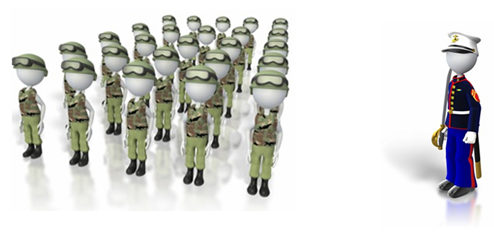
In the Marine Corps, you can give an order to your troops and they have to carry out the order. There is no such thing as, “I don’t feel like it.” or “I don’t think that’s a good idea.” If a senior Marine orders something to be done, we do it or face the consequences, , , and that could mean possible jail time.

Discipline is straightforward and simple, , , you obey orders.

Well, I learned this aspect very quickly, , , but the most valuable lesson I learned was that if you want your men to do a quality job and with enthusiasm, , , then you must explain why we are doing this, what’s in it for them, and what the benefit will be in doing this task. In other words, you need to persuade a bit and not just give orders. This is especially true with IT people.

I literally began changing my management style from an authoritative manager to a persuasive manager without realizing it. I made this change because I somehow understood the results were better when I discussed the reasons and explained why we needed to do certain things with my staff. Twenty years later, this work behavior dynamic is what helped me land the CIO role in one of the fastest growing companies in the US at that time.

I didn’t know or understand anything about employee work behavior tendencies until 20 years later. I’m convinced I began changing my normal personality from authoritative to persuasive in the Marine Corps, , , even though I never realized it was happening until many years later.

A challenge we have is that IT managers in large part are authoritative managers, , , it’s my natural profile as well.  We are more comfortable giving orders. But to truly succeed, we need to empower our employees so they want to do these jobs, , , otherwise they resist.

When employees are empowered, understand the reasons for the work, and feel like it will benefit them, , , maybe even have some fun with it, , , they do a much better job. And that’s what we want, , , quality work and results.

My Marine Corps experience was great but the most valuable experience was starting to learn how to motivate and lead people.

Why playing in the US Open is like managing an IT organization

The US Open golf tournament started today at Congressional Country Club in Washington, D.C. I’ll spend the next four days glued to the TV with my son, Eddie. Major golf tournaments are some of the best father-son times we have and the US Open is at the top.

In 1992 Eddie, Dorine, and I flew to California to attend the US Open held at Pebble Beach that year. It was six months before Eddie’s auto accident which changed all of our lives forever, , , but one thing has not changed, , , the fun we get in watching US Open golf together. It is one of the best Father’s Day gifts I receive every year.

The title of this post is, Why playing in the US Open is like managing an IT organization. You might think this parallel to be a bit strange, but if you read on you will understand why I think there are similarities.

First of all, , , I played competitive golf in high school, college, and in the Marine Corps, , , plus many tournaments since then. Lots of golf tournaments.

I was also a CIO and IT manager for over 20 years, , , and I have seen similar types of things occur in tournament golfer and CIO.

Here are a few things that will unfold at the US Open this week that are similar to what takes place with CIO’s.

    • 156 players will start the 4-day tournament. After 2 days, the tournament cuts the field to the top 60 players and ties or anyone within 10 strokes of the lead. IT parallel – CIO’s get cut from their companies if they do not perform, , , it is one of the highest turnover executive positions in a company. 
    • Prior to the tournament, players practice and determine how to play each hole the best depending upon where the tees and pins are placed. IT parallel – A CIO of a new company conducts an IT assessment to determine what his team should work on.
    • Professional golfers develop a tournament strategy for the conditions and difficulties of the course. IT parallel – CIO’s develop an IT strategy to attack the business needs and issues of the company.
    • Conditions change, , , weather, pin placements, who you play with, playing conditions of the course. IT parallel – A CIO’s environment changes almost daily as business needs and issues change, , , people come and go, , , and technology changes.
    • Players will have to persevere through a difficult stretch of holes, , , how they respond can decide a winner or loser of the tournament. IT parallel – Every day will not be a great day as a CIO, , , how you deal with adversity determines how successful you will be.
    • Unexpected events happen, , , an errant tee shot can disrupt a great round unexpectedly. IT parallel – A lightning storm, flood, hurricane or unexpected event can turn your IT world upside down in a moment. You have to have contingency plans to weather the storm.

    It will be interesting to watch the ebb and flow of play in this week’s US Open at Congressional. Just watching the morning play you can tell it is going to be a tough test. It’s the same for a CIO, , , no one said it would be easy but with the right tools, preparation and a positive mental attitude your chances are much better in both professions.

IT employee work behavior – video excerpt from the IT Manager Institute

IT managers need to understand the work behavior tendencies of IT employees? As you have seen in my 4-part post, , , IT employees are amazingly similar in how they approach their work.

Learn more by viewing the online training session below!

I can assure you this information will be an eye opener and it’s something all IT managers need to have an appreciation for. It will give you insight about yourself as well as most of your IT employees.

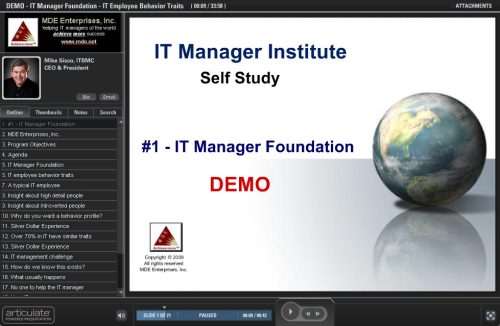
Click image to view excerpt on IT Employee Work Behavior

The sample training module is part of Session 1 – IT Manager Foundation from my IT Manager Institute Self Study. It is 33 minutes long and worth your time to watch.

CLICK HERE to view the training module.

IT employee work behavior – part 4 of 4

70% in IT have authoritative management style

I summarized the work behavior approach for the vast majority of us in IT in the last post and said I would tell you more in Part-4. Here is the summary for you once again:

Work behavior traits for groups A, C, and D are 90%, , , that’s essentially everyone in IT. Remember, it is managers, DBA’s, Desktop technicians, , , anyone in the IT organization from what I have seen with my research.

Group B is the shy and introverted group of traits. 70% of us don’t want to discuss the issue, , , we just want you to “do your job.

This profile is an authoritative manager profile:

  • Do it
  • Do it now
  • Do it my way
  • No discussion

Roughly 7 out of 10 employees in your IT organization are “wired” this way. They have authoritative management styles in their approach to work.

I’m “wired” this way, , , you are very likely “wired” this way. Roughly 7 out of 10 people in your organization are “wired” this way.

This is not necessarily a problem, but it certainly can be as you might expect. Here are a couple of reasons why:

  • People are resistant to change. If you do not explain it and convince them of some benefit to them, , , they quite often resist.
  • Clients do not like having things forced upon them.
  • Independent people (like 90% of us in IT are) do not like to do things “your way”, , , we prefer to do it “our way”.

Make one subtle change and you change your approach from “authoritative” to “persuasive”. Modify the part where you do not want to discuss the issue by explaining the reason for things and the benefits in doing things, , , and you become a persuasive manager versus an authoritative manager.

This is a big deal and is a much more effective management approach in most situations.

Let me explain the difference. In a military combat situation, , , you want split second decisions to be made and you want the troops to follow the commanding officer’s direction without flinching. In this situation, authoritative management styles work very effectively and are actually what you prefer to have.

However, in a professional setting like your IT organization, persuasive managers are much more effective and have a stronger following with team members.

One slight tweak makes you a much more effective IT manager.

But don’t get me wrong, , , changing your communication approach at work will not be easy. Remember, your “DNA” is telling you that you probably aren’t a very good communicator and you don’t like to communicate with people outside your immediate network.

In my personal situation, I intuitively made the change from authoritative to persuasive before I ever understood anything about work behavior. I believe I must have learned when I was in the US Marine Corps that you get a much better result from IT people when you explain things rather than simply give them orders.

Now, in the Marine Corps you can just give an order and can expect your men to carry out the order. If they don’t they can go to jail, , , it’s a pretty simple deal.

But, if you want the best results, , , your men need to understand why we are doing things and what’s in it for them, , , the benefit to them. Even things like going on a 3-mile run is something they need to understand, , , otherwise, they kick and moan about it and it’s not as good a result as you would like.

I saw this dynamic work in my early years of management so over time my approach at work became more persuasive than authoritative, , , I modified my work behavior by communicating more and the results got better.

Let me repeat, , , I actually modified my personality at work from a manager who tends to naturally want to just give orders and expect you to do the work and not ask questions to a manager who explains why we need to do these things.

Changing your behavior at work does not change your basic personality. In reality, , , I’m still deep down that authoritative manager and would prefer to have no discussions, , , but I have learned that I get a much better result when we explain and convince the team why we need to do something and the benefits we will receive. So, , , I have the discussions. It takes time and energy but it’s worth the effort.

At work, people see me as a more social and outgoing person than who I really am, , , I change my personality at work to do what is necessary to do a better job.

Other things happen at work as well, , , I force myself to communicate. I force communication events with employees, clients, senior managers, , , even vendors. It’s not something I inherently like to do but I know stronger communication is necessary to get the job done, , , so once again, I modify my personality at work and force myself to communicate with others.

This is why understanding the dynamics of work behavior can be so helpful in contributing to your success.

You have to learn who you are and identify if your approach to work will be effective. If you are lost in the detail, , , you have to find a way to “get out of the technology weeds” and depend more upon your people. If you aren’t communicating effectively, , , put processes in place that force you to start communicating more with staff and clients.

You can modify your work behavior approach and for many IT managers, you will need to if you want to be successful.

How do you learn “who you are”?
There are three tools I am familiar with and all three are effective tools in discovering what makes you tick:

  1. Personalysis
  2. Myers Briggs
  3. Predictive Index (PI)

If you follow my work in the ITLever Blog, read my books, or attend one of my classes, , , you will discover that I define what you need to do to be successful and how to do it, , , and give you tools to help you make it happen.

It’s your job to learn who you are and whether you have to modify your approach to do these things.

What you will also discover is that many of the processes and tools I use are specifically designed to overcome some of the work behavior tendencies that can cause an IT manager problems.

For example, let’s take the “lower desire to communicate issue” inherent in an introverted and shy person. I know I’m one of these people so two of the communication processes I initiate in a company is to hold monthly IT staff meetings and monthly client status meetings. We schedule them and it forces me to prepare for the meetings and to communicate with clients and employees, , , otherwise, I probably will not get around to it.

Learn about the dynamics of your personality and work behavior tendencies. It will help you become a better manager. Take it a step further and learn about your individual staff’s tendencies, , , it will help you manage and lead them more effectively.

Learn more by viewing an online training module taken from the IT Manager Institute Self Study program, , , go to my next post.

IT employee work behavior – part 3 of 4

Part 3  –  Challenges in who we are

Let’s review our last two posts. In Part-1, I asked you to identify the traits of what you would want to have in an IT manager. You could do the same exercise for any IT position.

In Part-2, I identified the traits that characterize most IT employees, , , whether they are managers, programmers, work on the Help Desk, or are heavy technical system administrators. If you are in IT, my research of more than ten years with thousands of employees and hundreds of IT managers from all over the world identifies these key work behavior traits in IT employees:

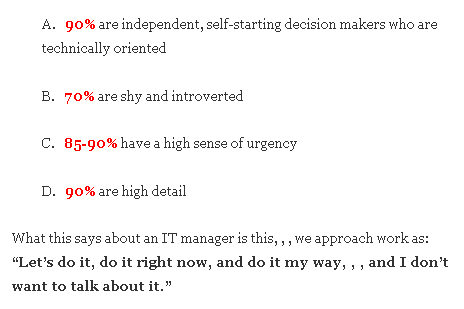
A.   90% are independent, self-starting decision makers who are technically oriented

B.   70% are shy and introverted

C.   85-90% have a high sense of urgency

D.   90% are high detail

What this says about an IT manager is this, , , we approach work as:
“Let’s do it, do it right now, and do it my way, , , and I don’t want to talk about it.” 

More on this in Part-4.

For now, let’s talk about what it means to have the attributes that so many of us in IT have. There are some good things and there are some challenges. We should take advantage of the positives and work on the challenges to be as successful as we can possibly be.

Before I start, let me emphasize something. There is nothing wrong with what anyone’s personality traits or work behavior tendencies are. What’s important to understand is that some of these tendencies can hinder your success. Knowing what they are and learning how to adjust to offset them will help you be much more successful.

What it means to be independent
Being independent works well as a programmer, , , your success is often based upon what you personally can accomplish. Being independent in an IT manager role is not a bad thing, but it causes us a real challenge. Depending upon others to do things to achieve success is tough, , , especially when your past experience has been pretty much based upon what you can do yourself.

Managers depend upon their employees to succeed at virtually anything. It’s a tough transition to go from the technical hero many of us were to the manager who is now dependent upon others to get things done.

Independent, self starters who are goal oriented like being the hero. As the manager, your job is to make your employees the hero, , , much easier said than done.

What it means to be introverted
Nothing wrong with being shy and introverted. As a Systems Administrator or programmer, you can focus on the technology and not worry about having to communicate a lot. In an IT manager role, effective communication is absolutely essential for success.

The challenge we have as IT managers who are more introverted, , , (I’m a perfect example of this), , , is that we typically don’t develop our communication skills unless someone has invested in this for us. This was my case, , , it’s not an area I would have developed but my senior managers fortunately knew the importance of communication and invested in developing my communication skills.

The second challenging part of being shy and  introverted is that our desire to communicate is lower. Our attitude is simply, “Why bother?”

Introverted managers (over 70% of IT managers are introverted) have to create processes that will force them to communicate. Otherwise, they just won’t get around to it.

What it means to have a high sense of urgency
85-90% of us in IT have a high sense of urgency. This means we don’t like to work on repetitive things. We would make terrible assembly line factory workers.

People with high sense of urgency are impatient and not so tolerant of others who might be slower or who make mistakes. This can cause internal conflicts.

Having a high sense of urgency is a good thing for an IT manager, but “in the storm”, you have to become a calming effect, , , not someone who is viewed as pouring gasoline on the fire.

What it means to be high detail
This is one of the tougher issues for IT managers. As technicians, we pride ourselves for knowing the technology inside and out and being able to control the technology. It takes precision and knowledge to do this, , , requires high detail focus so we excel in it.

As managers, we can no longer work at this level of detail. What’s important now is what we can get accomplished through our people, , , not what we can do ourselves.

Letting go of the detail and being able to work at a higher level is one big challenge, , , VERY BIG.

Transitioning from technical expert to business manager is one of the toughest challenges you will face. Far too many don’t succeed in it. This high detail issue is one to become very aware of and to realize how much of an obstacle it can be in becoming a successful IT manager.

IT employee work behavior – part 1 of 4

The vast majority of IT employees have similar work behavior tendencies, , , or personality traits.  So similar it is scary.

We are all unique, but the way we approach work is remarkably similar.

Why is this important?
Because your work behavior tendencies can help or hinder your success. Understand them and adapt where needed and your success will be much greater. And remember, , , this applies to anyone and everyone in your IT organization.

Let me give you an example. If I were to walk into a room of 100 IT people made up of managers, programmers, BA’s, desktop technicians, Help Desk, etc. , , , I already know what the personality make-up of the group will be before getting to know any of them.

I’m so confident, I would bet you a lot of money I could define the work behavior traits of the group.  I’ve seen this repeated time after time.

How do I know?

I’ve observed and researched this issue for over ten years. Initially, I thought the consistency I was seeing was just an anomaly. Later, I understood that there is a certain personality type that’s drawn to work in the IT field. You will see a similar consistency in personality traits with sales people.

It doesn’t matter what position you are looking at in IT, , , years of experience won’t change it, , , doesn’t matter if you are in a large or a very small company, , , and it won’t be any different if you are in South Africa, China or the US. I’ve measured these results in all types of situations and in all parts of the world, , ,  if you are in an IT organization, there is a high probability your work behavior tendencies are going to be like most of us.

I use the terms “work behavior” and “personality traits” to mean the same thing.

In this 4-part post, I want to share things about the work behavior tendencies that exist in the majority of your IT staff. Being aware of this can help you understand why things happen, , , or do not happen.

It can help you realize why certain types of things are such a challenge for some of your people.

Understand this dynamic of “what makes us tick” well enough and you can even use the information to resolve employee conflicts. I know because I’ve seen it up close.

IT attracts a certain personality type

What I’m about to share applies to anyone in the IT organization, , , from CIO to the Desktop Technician. If you are in IT, the personality traits I’m about to share in this 4-part post applies to you.

OK, , , to start we are going to do a little exercise.
I want you to select desirable traits for an IT manager. You could work through this exercise for any position in the IT organization (IT manager, project manager, Systems Administrator, DBA, etc.).

For these purposes, I want you to focus on IT manager.

For each item, I will give you two groups of work behavior traits, , , a red group and a green group. I want you to select either the red group of traits or the green group of traits you would prefer in an IT manager.

There may be traits in both the red group and green group you would like in an IT manager, but you need to select the group of traits you would most prefer, , , it’s either “red” or “green” for each set.

Write them down to refer back to as we cover this topic in the next three posts:
Set #1  –  Red or Green?
Set #2  –  Red or Green?
Set #3  –  Red or Green?
Set #4  –  Red or Green?

Here we go:

Traits Set #1
Red
Independent
Self starter
Decision maker
Analytical mind
Creates change
Technically oriented

Green
Indecisive
Prefers to follow than lead
Unassuming
Agreeable
Lacks confidence in new areas
Willing worker

Traits Set #2
Red
Socially oriented
Warm
Friendly
Cheerful
Delegates authority
Talkative

Green
Reserved
Serious
Sincere
Thinker
Enjoys own company

Traits Set #3
Red
Relaxed
Patient
Methodical
Adjusts to repetition easily
Low sense of urgency

Green
Quick
Impatient
Fast learner
High sense of urgency
Ambitious
Drive to get things done

Traits Set #4
Red
Detail oriented
Careful
Thorough
Accurate
Conservative
Knowledgeable about the job

Green
Delegates details easily
Stubborn
Informal
Casual with details
Not obliged to conform
Lacks follow-up

Finished?

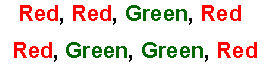
You should have four trait groups selected, , , something like “red, red, green, green”, , , or “red, green, green, red”, , , or “green, green, green, green”. Keep this handy for the next three posts.

Did you select one of the following combinations?

There is a high probability you did.


Let me give you some preliminary information about what’s to come.

In Part-2, I’ll discuss four key personality trait areas or work behavior tendencies we all have. The remarkable thing is that in three of the four areas, 90% of IT employees have the same tendencies. In the 4th area, 70% of all IT employees have a certain set of traits, , , and I’m guessing you missed this one in your exercise.

What you probably selected in this set is what is desirable in an IT manager but lacking in most IT managers unless they recognize it and do something to overcome it. I’ll explain in my next post.

In Part-3, I’ll share the challenges these groups of work behavior tendencies can give an IT manager. I’ll even share some things they do to challenge your technical staff.

In Part-4, I’ll summarize who you probably are as an IT manager and challenge you to modify a couple of your tendencies to become more successful.

If you subscribe to ITLever (it’s free), you will receive automatic email notification of new posts.  Simply select the EMAIL SUBSCRIPTION link in the right-hand column.