Monthly Archives: July 2011

An IT manager must be a teacher

Let me share a personal story that goes far back into the dark  ages of time, , , the mid-1980’s.

I was with a company and we reorganized the company to place more focus on our clients. In this reorganization I was assigned the IT support manager position to support 25 hospital clients using software applications our company developed.

I inherited 25 or so IT employees, , , mostly programmers with a few Business Analysts, Help Desk and Infrastructure people. Most of my new staff had 3-5 years experience in supporting these clients. It was a young group but very smart and high energy, , , one of the best IT organizations I’ve worked with.

They knew the software application inside out, , , knew a lot about client service, , , and were very conscientious about doing a good job for our clients.

Experienced, smart, and conscientious, , , seems like we would have been very successful without the new manager (me) having to do very much.

WRONG!!

What the team was missing was processes and insight about what it actually takes to take care of your client. I would learn the hard way over the first few months that I would need to teach them some of the basics in:

  • Troubleshooting problems
  • Follow-up
  • Communication, , , especially listening
  • “The client is always right”

Let’s take just the first one, , , troubleshooting.
We had a very large client who had apparently always had problems, , , people from this large hospital were difficult to deal with, demanding, and could even be rude.

If you step back for just a moment and think about these things, there is usually a reason why people act this way. In this case, it stemmed from a recurring problem the client had every month end. It was a real problem for them and my staff either discounted the issue or did not fully understand the problem, , , so the same issue came up every month.

After getting hit with this issue myself, I decide to take a small group to the client to observe what was taking place. To resolve a problem, you have to know what the specific issues are, so that’s what we set out to do, , , troubleshoot the problem.

The issues were immediately apparent because we were there and “heard” what the client was saying, , , we experienced it with the client so we understood what was actually taking place.

Here is where it gets important:

  • We quantified the specific issues
  • Got the client’s agreement these were the issues
  • Recommended a solution
  • Gained client agreement again to support our recommendation
  • Implemented the solution

This solved our client’s issues, , , and guess what!

They became less demanding and more pleasant to work with. Interesting how this works.

The point
Even though my team had tremendous knowledge and experience and they were very intelligent people, , , they were not troubleshooting the issues with this client very well. They could not quantify the issues for me when I asked about the problems the first time I received a phone call from our “unhappy client”.

It was a great teaching opportunity that helped the team develop into a more capable organization.

Inspect and be sure your people know how to troubleshoot a client issue.

Personal Development Scorecard

To achieve great things in your career you need to develop your skills, , , skills that help you succeed in your current position as well as any future position you want to reach for.

Use a Personal Development Scorecard to identify skills you need to develop and track the inventory of assets you acquire as you invest in your future.

Download this tool at:
www.mde.net/tools/PersonalDevelopmentScorecard.xls

Part-1 is for Manager Skills


Part-2 is for Non-IT Skills. You need both type of skills to succeed.

Use this tool to develop a training and development track for yourself and while you are at it, why not use it to develop training tracks for each of your employees.

Where does all the time go?

Do you know what you spend the bulk of your time on day to day?

It might surprise you how much of your time is simply wasted.

Time is valuable, , , you have a finite amount of it every day and what you do with your time either adds value for you and your career or it’s wasted, never to be available to you again.

Consider time to be money, , , let’s say every hour of every day is worth $100.00 each. You have two options with every hour you have in a day, , , invest it or waste it.

If you use the time to do something of value that will help you succeed in something, it’s an investment. Spend time on things that do not add value and it’s wasted.

We all start with roughly  16 productive hours a day, , , let’s assume you spend 8 hours a day for sleep and rest. We won’t call this time an investment or a waste, , , we will make sleep time neutral although in reality I think it’s an investment in keeping you healthy. You may not need 8 hours sleep, , , it’s your call.

OK, you have 16 hours or $1,600 of value  to spend. Time to determine what you are spending it on, , , to learn if you are investing or wasting your time. Here is a little exercise for you.

Download the spreadsheet below at www.mde.net/tools/ActivityLog.xls

Let’s take a closer look at the headings I put in the tool.

  • Meeting
  • Phone
  • E-mail
  • Project
  • Planning
  • Travel
  • Commute
  • Personal
  • Rest
  • Other

You can change the column headings to fit your activity as you like.

Put in the time spent on each activity for each hour of the day. I like to use 15-minute increments, , , 15 minutes = .25 hour, 30 minutes = .5 hour, etc.

At the bottom, each activity type is totaled and a grand total should tally to 24 hours. If not, you have missed something.

If you want to be more specific in your activities, add as many columns of activity you want to help you better understand where you spend your time.

Do this for 7 days, , , 14 days is even better. It takes just a few minutes each day to recap where you spend your time.

Be honest with yourself, , , if you took the afternoon off to play golf and spent 5 hours at the golf course, , , mark it personal, , , not meeting time unless you actually did spend much of the time meeting. It is highly unlikely, though.

At the end of the week, do a quick analysis to see where you are spending your time. You might be amazed at how much time is actually lost in a day, , , and especially in a week.

You may want to do this exercise with your staff. It will be an eye-opener for them and should give you lots of insight into the productivity of your team.

Remember, it is your time. Invest your time in productive things and reap the benefits, , , waste it and you miss out on what you could have accomplished.

Best of success.

Should your CIO be technical?

This is a long-standing debate in the IT world, , , should a CIO be technical or not?

I’ll give you my perspective having managed IT organizations at a CIO level for more than 20 years.

The answer you will get from me is “No, , , definitely not.”

Before you get mad and leave, let me explain.

I was technical early in my career and when I got an opportunity to manager I tried to continue doing some of the things that helped me achieve success as a technician. I tried to do much of the technical work.

The problem was that I was doing more of the work than I should have been doing and not requiring the work to be done by my IT staff. I was having a tremendous challenge in transitioning from technical expert to manager.

Let me describe it slightly different, , , difficulty in becoming a business manager.

In reality, I was stealing from my employees but didn’t realize it. I was still trying to be the hero like a technical expert tries to do in an IT organization by showing my boss “what I can do”.

I learned a hard but valuable lesson from this first CEO I worked for as an IT manager. He told me, “Mike it’s no longer important what you can do, , , but what you can get accomplished through your team. You can’t do it all and certainly can’t get enough accomplished yourself.”

This lesson was ingrained in my head and I’ve never forgotten it.

He wasn’t telling me I shouldn’t be technical but he was suggesting I needed to delegate and depend upon my IT staff much more.

It’s great to have a technical perspective, but a manager should spend time learning about management processes, strategic planning, how to communicate effectively, and how to coach and motivate IT employees, etc. These are the things that will make you successful as an IT manager, not being the technical doer.

Your success will be based upon what your team gets accomplished for the company.  The more you can organize and focus your team to do what’s needed by your company the more successful you will be, , , it’s about your organization becoming successful, not you.

As an IT manager or CIO, you now have a full-time job learning about the business issues and needs of each of the departments in your company and then developing IT support strategies and plans to address these needs.

Management is a full-time job, , , and IT management is more than a full-time job. There is much to learn and considerable amount to do, , , every day.

My recommendation is that you must leave your technical skills behind and accelerate your learning in areas of:

  • communication
  • strategy
  • negotiation
  • business understanding
  • budgeting
  • project management
  • employee development and motivation
  • planning skills
  • presentation skills

Most CIO’s come from technology backgrounds just like I did, but I have seen a few very effective CIO’s that had no technical background at all. What they did have was excellent management skills and understanding of what a manager role was all about, , , defining appropriate goals and objectives for your team and then organizing and focusing the team to achieve them.

Best of success in your transition from technical expert to business manager.

Is your head in the clouds with cloud computing?

Are you thinking about putting some of your computing services up on the cloud with an external vendor? Maybe you already have.

Just because someone else is maintaining these services and supporting you does not mean things can’t or won’t go wrong.

It is still computing services and computing services ultimately fail, , , sooner or later. The question is, “Will you be prepared?”

I just read a great Infoworld article titled, The 10 Worst Cloud Outages (and What We Can Learn From Them). Initially, I was just curious so I decided to take a look, but what I found was very interesting and worth the read.

Real case situations with lessons learned and tips that can help you be prepared.

Read the article.

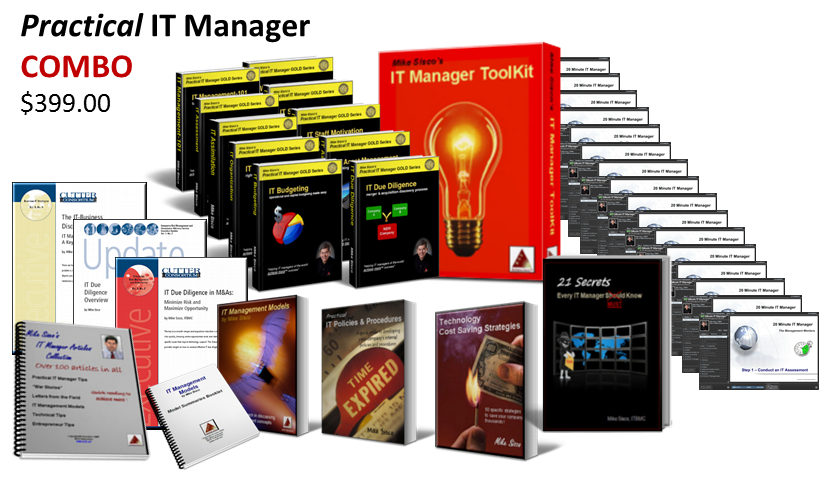
20 Minute IT Manager training library – new options

Tom Mochal and I just announced three new bundle options  for the 20 Minute IT Manager.

Build your own personal or team training library in minutes with any of the options below:

  • The Ultimate Bundle – $499.00 (162 sessions)  – BEST VALUE
  • Tom Mochal Bundle – $299.00 (80 sessions)
  • Mike Sisco Bundle – $299.00 (82 sessions)
  • IT Management Bundle – $199.00 (54 sessions)  NEW
  • Project Management Bundle – $199.00 (57 sessions)  NEW
  • Leadership, Personal Development, People Management Bundle – $199.00 – (51 sessions)  NEW
  • Single sessions – $9.99 each

HUGE SAVINGS on any of the bundled options.

Every topic is 20 minutes in length or less and great ” lunch and learn” sessions. They will be resources you will reference for years to come.

CLICK HERE to learn more and view the entire topic list.

IT strategy presentation tip

When you plan to deliver an IT strategy to senior management, pay attention to who is sitting in the room and what they want from you.

If your audience is the CEO, CFO, and COO or possibly the Board of Directors of your company, your presentation is quite different than if your senior manager is a CIO with a stronger technical background.

Let’s assume your IT strategy presentation is to the CEO and CFO, , , the top two executives in the company. There is also a difference in these two people, but the primary target is the CEO, , , the boss.

If this is the case, develop a presentation that targets your CEO’s need. Normally, a CEO wants “the answer” and not a lot of detail, , , especially not technical detail.

In most strategy presentation meetings you will have an hour, maybe two at most to present and discuss your strategy.

Think more like you have 20 to 30 minutes of actual presentation time. I can assure you an hour will go by faster than the “blink of an eye”.


An 18-24 month IT strategy probably has a dozen, maybe even up to 60 projects. You will never cover a dozen projects or more.

You need to summarize your list of projects into high level initiatives. Let’s say you have 60 projects you believe are needed to address the business needs and issues of your company.

Summarize your 60 projects by consolidating similar types of work into 6 to 8 major initiatives. For example, 10 projects may be Data Center type of work, , , if so, create an initiative called Data Center Improvements.

Maybe you have 3 technology conversion projects as a result of acquiring three companies, , , summarize these 3 projects into a high level initiative called Technology Assimilations Initiative, and show the key projects in it when you draw a time line picture.

Something like this:

You graphically show three assimilation projects (A1, A2, and A3), but you talk about the Technology Assimilations Initiative.

This saves lots of time and discusses your points at the proper level for a CEO and CFO.

Some initiatives may have dozens of projects that you discuss as a single initiative. Six to eight initiatives will be about the extent of what you will be able to cover and have ample time for questions and discussion.

I’ve seen many IT managers try to cram too much in an hour presentation and it ends up missing the mark and failing to get accomplished what was needed.

Summarize your projects into high level initiatives, plan on 20-30 minutes of real presentation time, and anticipate the questions you might get from the audience who will be in the room.

Do these things and your IT strategy meeting will go much smoother.

Ten reasons that cause IT projects to fail

Here are some things to ponder:

  • Delivering projects successfully creates credibility for an IT organization.
  • There are dozens of project management methodologies.
  • PM tools are everywhere you look.
  • Several PM certifications exist.
  • Project management training is easy to find.

Yet, project failure in the IT world is rampant, , ,  lots of press about it. So here is the question,

“With all this information and resources to help you manage projects effectively, how can we continue to have such high project failure rates?”

You would think the need for credibility alone would be enough to help us make improvements.

Here is a list of why I think IT projects have such high failure rates:

  1. IT managers may not understand how important delivering projects successfully is in establishing credibility so they don’t invest enough in PM training and methodology.
  2. Insufficient time is spent on the front end to define the specific objectives and deliverable of a project.
  3. The project lacks sufficient resource to execute the project.
  4. Not enough buffer  included in the project plan, especially when estimating how long tasks will take and how much things will cost.
  5. Scope creep, , , occurs when additional requirements are added to the project after the scope has been defined by the Project Manager and agreed to by the Project Sponsor.
  6. Insufficient commitment from the Customer, , , usually internal department managers of the company fail to invest the resources needed to complete the project successfully, , , they just want IT to get it done for them.
  7. Lack of getting buy-in from project team members in the beginning of a project that they can complete assigned tasks when they are targeted to.
  8. Lack of ongoing monitoring and managing of the project week to week.
  9. Project team members waiting to the last minute to work on tasks.
  10. Poor communication.

This last reason, , , poor communication, , , is the root cause of many of the items on the list. IT people are generally poor communicators because 70% of us are shy and introverted. This is a big reason a high percentage of IT projects fail year after year.

Invest in your team’s project management skills and keep records of your performance, , , both in success rates and the value delivered. A simple and quick way to do this is with an IT Initiatives Portfolio. Go to https://itlever.com/2010/05/11/it-initiatives-portfolio/

Awareness is one of the first things we need. Become aware of how important project management is to your team’s credibility and track record and prepare sufficiently to deliver projects successfully.

With today’s tools and training that’s readily available, there is no excuse for a poor project management track record. If you allow it to happen, it is undermining your credibility and preventing you from future opportunity.

3-day weekends

Just a quick post, , , we are about to go celebrate July 4th, , , our Independence Day and a major holiday here in the US.

Let’s see, , , I hear we are having ribs, chicken, potato salad, baked beans and key lime pie.

Can’t wait. Our July 4th meal with a few friends is always one of the special days of the year.

3-day weekends are important to have from time to time. Even though I’ve been working all weekend (got a huge project I’m working on), , , we plan to party some this afternoon and know we will have a great time.

Short holiday bursts give you relax time and help you recharge the batteries. Take advantage of them and hope you enjoyed your time off if you are in the US.

New sidewalk art

He’s at it again, , , take a look at new art I discovered. Everything is drawn with chalk on a flat surface.

Watch your step!

The baby is real

Mountain Dew saves the world 🙂

Didn’t you always wonder where Santa letters went?