IT employee work behavior – video excerpt from the IT Manager Institute

IT managers need to understand the work behavior tendencies of IT employees? As you have seen in my 4-part post, , , IT employees are amazingly similar in how they approach their work.

Learn more by viewing the online training session below!

I can assure you this information will be an eye opener and it’s something all IT managers need to have an appreciation for. It will give you insight about yourself as well as most of your IT employees.

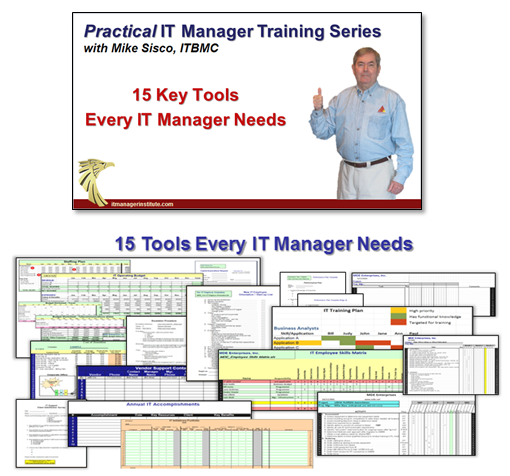
Click image to view excerpt on IT Employee Work Behavior

The sample training module is part of Session 1 – IT Manager Foundation from my IT Manager Institute Self Study. It is 33 minutes long and worth your time to watch.

CLICK HERE to view the training module.

IT employee work behavior – part 4 of 4

70% in IT have authoritative management style

I summarized the work behavior approach for the vast majority of us in IT in the last post and said I would tell you more in Part-4. Here is the summary for you once again:
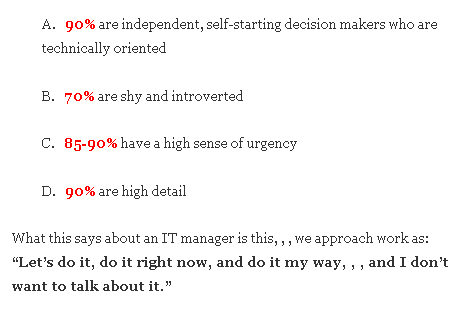
Work behavior traits for groups A, C, and D are 90%, , , that’s essentially everyone in IT. Remember, it is managers, DBA’s, Desktop technicians, , , anyone in the IT organization from what I have seen with my research.

Group B is the shy and introverted group of traits. 70% of us don’t want to discuss the issue, , , we just want you to “do your job.

This profile is an authoritative manager profile:

  • Do it
  • Do it now
  • Do it my way
  • No discussion

Roughly 7 out of 10 employees in your IT organization are “wired” this way. They have authoritative management styles in their approach to work.

I’m “wired” this way, , , you are very likely “wired” this way. Roughly 7 out of 10 people in your organization are “wired” this way.

This is not necessarily a problem, but it certainly can be as you might expect. Here are a couple of reasons why:

  • People are resistant to change. If you do not explain it and convince them of some benefit to them, , , they quite often resist.
  • Clients do not like having things forced upon them.
  • Independent people (like 90% of us in IT are) do not like to do things “your way”, , , we prefer to do it “our way”.

Make one subtle change and you change your approach from “authoritative” to “persuasive”. Modify the part where you do not want to discuss the issue by explaining the reason for things and the benefits in doing things, , , and you become a persuasive manager versus an authoritative manager.

This is a big deal and is a much more effective management approach in most situations.

Let me explain the difference. In a military combat situation, , , you want split second decisions to be made and you want the troops to follow the commanding officer’s direction without flinching. In this situation, authoritative management styles work very effectively and are actually what you prefer to have.

However, in a professional setting like your IT organization, persuasive managers are much more effective and have a stronger following with team members.

One slight tweak makes you a much more effective IT manager.

But don’t get me wrong, , , changing your communication approach at work will not be easy. Remember, your “DNA” is telling you that you probably aren’t a very good communicator and you don’t like to communicate with people outside your immediate network.

In my personal situation, I intuitively made the change from authoritative to persuasive before I ever understood anything about work behavior. I believe I must have learned when I was in the US Marine Corps that you get a much better result from IT people when you explain things rather than simply give them orders.

Now, in the Marine Corps you can just give an order and can expect your men to carry out the order. If they don’t they can go to jail, , , it’s a pretty simple deal.

But, if you want the best results, , , your men need to understand why we are doing things and what’s in it for them, , , the benefit to them. Even things like going on a 3-mile run is something they need to understand, , , otherwise, they kick and moan about it and it’s not as good a result as you would like.

I saw this dynamic work in my early years of management so over time my approach at work became more persuasive than authoritative, , , I modified my work behavior by communicating more and the results got better.

Let me repeat, , , I actually modified my personality at work from a manager who tends to naturally want to just give orders and expect you to do the work and not ask questions to a manager who explains why we need to do these things.

Changing your behavior at work does not change your basic personality. In reality, , , I’m still deep down that authoritative manager and would prefer to have no discussions, , , but I have learned that I get a much better result when we explain and convince the team why we need to do something and the benefits we will receive. So, , , I have the discussions. It takes time and energy but it’s worth the effort.

At work, people see me as a more social and outgoing person than who I really am, , , I change my personality at work to do what is necessary to do a better job.

Other things happen at work as well, , , I force myself to communicate. I force communication events with employees, clients, senior managers, , , even vendors. It’s not something I inherently like to do but I know stronger communication is necessary to get the job done, , , so once again, I modify my personality at work and force myself to communicate with others.

This is why understanding the dynamics of work behavior can be so helpful in contributing to your success.

You have to learn who you are and identify if your approach to work will be effective. If you are lost in the detail, , , you have to find a way to “get out of the technology weeds” and depend more upon your people. If you aren’t communicating effectively, , , put processes in place that force you to start communicating more with staff and clients.

You can modify your work behavior approach and for many IT managers, you will need to if you want to be successful.

How do you learn “who you are”?
There are three tools I am familiar with and all three are effective tools in discovering what makes you tick:

  1. Personalysis
  2. Myers Briggs
  3. Predictive Index (PI)

If you follow my work in the ITLever Blog, read my books, or attend one of my classes, , , you will discover that I define what you need to do to be successful and how to do it, , , and give you tools to help you make it happen.

It’s your job to learn who you are and whether you have to modify your approach to do these things.

What you will also discover is that many of the processes and tools I use are specifically designed to overcome some of the work behavior tendencies that can cause an IT manager problems.

For example, let’s take the “lower desire to communicate issue” inherent in an introverted and shy person. I know I’m one of these people so two of the communication processes I initiate in a company is to hold monthly IT staff meetings and monthly client status meetings. We schedule them and it forces me to prepare for the meetings and to communicate with clients and employees, , , otherwise, I probably will not get around to it.

Learn about the dynamics of your personality and work behavior tendencies. It will help you become a better manager. Take it a step further and learn about your individual staff’s tendencies, , , it will help you manage and lead them more effectively.

Learn more by viewing an online training module taken from the IT Manager Institute Self Study program, , , go to my next post.

IT employee work behavior – part 3 of 4

Part 3  –  Challenges in who we are

Let’s review our last two posts. In Part-1, I asked you to identify the traits of what you would want to have in an IT manager. You could do the same exercise for any IT position.

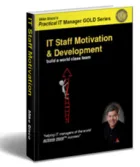
In Part-2, I identified the traits that characterize most IT employees, , , whether they are managers, programmers, work on the Help Desk, or are heavy technical system administrators. If you are in IT, my research of more than ten years with thousands of employees and hundreds of IT managers from all over the world identifies these key work behavior traits in IT employees:
A.   90% are independent, self-starting decision makers who are technically oriented

B.   70% are shy and introverted

C.   85-90% have a high sense of urgency

D.   90% are high detail

What this says about an IT manager is this, , , we approach work as:
“Let’s do it, do it right now, and do it my way, , , and I don’t want to talk about it.” 

More on this in Part-4.

For now, let’s talk about what it means to have the attributes that so many of us in IT have. There are some good things and there are some challenges. We should take advantage of the positives and work on the challenges to be as successful as we can possibly be.

Before I start, let me emphasize something. There is nothing wrong with what anyone’s personality traits or work behavior tendencies are. What’s important to understand is that some of these tendencies can hinder your success. Knowing what they are and learning how to adjust to offset them will help you be much more successful.

What it means to be independent
Being independent works well as a programmer, , , your success is often based upon what you personally can accomplish. Being independent in an IT manager role is not a bad thing, but it causes us a real challenge. Depending upon others to do things to achieve success is tough, , , especially when your past experience has been pretty much based upon what you can do yourself.

Managers depend upon their employees to succeed at virtually anything. It’s a tough transition to go from the technical hero many of us were to the manager who is now dependent upon others to get things done.

Independent, self starters who are goal oriented like being the hero. As the manager, your job is to make your employees the hero, , , much easier said than done.

What it means to be introverted
Nothing wrong with being shy and introverted. As a Systems Administrator or programmer, you can focus on the technology and not worry about having to communicate a lot. In an IT manager role, effective communication is absolutely essential for success.

The challenge we have as IT managers who are more introverted, , , (I’m a perfect example of this), , , is that we typically don’t develop our communication skills unless someone has invested in this for us. This was my case, , , it’s not an area I would have developed but my senior managers fortunately knew the importance of communication and invested in developing my communication skills.

The second challenging part of being shy and  introverted is that our desire to communicate is lower. Our attitude is simply, “Why bother?”

Introverted managers (over 70% of IT managers are introverted) have to create processes that will force them to communicate. Otherwise, they just won’t get around to it.

What it means to have a high sense of urgency
85-90% of us in IT have a high sense of urgency. This means we don’t like to work on repetitive things. We would make terrible assembly line factory workers.

People with high sense of urgency are impatient and not so tolerant of others who might be slower or who make mistakes. This can cause internal conflicts.

Having a high sense of urgency is a good thing for an IT manager, but “in the storm”, you have to become a calming effect, , , not someone who is viewed as pouring gasoline on the fire.

What it means to be high detail
This is one of the tougher issues for IT managers. As technicians, we pride ourselves for knowing the technology inside and out and being able to control the technology. It takes precision and knowledge to do this, , , requires high detail focus so we excel in it.

As managers, we can no longer work at this level of detail. What’s important now is what we can get accomplished through our people, , , not what we can do ourselves.

Letting go of the detail and being able to work at a higher level is one big challenge, , , VERY BIG.

Transitioning from technical expert to business manager is one of the toughest challenges you will face. Far too many don’t succeed in it. This high detail issue is one to become very aware of and to realize how much of an obstacle it can be in becoming a successful IT manager.

IT employee work behavior – part 2 of 4

Part 2 – Who we are

If you have not read the first post in this 4-part series and completed the exercise, now is a good time to do it.  Click here to read the post.

Do you have the color combination selected of the traits you would like to have in an IT manager?

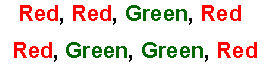
Most people who take this exercise pick one of two color combinations:

If you look closely, they are exactly the same except for the second color. In the first series, the second color is Red, , , and in the second series it is Green. The other three color options are the same in both series.

There are four personality areas I want to discuss with you. With what I’ve just laid out, you can already see that the majority of opinions select the same color combination in three of the four areas. The reason is because we are all quite a bit alike when it comes to how we approach work as IT employees, , , especially in three of the four areas.

Here are the keys that make it this way.

Traits Set #1, , , Technically oriented or social?
We want decision makers who are technically oriented managing our IT organizations. We do not want people who prefer to follow and are indecisive as managers. Therefore, RED gets the vote almost all the time.

Ninety percent of IT employees have RED tendencies in this area.

Traits Set #2 – Introverted or extroverted?
We would like our IT managers to be excellent communicators and comfortable in communicating with others. That’s what we would like but seventy percent have GREEN traits. This means most IT managers are shy and introverted.

It does not mean they can’t communicate well, but communication with people outside their immediate network like department managers and senior managers is definitely a challenge that must be overcome.  GREEN traits are where most IT people are in this one.

Traits Set #3 – High or low sense of urgency?

We would like an IT manager to have a high sense of urgency, , , not someone who is happy if we resolve a problem three days later. If a system is down, the IT manager needs to be in a hurry to get it fixed. At the same time, the manager needs to be a calming effect, , , not Chicken Little running around shouting, “The sky is falling!”.

Eighty-five to ninety percent of IT managers have a high sense of urgency, , , so GREEN traits get this vote.

Traits Set #4  –  High or low detail?
This is a tough one. As a programmer or a Systems Administrator, we need to be high detail to do a good job. Fortunately, ninety percent of us are high detail in IT. The challenge comes when we become IT managers. As a manager, you don’t want to be so detail oriented. Don’t get me wrong, there is a lot of detail when working as a manager, , , but now we have to delegate and let others take care of the technology detail.

Many of us have a difficult time letting go of the detail, and I can tell you this will impede your progress as a manager if you can’t make the transition from technical expert to business manager. It’s a whole different ball game when you become the manager.

So, RED includes the traits that are found in 90% of the IT staff.

Basically, you can say that 90% of all IT people are:
Independent
Self starters
Decision makers
Technically oriented
Have a high sense of urgency
Do not like repetitive tasks
High detail and knowledgeable about the job
Like to have things done accurately and their way

That’s essentially everyone in IT if it is 90%.

70% are shy and introverted. That’s also quite a majority of your people or of the IT manager community. If you are shy and introverted, it means two things:
1. You probably have weak communication skills.
2. Your desire to communicate is lower.

Not a problem too much as a programmer, , , but for an IT manager this one becomes a real issue.

In the next post, I’ll share some insights and challenges about the four personality areas that drive most of your IT staff:
– Independent and technically oriented (90%)
– Shy and introverted  (70%)
– High sense of urgency  (85%)
– High detail  (90%)

IT employee work behavior – part 1 of 4

The vast majority of IT employees have similar work behavior tendencies, , , or personality traits.  So similar it is scary.

We are all unique, but the way we approach work is remarkably similar.

Why is this important?
Because your work behavior tendencies can help or hinder your success. Understand them and adapt where needed and your success will be much greater. And remember, , , this applies to anyone and everyone in your IT organization.

Let me give you an example. If I were to walk into a room of 100 IT people made up of managers, programmers, BA’s, desktop technicians, Help Desk, etc. , , , I already know what the personality make-up of the group will be before getting to know any of them.

I’m so confident, I would bet you a lot of money I could define the work behavior traits of the group.  I’ve seen this repeated time after time.

How do I know?

I’ve observed and researched this issue for over ten years. Initially, I thought the consistency I was seeing was just an anomaly. Later, I understood that there is a certain personality type that’s drawn to work in the IT field. You will see a similar consistency in personality traits with sales people.

It doesn’t matter what position you are looking at in IT, , , years of experience won’t change it, , , doesn’t matter if you are in a large or a very small company, , , and it won’t be any different if you are in South Africa, China or the US. I’ve measured these results in all types of situations and in all parts of the world, , ,  if you are in an IT organization, there is a high probability your work behavior tendencies are going to be like most of us.

I use the terms “work behavior” and “personality traits” to mean the same thing.

In this 4-part post, I want to share things about the work behavior tendencies that exist in the majority of your IT staff. Being aware of this can help you understand why things happen, , , or do not happen.

It can help you realize why certain types of things are such a challenge for some of your people.

Understand this dynamic of “what makes us tick” well enough and you can even use the information to resolve employee conflicts. I know because I’ve seen it up close.

IT attracts a certain personality type

What I’m about to share applies to anyone in the IT organization, , , from CIO to the Desktop Technician. If you are in IT, the personality traits I’m about to share in this 4-part post applies to you.

OK, , , to start we are going to do a little exercise.
I want you to select desirable traits for an IT manager. You could work through this exercise for any position in the IT organization (IT manager, project manager, Systems Administrator, DBA, etc.).

For these purposes, I want you to focus on IT manager.

For each item, I will give you two groups of work behavior traits, , , a red group and a green group. I want you to select either the red group of traits or the green group of traits you would prefer in an IT manager.

There may be traits in both the red group and green group you would like in an IT manager, but you need to select the group of traits you would most prefer, , , it’s either “red” or “green” for each set.

Write them down to refer back to as we cover this topic in the next three posts:
Set #1  –  Red or Green?
Set #2  –  Red or Green?
Set #3  –  Red or Green?
Set #4  –  Red or Green?

Here we go:

Traits Set #1
Red
Independent
Self starter
Decision maker
Analytical mind
Creates change
Technically oriented

Green
Indecisive
Prefers to follow than lead
Unassuming
Agreeable
Lacks confidence in new areas
Willing worker

Traits Set #2
Red
Socially oriented
Warm
Friendly
Cheerful
Delegates authority
Talkative

Green
Reserved
Serious
Sincere
Thinker
Enjoys own company

Traits Set #3
Red
Relaxed
Patient
Methodical
Adjusts to repetition easily
Low sense of urgency

Green
Quick
Impatient
Fast learner
High sense of urgency
Ambitious
Drive to get things done

Traits Set #4
Red
Detail oriented
Careful
Thorough
Accurate
Conservative
Knowledgeable about the job

Green
Delegates details easily
Stubborn
Informal
Casual with details
Not obliged to conform
Lacks follow-up

Finished?

You should have four trait groups selected, , , something like “red, red, green, green”, , , or “red, green, green, red”, , , or “green, green, green, green”. Keep this handy for the next three posts.

Did you select one of the following combinations?

There is a high probability you did.


Let me give you some preliminary information about what’s to come.

In Part-2, I’ll discuss four key personality trait areas or work behavior tendencies we all have. The remarkable thing is that in three of the four areas, 90% of IT employees have the same tendencies. In the 4th area, 70% of all IT employees have a certain set of traits, , , and I’m guessing you missed this one in your exercise.

What you probably selected in this set is what is desirable in an IT manager but lacking in most IT managers unless they recognize it and do something to overcome it. I’ll explain in my next post.

In Part-3, I’ll share the challenges these groups of work behavior tendencies can give an IT manager. I’ll even share some things they do to challenge your technical staff.

In Part-4, I’ll summarize who you probably are as an IT manager and challenge you to modify a couple of your tendencies to become more successful.

If you subscribe to ITLever (it’s free), you will receive automatic email notification of new posts.  Simply select the EMAIL SUBSCRIPTION link in the right-hand column.

Teamwork is difficult for IT employees

Teamwork is essential for your IT organization to succeed. None of us would question it.

But did you ever consider that teamwork is not a basic trait in your IT staff. In fact, working on and within a team is a challenge for most of your IT people.

Here is why.

90% are independent, self starters who are goal oriented. Did you hear me say, “independent“?

Also, more than 90% are high detail people who like to do things their way. They are control oriented people who like to do the work themselves and have things done “their way”.

These two issues are not exactly made for teamwork. In fact, they can work against good teamwork.

Does this mean IT employees can’t be good team players? Certainly not, , , but it is important for IT managers to understand that it’s not a natural thing for 90% of your staff who have these two traits  —  independent and high detail.

What this means is that the IT manager must work hard to ensure teamwork is created in your organization and people know how to become good team players. As an IT manager, you want to reinforce teamwork and client service  all the time.

Help your IT staff understand that “we will all be successful together”. If the IT organization (the team) is not successful, there won’t be any successful individuals. It’s about the team, , , not about the individual. When the team is successful, we can all achieve success.

In a functional team, people have very specific assignments and responsibilities. They know how to do their jobs and when everyone succeeds in their work, the team succeeds. Failure in any area can cause the team to fail so people need the tools and knowledge to do their job and you as manager must be certain all things necessary for success are addressed.

People need to look out for one another, , , and help one another. It’s very difficult for someone who is highly independent and goal oriented to want others to succeed or to be the hero. We want those accolades for ourselves.

Learning how to become cooperative and eager to help others succeed is a key strategy you want to reinforce with your team, , , even reward this behavior when you see someone exhibit it.

You have to teach your IT staff fundamentals, , , like a football coach teaches blocking and tackling. Fundamental skills like teamwork, project management, communication, and client service are essential for your success.

Don’t forget to look at yourself when you think about this, , , 90% of all IT managers are also independent and high detail people.

Sitting on the fence can be hazardous to your health

Do you sit on the fence or do you take a position?

I hate it when I see someone in a situation and they can’t make a decision, , , or give you specific feedback to your question.

Sitting on the fence is unacceptable.

It’s OK to say, “I don’t know.” That’s acceptable and takes a position, , , albeit a neutral “don’t know” position.

It’s not OK to hum haw around and talk but say nothing and not take a position when someone asks you about something. A simple, “I don’t know.” will suffice, thank you.

You may think it is the safe thing to avoid taking a position, but I believe it causes you to lose credibility. Senior executives want your position on things, , , even if it’s an “I don’t know.” If they ask you a question they want your input, not a bunch of rhetoric that ends up telling them nothing.

Do this a few times and you will discover senior management asks for your opinion less and less.

Have you ever asked for input and the person talks a lot but doesn’t say anything? I hate it when this happens, , , as do most executives.

As a manager, your job is to get something that’s gray to black or white. Instead of sitting on the fence about an issue, your job is to determine if it needs to be on one side or the other.

Get the issue to one side of the fence and you can move forward. We don’t make progress when we are “on the fence”. Even if you make a mistake and take the issue to the wrong side, you can correct the mistake and move forward.

Time to assess where you are

OK, five months of the year are complete, , , only seven months to go. Now is a great time to assess a few things:

1.  Are you completing your IT strategy?
Hopefully you are making great progress in completing the big items planned for this year. If not, you need to step up the pace, , , five months has passed very quickly and the end of the year will be here before you know it.

2.  How is your budget looking?
Better check where you stand with your budget and forecast out the trends of your major expense categories. If you are already behind in achieving your budget for the year, you need to make corrective action quickly, , , waiting until September or October will be too late. If you see certain expenses trending higher than what they need to be to make your plan, , , anticipate the result and make corrections as needed to achieve your plan.

3.  Are you taking care of your people?
Have you done anything nice for your staff this year? The next few months is a good time to do something. Take care of your people and they will be motivated and encouraged to take care of you. It doesn’t require lots of money, , , just pay attention to them and do something fun from time to time and show them you appreciate their efforts. Telling them you appreciate them is also very helpful.

4.  Does senior management know what you are doing?
Are you communicating with senior management and department managers so they know what your IT organization is getting accomplished, , , and are you translating these successes into business value components where they will “get it”. If you don’t know what I mean by “business value”, read the post titled, Business value is key.

5.  How are your clients feeling about IT support?
Are your clients happy with what you are doing or do you know? If you aren’t sure, now is a good time to check with them to insure your team is on course for a successful year.

Mid-year inspections are valuable to help ensure you achieve what you want to achieve this year. The freshness of a new year has worn off by now and we are now into the drudgery of the work, , , it’s time to highlight some things and create renewed focus on what you and your team are trying to get accomplished this year.

Your staff and you may be getting a bit tired or a bit down so make it a point to do something that shows you appreciate them. Have some fun.

Staff will begin taking vacations, , , be sure they do so they can come back fresh and ready to go. Be certain you do this for yourself, , , and when you take vacation, try to actually take a true leave of absence and get completely away from the work. It will help you and make you more productive when you return.

Assess where you are, make adjustments as needed, and push forward to make the progress you need to make this year.

ITLever reaches one year anniversary

Our first year of using ITLever as a Blog medium has been a lot of fun and I hope beneficial to all who have visited.

In this first year, I posted 300 articles, , , not quite one a day but pretty close. We intentionally included a variety of things from serious IT manager topics,  lots of “how to” tips, IT manager tools and templates you may download, , , and some JUST FOR FUN posts to help us all get away from the work from time to time.

I also posted a few things about my travels as I delivered the IT Manager Institute this past year. Many of these will become some of my fondest memories, I’m sure.

I reduced travel in 2011 to focus on a couple of new projects as we continue our company’s mission of “helping IT managers of the world achieve more success”. You will hear more about this soon.

I hope you have enjoyed ITLever as much as I have in creating it. I encourage you to Leave me a Message in any of the posts to let us know if we are providing content that’s of value to you, , , or if you have different ideas or something to add, , , it’s helpful to our readers.

Thanks again to all who follow our journey in ITLever and feel free to contact me at  info@mde.net if you have ideas or insight that helps you gain more value from the ITLever site.

Don’t miss anything. Subscribe to ITLever to receive new posts automatically. Select the link in the EMAIL SUBSCRIPTION section under my photo in the far right column. It’s free and you may opt out a any time.

Save

Save

Tell me your best gadget story

Technology “gadgets” are great.

They boost productivity, make things easier, or are just fun to have. Whether it is a GPS device, a golf range finder, imaging software, iPad app, new headphones, or a Yoda flash drive, , , we like our “toys”.

I want to hear about the gadgets you like the most.

Post a comment to this post and tell me about your favorite gadgets, , , and do not assume everyone knows about it. I can guarantee the simplest thing you have will be new to many of us. Read my story below and you will see why I say this.

—  —  —  —  —  —

New discovery of an old technology
My brother, Mark, is a great guy with lots of knowledge. He has worked on some extremely large projects and traveled to many parts of the world as a result like China,  Scotland, Ireland, and France.

I’m always learning new things from him, , , especially about new technology gadgets, photography, etc. He has a lot of knowledge about many things.

His youngest daughter graduated from high school last Thursday and we went to his house afterward for a little celebration.

As I entered his home, Mark tells me he has this great new gadget he is very excited about.  I’m always interested when I hear this because he finds some truly great things, , , and for him to be excited about it means it will be something truly special.

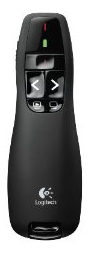
What shocked me was when he showed me a Logitech Presenter, , , a hand-held device that includes a USB component to plug into your laptop’s USB connection. It allows you to page your PowerPoint presentations forward and backward, , , a wireless presentation clicker.

Neat – yes, , , it just blew me away that he is just discovering this great little gadget. I’ve been using one for 9 years in my IT Manager Institute class. Don’t know what I would do without it. No cords to fool with and allows me to roam all over the room, , ,  even includes a laser pointer. Like I said, it is a great tool if you make presentations.

The point, , , don’t assume others know what you know. I wrote a post about this topic titled, Others may not know what you know, , , you might want to read it.

This incident reinforced with me again just how true this is.  If someone had told me Mark would not know about this little gadget, I would have laughed, , , sure enough, the laugh would have been on me. Only wish I had told him about it years ago, , , and I’m wondering what little gadgets he knows about  but hasn’t thought to tell me.

Mark, if you read this, post a comment and share a couple of your best gadgets.

I hope everyone who reads this post will take two minutes to make a comment and share their gadget story.