Clear your calendar and block out the time

You haven’t heard from me for a few days. It’s because I’m working on a major project and have been “heads down and in the weeds”.

Remember me suggesting you “have to block out time to focus on a major project”, , , like developing your budget, , , building a strategic plan, etc.?

Well, it’s no different for me. I have been trying to work on a big writing project for some time and haven’t been able to focus like I need to, , , so I cleared my calendar and have been focused like a laser beam for the past couple of weeks.

No travel, pulled back on my IT Manager Institute class schedule, , , and focused time and energy to the project work I need to work on. Guess what, I’m seeing some results.

The project is going well although slower than what I would like. Isn’t that always the case?

Look for my announcement in a few weeks to let you know what’s coming.

Another “industry average” to be careful with

Many CEO’s monitor IT spending by taking a look at a calculation called the IT Expense as a Percentage of Revenue. A good CEO knows about what his IT organization should spend, , , he may even have an industry average he uses to compare your spending with the rest of the industry.

Using this calculation is a good thing if used in the right context, , , but you need to be careful.

Let’s say your industry average is 2.5%. In other words, an average company in your industry spends 2.5% of revenue on IT. If your company has $500 million in annual revenue, that means your IT organization spends about $12.5 million a year if you are at the “industry average”.

What if you are spending $17.5 million (3.5% of revenue), , , or maybe 5% of revenue, twice the industry average? Does this mean you are doing a poor job in managing your IT organization?

No, , , definitely not. It certainly could mean you are doing a poor job, but the IT spending percentage of revenue alone does not tell the whole story.

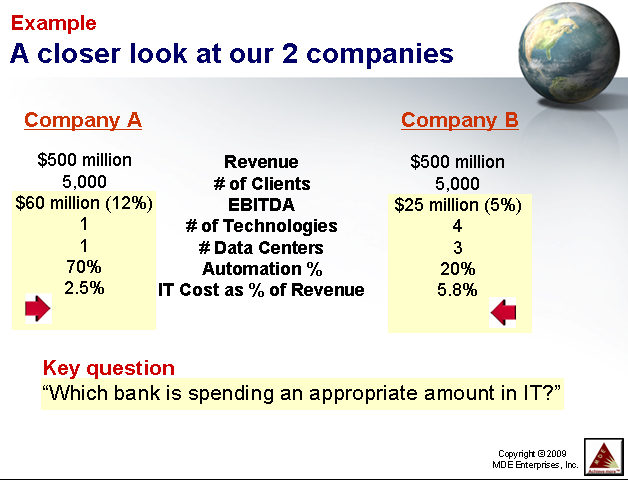
Take a look at this example I use in my IT Manager Institute class.
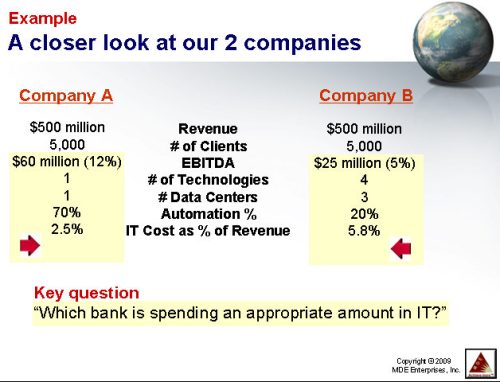
In this example we have two companies with about the same revenue and the same number of clients, , , but that’s where the similarities end. EBITDA (earnings before interest, taxes, depreciation and amortization) is quite different. Some call this operating income.

Company A is much more profitable than Company B. Why is that?

Well, there could be many reasons, but two reasons show up on the slide. First, Company A is much more automated. Automation tends to indicate the company is much more productive and has fewer clerical functions and processes less paper, , ,  which reduces cost.

The second reason is because Company B is spending a lot more in IT. In fact, they are spending over twice as much money in IT than Company A spends.

Why?

The slide tells you the reason. Company B has many more technology platforms and multiple data centers. The background you don’t see that’s provided in the class is that Company A grew by simply adding new business. Company B grew by acquisition and has not consolidated the technologies.

Both companies are the same revenue size but have very different situations.

In class, I ask a key question, , , “Which IT organization is doing the best job?”

Take a look at the graphic below again and answer the question before moving on. Which company is doing the best job, , , Company A who is spending 2.5% of revenue for IT (let’s also say this is the industry average), , , or Company B who is spending 5.8% of revenue for IT (over twice the industry average)?

In every class, most will say that the CIO in Company A is doing a better job. This is the answer I get almost every time.

The answer is, “I can’t tell who is doing a better job in managing their IT organization, , , until I conduct an IT assessment and determine what’s going on and what the issues are.”

Certainly Company B is spending a lot more money than Company A, , , but even on the slide with very little information I can see that this IT manager has more to deal with.

Once you conduct an IT assessment on both companies, you might determine that Company B should be spending 7% of revenue to attack the issues it has. Company B’s CIO might actually be doing a much better job than Company A’s CIO, even though he is spending over twice the money for the same size business.

The point
The message here is that you have to be careful with industry averages. They tell you what the average is for all companies in the industry, , , but your company’s situation determines at what level you should be performing. You have to understand the variables that exist before coming to any meaningful conclusion.

Company B will need to spend more in IT than Company A for some amount of time until more of the opportunities are achieved and Company B begins to catch up with Company A.

Over time, Company B becomes more profitable as IT spending decreases and more automation is developed.


Mike Sisco attacked by alligator

Did the headline get your attention?

No, I wasn’t really attacked by an alligator, but I wanted to have some fun with this post, , , and also bring to your attention of the need in using an “attention getter” when making a presentation.

Your first sentence and first two minutes have to get your audience’s attention. If you don’t get it, your presentation is likely to fall flat.

One of the things I do in my IT Manager Institute is to tell my students, “You have the toughest management job in your company!”

And then I explain why, , , which leads me up to the processes and tools to help them overcome these obstacles that face an IT manager.

Back to the “alligator attack”, , ,

Last week I was doing some yard work at our Camp Liberty on the Buffalo River, , , nothing major, just some cleanup and doing a few things I’ve been meaning to do for some time.

In one of the landscape islands is a small concrete alligator, , , one of those decorative pieces people put in their yard. Dorine was out taking photos of my Uncle Bob and me working so I thought I would have some fun. Here is the photo she got.

Nice tennis shoes

To take it a step further, I decided to make a newspaper article about it and this is what I came up with.

Click on the image and you can read the story

Sometimes you actually need to use a bizarre or shocking headline to get your audience’s attention. When you do, be sure to give them something valuable to keep their attention.

IT Project Management: a practical approach

In my last post, I discussed the importance of project management in creating IT credibility. You won’t be credible unless you deliver projects successfully. Period, , , end of story !!!!

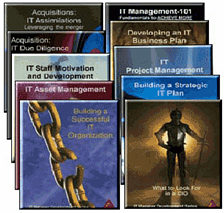
My company mission is to “help IT managers of the world achieve more success”. The very first thing I did in this effort was to write a few books (10 actually) to provide insights and tips on things that actually help you achieve more success as an IT manager.
One of the keys is to deliver projects successfully, , , so naturally, there is a book on project management.

Delivering projects successfully is so important. The book is based upon my experiences in delivering projects successfully, , , both as a young IBMer and later as an IT manager and CIO.

IT Project Management: a practical approach is straightforward and includes the simple process I use and the tools to help you deliver projects successfully. It also includes insights and tips from my experiences that will give you an advantage or edge, , , something we all need.

Short, straightforward, practical, , , and to the point. That’s what we want so that’s how I wrote this one. It is one of my best sellers.

Buy the e-book for $29.95.

Buy the whole series of 10 e-books plus BONUS IT Manager ToolKit (a $175.00 value on its own) for $279.00

$279.00 — Full series + IT Manager ToolKit

Getting IT credible, , , project management is key

In an earlier post, I mentioned, “The most important part of creating IT success is being able to conduct a thorough IT assessment so you can determine what your organization needs to work on.” CLICK HERE to view.

The second most important element required for IT success is that you must become a credible organization.

“Credible”, , , what does “credible” mean?

Credibility only comes when your client trusts you can and will do what you say you will do. Simply put, it means you deliver projects successfully.

You can conduct a great IT assessment and deliver an eloquent strategy that gets lots of acceptance, , , but if you can’t deliver projects successfully, you will not have credibility. Getting credible is absolutely a requirement to become a successful IT manager at any level. 

That’s why project management is so important for an IT organization.

There are three main parts to all of this:

First, you have to define and prioritize the projects. This happens during an IT assessment.

Second, you have to deliver the project, , , this is actually the project management component.

Third, you need to track your projects and demonstrate your success rate in delivering projects on time, within budget, and meeting client expectations.

All three components are very important. If you don’t identify the appropriate projects to work on and prioritize them so they help your company the quickest, clients don’t think you are focused on the right things.

Deliver a project successfully but fail to communicate your success and no one will know about it, , , so it’s important to “bookend” the project work with an appropriate assessment on the front and effective reporting on the back.

See my IT Initiatives Portfolio post and download a simple tool to help you quantify and report your project successes, , , CLICK HERE to view.

There is absolutely no excuse for failing to deliver a project successfully in today’s world. With the methodologies, tools and training in this area you would think that most IT projects are delivered successfully, , , but to our dismay they are not.

Studies show there is a high failure rate with IT projects, , , year after year.

You don’t have to have a PM certification like a PMP to deliver a project successfully, but you do need to know something about project management and it helps to have a few tools. A PM certification doesn’t say you are a successful project manager, , , it says you have knowledge about project management and passed an exam.

I’ve delivered hundreds of projects successfully with some of the simplest tools. The key is knowing what to focus on and doing a few key things that positions you to deliver your project successfully. Do these things well and success is achievable.

In a future post, I’ll give you my “Tips to project management success”.
If you are looking for project management help, I recommend you take a look at two resources:

  1. IT Project Management: a practical approach – I wrote this book to give managers a simple and practical process in project management and it includes the tools I use myself to deliver a project successfully. It’s a quick read and gets right to the point. Learn more.

  2. TenStep, Inc. and Tom Mochal – The company that provides the most in project management in the world is TenStep, Inc. Tom Mochal has created an international force in providing project management tools, training and consulting services.  Check out www.tenstep.com.

Project management is the cornerstone of credibility

It is why you should focus quickly on delivering projects successfully when taking responsibility for a new IT organization. Get credible and IT success is just around the corner.

“Net it out”

When you communicate with your client whether it is senior management or department managers, you need to “net it out”.

What I mean is that you need to give them the bullet points, , , the answer, , , the abbreviated or abridged version, , , , , , , , , , not the paragraph, highly detailed version.

Business people start turning you off within two to three minutes if they hear lots of detail, , , and especially if they hear “technology”.

Senior managers want the answer. If they need more detail, they will ask questions and get to the detail they need. Middle managers of business are similar although many can be a bit more detail, , , but when it comes to technology, they don’t want to hear very much about how, , , only why we need the things you are recommending.

“What’s in it for me?” That is the question you need to answer as you communicate with business people.

The challenge we have as IT professionals is that because we are so detail oriented, we think others want and need to understand the detail.

They don’t usually want it, need it, and are usually not interested in all the detail. You are wasting your breath when you discuss many of the things in technology at a detail level and you are wasting their time.

Give them the answer and be prepared to discuss the issue at lower levels as needed.

Beware the “industry average” trap

I love it when my CEO returns from a trip and discovers something from the airline magazine to question me about. Let me give you an example:

In Delta Magazine, he reads an article that suggests the average number of users to Desktop Technician ratio is 150 to 1 in most companies. (I just made this number up to illustrate a point)

When he gets back to the office, he calls me in and asks me, “Mike, what is our User to Desktop Technician support ratio?”

I do a quick mental math calculation of total users divided by my number of desktop support resources and say, “It is around 100 to 1.”

My CEO looks puzzled and concerned, , , then he asks the magic question, “Why is our IT organization not as good as most?”

Upon finding out what he is talking about and where he is coming from, I have to explain why our number is not as good as what he read in Delta Magazine.

When you see an industry average of anything, you have to remember, , , it is an industry average. What this means is there are many companies who will have much better numbers and there are many companies who will have worse numbers.

Having a worse number than an industry average does not necessarily mean your IT organization is doing a poor job.

There are a lot of variables that affect this particular type of measurement such as:

  • Age of the equipment being supported
  • Distribution of the equipment in the company
  • Complexity of what you have installed on the desktops
  • Amount of change your company is going through
  • Special projects underway
  • Capabilities of the support staff
  • Responsibilities of the support staff
  • Capabilities of the users
  • , , , even how you define a “Desktop Technician” and what he does

Lots and lots of variables.

You can have a worse number than the industry average and actually be doing a better job than someone who has a much better number. You have to understand the situation before coming to any meaningful conclusion.

Quarterly strategy meeting

Every quarter Tom Mochal and I meet to discuss our two companies. Often, we have others join us who can contribute to the process. This time, Tom and his wife visited us at Camp Liberty and spent the night on the Buffalo River.

Tom and I prepare to meet at “The Point” above the Buffalo River

Our meetings are fairly short, but they mean a great deal to me for many reasons:

  • motivation
  • gaining insight from other viewpoints
  • additional analysis and feedback on my work
  • collaborative process

It’s important for you to collaborate your strategies with others and hear their feedback. It’s not always the feedback you want to hear, but you need to listen closely to what others think of your ideas. Honest opinion from those you trust is extremely valuable, , , and your strategies will be better because of it.

It’s also important for you to hear other strategies, especially if they have a similar business as in the case of Tom and me. Listening to other people’s strategies and ideas can be a great catalyst for your own thought process.

I can’t tell you how many times the light bulb has turned on in my head with a new idea when discussing something in these meetings. It happens at least once in every meeting.

Our 20 Minute IT Manager product concept was spawned in such a meeting way back in 2005. After developing the idea, Tom and I developed weekly training sessions for three years, , , 162 of them as a result. CLICK HERE for info.

In this weekend’s meeting, Tom and I decided to revive the 20 Minute IT Manager and develop more sessions for our audiences. You will see our announcement soon, , , we plan to begin releasing new sessions in June.

It was a great meeting with great friends, , , and I didn’t even charge them the standard Camp Liberty Hotel room rate. 🙂 🙂

Hail storm hits Camp Liberty

I was about to write a post about the big hail storm that hit us while spending time at our Camp Liberty today, but my wife probably does a better job so take a look at her post. 

CLICK HERE to see her story and photos of the tennis ball size hail that fell from the sky, , , thought it was coming through our cabin’s tin roof. 

All I can tell you is that it was incredible !! Her photos tell some of the story, , , here is one of them.

Hail next to a silver dollar.

Acquisition: IT Due Diligence

Conducting a solid IT assessment is the key to IT manager success, , , it is the most important part of managing an IT organization. You can’t be successful if you do not know what you need to work on and what you can do.

One of my most popular books is titled, Acquisition: IT Due Diligence. It provides an IT assessment methodology and all the tools you need to conduct a thorough IT assessment.

In the 1990’s I was the CIO of a company that became an acquisition machine. In 5 1/2 years, we acquired over 35 companies and grew the company from $30 million in revenue to over $700 million.

Prior to joining this company in 1990, I had never heard the term “due diligence”. Believe me, I got a quick dose of it.

Every department head was responsible for assessing, budgeting, developing and executing a transition plan for his or her organization. Mine was the IT organization. When I joined the company, we had no tools or processes to conduct assessments, , ,  so each of us developed what helped us size up our part of the new business in order to budget and develop an appropriate transition plan.

Our typical acquisition took about 60 days to complete once a Letter of Intent was issued to the prospective company owners and agreed upon. The timeline usually worked like this:

  • 1-2 weeks of research and preparation
  • 1-2 weeks of onsite discovery
  • 2-3 weeks of analysis, follow-up and writing due diligence reports

The due diligence process and tools I developed saved me, , , without them, the pace of our company acquisitions would have run right over me.

These tools are now 20 years old and they are the same tools I use to conduct an IT due diligence or assessment today. The reason is because an IT assessment is not really a “technical assessment” as much as it is a business assessment to determine what the IT organization should work on.

To do this, we need to learn the needs and issues of our client that require technology support and the capabilities and capacity of the IT organization, at a high level.

The challenge most IT managers have is that they want to dive deep into the technology detail, , , and learn all they can about the technology. The problem is that you don’t really have the time to do this in the beginning, , , there will be plenty of time later.

What we need to do initially is to identify material issues that have technology support implications and develop a game plan by which to start working on these issues.

I’ve conducted 45 IT assessments to support company acquisitions and dozens of IT assessments as a new CIO, IT manager, and Consultant.

In one situation, we acquired a company headquartered in Texas that was made up of ten companies, all in different cities and each with their own technology platform and operating procedures. The parent company had been acquiring smaller companies but had not assimilated any of them, , , the only things consolidated were Payroll, Accounts Payable, and their accounting functions. It was the equivalent of ten acquisitions, , , my tools allowed me to assess all of these entities in record time.

This due diligence process and tools works for both acquisitions as well as normal IT assessments you need to do such as when you join a new company, annual reviews, or when you are promoted and inherit a new IT organization.

CLICK HERE to learn more.