What vs. Why

When you start thinking about your next great project, put your business hat on and think about it from a business vantage point, not from your technology perspective.

There are three key factors you must understand PLUS you must understand another part that is the most important part of all. Read on.

Three key factors

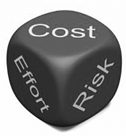
  1. Cost –  Certainly, a key ingredient is going to be the cost of doing something. So, develop a good idea as to what the cost will be and be sure to include the full cost implication of your new venture, including start-up and all project costs as well as ongoing costs once the project is completed.
  2. Effort –  What will it take in effort to get the new technology up and running? Time, resources, and the types of skills required all have important implications in delivering a new technology initiative.
  3. Risk –  There is both risk in delivering something new, , , but there may also be risk in not delivering it or in delivering it later than is needed. Risk has a cost so be sure you understand the risk implications of your initiative.

All of these things are key in evaluating any new IT initiative, but they are still not the key issue you need to look at, because none of these elements will actually help you get the project approved.

Each of these attributes (Cost, Effort, and Risk) deal with “WHAT”, , , the key piece is “WHY”.

The “WHY” factor
The element of an IT initiative that gets your recommendation funded is the “WHY” factor. “Why do we need to do this?” is far more important than understanding what it takes to get it done, , , although you will need this information as well.

If you can’t explain “Why”, then just forget about getting approval.

Ask yourself the question, “If I don’t understand why something needs to be done, would I spend money and effort to do it?”.

Probably not, , ,  hopefully not, , ,  you certainly should not!!!

This is exactly how your senior manager thinks about any recommendation you make, , , if he can’t understand “why”, it is very difficult to decide to spend money and put forth effort on something.

The “Why” factor is all about cost justification and the benefits that will be derived by doing something, , , and these benefits should be a business benefit, not necessarily an IT organization benefit.

Two key elements of “Why”:

  1. Cost justification –  something tangible has to be presented that makes the project worth the cost and effort.
  2. Benefits –  A business benefit must be articulated. Remember, it is all about the business, , , not about the technology. You focus your discussion on the technology and the business manager who must decide to spend the money or not will simply not hear you.

Learn to focus your recommendations on “WHY” and you will see that it has much more impact in getting your recommendations approved. Develop a solid track record of delivering cost justified initiatives that have business value benefits and you will be golden. It will turn the “No” and “Maybe” decisions into “Yes” votes of confidence.

Five IT trends to watch

I saw an article on TechRepublic today about “future trends in IT to watch” by Jason Hiner. His information is usually pretty good and is worth noting as he has actual operational management experience as well as being an editor in the publishing business.

Below is an excerpt. To read the full article, CLICK HERE

  1. The consumerization of IT –  More and more pressure on It as corporate employees continue to use more of their own technology and resist corporate standards
  2. The borderless network –  The completely isolated and protected network is no longer a reality in today’s business environment.
  3. The cloudy data center –  Many companies of the future won’t have a data center, , , it will be in the clouds somewhere.
  4. The state of outsourcing –  Many IT employees may work in your building or work virtually on your technology, but they will be paid and managed by an outside company.
  5. The mobilization paradigm –  Smartphones and iPads are just the tip of the iceberg of what’s coming.

These are all issues that face our IT organizations and some of the things we need to think about, , , the reality is that most companies will deal with one or more of these issues in the next two years.

Ten reasons software installation projects fail

Project failure usually means the project missed it’s delivery date or exceeded the planned budget. It could also mean it did not meet the client’s expectations, but we will focus on delivery timeframe and budget in this article.

Before we start, just a bit of background: I’ve been involved in hundreds of software installation projects in my career. The ten reasons listed below are what I’ve seen as the most prevalent causes of failure.

Software installation projects fail for many reasons. Most of the time, failure can be prevented if you are aware of what to watch out for. Here are ten key reasons why many software installation projects fail:

1.  Failure to check vendor references
One of the easiest things to do but is often bypassed is to check a software vendor’s references. Ask for a complete list of references and talk to or visit several clients to validate what you are trying to accomplish is actually being done by their clients. Solid client references equals credibility in my book.

Ask for clients who are actually using key features of the software that you have deemed important for your business. Too many times, new features are described to be part of the vendor’s functionality but when you start implementing the software you find it works very different than how you thought it did. A client reference will often provide valuable insight that helps you understand these nuances.

Take time to check critical feature/function and talk to clients about their implementation experience with the vendor. If there are problematic issues, learning about them before starting the installation is when you want to hear about these type of issues.

2.  Unrealistic expectations
Often, operational units of the company are dead set on certain functionality without even understanding what and how the feature actually works in an operational setting.

Another scenario is the concept that the new software will eliminate all of our old problems and make it all better. More often than not, there are no silver bullets that solve all your problems, , , or if they do, they create additional issues you must deal with. You want to try and understand these dynamics early in the project.

A third situation exists when users want so much feature/function, they don’t realize the amount of complexity they may be introducing into their work environment.

Take a close look at what the expectations for a new software program are and be sure the due diligence investment is made to fully understand the ramifications of these decisions. Learning these implications at the front of the project is much easier than learning mid-stream or at the end of a project, , , that’s usually painful.

3.  Lack of planning
Counting on the vendor to handle the project is the same as the ostrich burying his head in the sand when trouble approaches. It doesn’t work.

The IT department and the user departments must be fully involved in the project. Clear tasks should be developed with specific responsibilities, timeframes, and prerequisites.

To insure success, there should be a project leader on both the vendor side and from your company. Planning is a dynamic process, not an event. Once the project is planned and started, you have to focus on it consistently and adjust as needed to meet your stated objectives.

4.  Lack of testing
The quick way to install any software is to simply load the software, build the files, and “turn it on”. That’s also the quickest way to disaster. It may surprise you that this actually takes place in many companies.

Testing and validating your assumptions is a critical step at every juncture of the installation. You probably need to:

  • validate master file data
  • balance and verify transaction data
  • test certain features to validate configuration settings
  • test certain operations to determine operational processes to use for productivity and best practices in using the new software.

Test plans should be defined so you know that every aspect of the new program works like you think it should when you “go live”. Otherwise, expect lots of surprises, , , and these surprises are generally not good ones.

5.  Lack of committed resource
Lack of committed resources can occur at any stage of the project. It can occur from the vendor, from the User Departments, or even from your IT Department. It can also result from unforeseen circumstances such as illness, reassignment, change of business priorities, etc. Losing a key resource can create a huge obstacle to the project and jeopardize timing and cost.

When developing the project plan, be sure to work through the staffing plan for both critical skill and timing of when those skills are needed. There is usually some flexibility in a big project but watch this one closely.

The project manager needs to anticipate needs constantly to insure the project is getting the right resources at the appropriate time to keep the project on track.

6.  Not establishing specific milestones
Large projects need to have specific deliverables that will be met at certain timeframes, , , key milestones help you gauge performance and stay on track. Part of the reason you do this is to help the team realize the success being made but also to set a framework that helps you manage big bottlenecks and to get certain prerequisite steps completed that position you to move forward.

7.  Unaware the project is getting off schedule
You can’t be aware of everything taking place, or not taking place if you aren’t having regular project status meetings. They don’t need to be long drawn out affairs but you need to validate on a regular basis (I like weekly) that people are getting the things done that they are assigned to get done. Otherwise, there is a high probability the project is getting off track and will not meet its due date.

8.  Not anticipating the bottlenecks
Bottlenecks are everywhere. A good project manager knows how to sniff them out and to anticipate issues that may lead to potential bottlenecks. Eliminating one bottleneck leads to two others which might even slow the project down more.

Great project managers are really good at identifying bottlenecks  and proactively putting things into motion that either eliminate them or reduce their impact to the project.

9.  Insufficient training
Training on how to use and manage a new software application is critical. In large complex applications, configuration management is especially important because the setup can have all kinds of ramifications and can even cause a department to lose hundreds of hours of productivity or large amounts of data.

You should include your smartest and best people in the configuration setup and management training and limit it to just a few people. You must determine how business application decisions will be made and who will implement such changes when it means changing the setup files or certain data definitions of your master files.

Large companies will have data administrators who are accustomed to these issues, but small companies are often surprised by the amount of work, knowledge, and effort required to manage a new software application.

10.  Plan that is too aggressive
Strong project managers know to build in buffers that help them deliver a project on time. They know that things will happen and that you are going to need extra time and extra money at some juncture of the project.

Projects that are built with schedule and staffing with expectations that everything will go just as planned are doomed for failure from the start. Murphy’s Law of “if it can go wrong, it will go wrong” was probably created by a project manager.

Summary
There are many other reasons that will cause a software implementation project to fail; but if you address this list of ten, your odds of a successful project will be very good.

A big day for South Africa

I’ve been to South Africa on three occasions to deliver the IT Manager Institute and headed there again this coming Saturday to teach my 4th SA Institute next week – July 26-30, 2010.

Yesterday was a big day for South Africa following a month of excitement in hosting the World Cup soccer matches.

First it was Nelson Mandela’s 92nd birthday.  I have two photos of my visits to South Africa that have a Mandela connection:

At Nelson Mandela Square

At Mandela’s original home, now a museum

You can tell I’m in South Africa because I have the t-shirt  🙂

The second big event yesterday was when Louis Oosthuizen won The Open Championship of golf, , , some still call it the British Open. This one was held at St. Andrews, the home of golf and where they have played for some 600 years, , , several hundred years before the US became a nation.

Watching this tournament is one of the favorite things to do with my family; we enjoy links golf a lot. Some day, I hope to visit St. Andrews and play a round where so many legends of golf have played.

It was his first major championship win and he played impeccably the last two days as he held the lead. No one really ever challenged him and his game was in excellent form. This is a big deal for the game of golf in South Africa.

Louis Oosthuizen holds the claret jug trophy as he sits on the “old bridge with the St. Andrews clubhouse and 18th green in the background

I’m looking forward to my return visit to South Africa next week although the long plane ride is not all that much fun. We expect to have a great class and I’m excited about a new working relationship we are developing with Herbert Ruth, a South African professional who attended the Institute program in 2006.

Got my extra Rand (SA currency), electrical adapters and passport, , , looking forward to teaching our 40th IT Manager Institute next week. Hard to believe we have taught so many classes in such a short time. It has been great!!

Details of the IT Manager Institute at www.mde.net/institute

River

Our neighbors up the river from our Camp Liberty have a black labrador retriever named “River”, , , pretty appropriats as she stays in the Buffalo River quite a bit. To see her swimming alongside a canoe or just crossing the river is neat. She is as comfortable in the water as on land.

River is not only smart; she will play with you all day long, , , retrieving balls, sticks, even rocks. Here are some photos:

Yesterday, she played in the river with some people swimming and they were lobbing rocks to her. She went under the water to retrieve each rock and take it promptly to the bank. I thought our last flood created the rocky beach across from us (in the left background above), , , but from what I observed yesterday I’m not so sure, , , it may heve been built by River, , , one rock at a time. She will play and retrieve things as long as you are willing to play. 

River watches the Buffalo River after her play time.

River and Miss Liberty – two icons on the Buffalo River

Having trouble getting IT initiatives approved?

I was talking with a company CFO about his IT challenges and one of the points he made rang so familiar. It’s something I’ve seen throughout my career.

His comment was, “I’m actually eager to spend money in IT, but it is frustrating when our IT Director asks for approval to hire a new employee or to buy new technology but doesn’t provide any justification for doing it.”.

This is something that occurs all too often.

Another comment I’ve heard from IT managers and CIO’s throughout my career is, “The company won’t spend any money.” or “I can’t get my projects funded.”

Interestingly, all of these comments are related and arise from the same issue.

IT managers who come from heavy technical backgrounds aren’t always taught the need to justify new technology expenses. A key initiative may appear to be totally obvious to them that the company needs to do something, but I can tell you that it is definitely not obvious to most CFO and CEO’s.

I can also tell you that I’ve never found it terribly difficult to get my IT initiatives funded. There are two very simple reasons for it:

  1. I know that every initiative needs to be cost justified so they are.
  2. My initiatives are always closely tied to the company’s needs and provide quantifiable business value.

Number 2 is not something I say lightly.  I make it a point to develop strategies and budgets that support the business needs and objectives of the company. I also communicate these plans to senior management of the company and gain their endorsement by validating that “these are the things we should be doing”. More importantly, I show the business value that the projects will deliver.

Cost justified initiatives that have understandable business value usually get the approval nod.

Senior managers have one goal that’s well above any other and that is to achieve the financial commitments made to their Board of Directors and stockholders.

Unexpected spending runs contrary to this primary mission. Most of us have a certain amount of distaste for surprises and senior executives are no different.  It’s a lot easier to add new staff when your operating budget anticipated the possibility of such a need and is included in the budget numbers.

I never recommend hiring a new employee unless there is ample justification. In fact, I’ve been known to be more reluctant to hire a new employee than some of the senior managers.

The key message here is that when you ask for something that’s not budgeted and planned for (and this will be rare in my case), my senior management team knows that I’ve thought through the issue and have plenty of justification (cost, benefit, etc.) that warrants the additional expenditure.

In addition, they know that if it’s above the budgeted operations plan, I’ve determined how to make up for this extra expense so I still make the plan.

Managers who don’t anticipate the “Tell me why” comment from their CFO or CEO will have difficulty in getting what they want.

It’s not the senior manager’s job to know why we need more IT staff or new technology. That’s the senior IT manager or CIO’s job, and those who can’t articulate the justification are the ones who make statements like, “The company isn’t willing to spend money in IT.”

I’ve joined companies where the outgoing CIO told me that he could not get anything done for lack of money. All I can say is that I never found it to be difficult at all to get those same senior managers to fund reasonable initiatives that helped the business.

The scenario I usually find is that there is plenty of money to spend on the right things. The problem is that the former technology managers were spending too much for things that were not critical to the business or that did not add real value. They were buying technology, , , not approaching technology as a business manager would and buying only what’s needed to help the company be successful.

If your senior management team isn’t willing to fund your requests, , , stop for a moment, step back and take a hard introspective look at the situation and ask yourself, “Why is this the case?”.

Be objective and remove any self imposed desire or emotion from your thoughts. Put yourself into the position of the business owner as if the money were to come right out of your own pocket. Would you still be doing all the things you are spending money on or would you revise your initiatives and do something different, , , especially, if payment came out of your own pocket?

I’ve performed due diligence on IT organizations of companies we were about to acquire and I’ve conducted IT assessments for many companies in a consulting role. It’s amazing how many times you hear comments like “reluctance to spend on IT”, “can’t get funding for our IT projects”, etc.

When I hear these things, I take a very close look to determine if the IT organization is really in sync with the business “owners” (senior management team). In most cases, they are not.

It’s not that IT managers do not want to do the right thing for the company. It has more to do with background and experience. For example, if a young CIO comes from a predominately network and infrastructure background he tends to focus in improving the network and infrastructure. All the while, the real problems may be with the business applications or Help Desk.

We tend to focus on what we know. Unfortunately, most of the people that are promoted to IT manager haven’t really been exposed to techniques of how to manage a business effectively. They are predominately technicians by trade, not business managers.

When you become a manager, it’s more about the business than about the technology. Technology is the means of making great strides and improvement, but without a real business need the best technology solution can be a waste of money.

The next time you prepare to ask for more money for more staff or new technology, ask yourself these questions so you know the answer when your CFO or CEO asks you:

  1. What is the benefit?
  2. What is the cost justification?
  3. What will not making this investment do to us?
  4. Do we have to make the investment now or can we wait?
  5. Is it budgeted?  If not, why not?

If you have solid justification that meets the needs of the business, you will probably find yourself getting more of what you ask for.

Create a track record of making wise investments in the initiatives you recommend and getting tangible results from them and you will find the scrutiny and analysis of your recommendations become less and less. It’s a matter of trust and knowing that you only do things that truly benefit your company.

It’s all about earning trust and respect by producing positive results.

15 tips in starting a new consulting career

A subscriber of my newsletter asked me about my insight in getting into the consulting arena full time. He has twenty years of IT experience and is apparently very interested in pursuing the opportunity of working for himself.

I have been on my own for ten years now, and I can say that although I thought I was fully prepared to run my own company, there were some things that I had to learn the hard way.

I’m very fortunate in that my book sales and training programs do very well. I love what I do and enjoy the work. Even so, there are things missing in my business that I really enjoyed in a corporate environment.

Here is how I responded to the question. It might be worthwhile if you are thinking about a future consulting career.

These are thoughts I have based upon being on my own for ten years now after more than 20 years as an IT Manager and CIO in the corporate world.

1. Try to insure you have 1 to 3 solid clients to start with that will provide a minimal level of revenue for you. The amount you need is dependent upon your own personal situation. You need to establish positive references quickly and having more than one client will help you get started quickly.

2.  Marketing and sales is the most important part of growing your business unless you are very lucky and word of mouth grows it for you. The technology services market is very competitive so don’t assume you will have clients by simply displaying your company sign.  Talk to most consultants and you will hear them say that there is a constant need to develop new clients through marketing and selling. Do not underestimate the importance of this aspect.

3.  It always takes longer to develop new business initiatives than you think. It took me three to four months to research, select, and implement a shopping cart and credit card process for my web site in 2001. I’m glad I took the time because I have been very pleased with the services I chose. Similarly, many of the basic products and services I now take for granted were developed after many hours of effort only because I had never done it before. When you can, connect with someone who has already gone through what you are trying to do and take advantage of their prior learning effort and experience; you will get there quicker with a mentor helping out.

4.  Plan to work harder and longer, especially in the formative years of your business. There are weeks when I log conservatively 80-100 hours a week and I have no commute to the office. Part of this is just me enjoying what I do, but the other part is that it takes more effort on your part when you are a small company. A small business owner has to wear many hats: consultant, salesman, marketing, accountant, , , and “chief bottle washer”. In your early years, you will probably find yourself working a lot more, not less.

5.  Don’t hire people until you have sufficient business to cover it. What I mean by this is that your business should be generating sufficient revenue before adding new employees unless you have a funding source to cover it. Unless you have plenty of funds set aside or some very lucrative revenue producing clients, you need to keep your overhead expenses low. There is a reason why most businesses do not make it beyond 3 years, , , they are under capitalized.

6. As much as possible you want to avoid building up Accounts Receivables. My business is great in that I’m almost always paid before delivering the service or product, but that’s unusual. In my consulting work, I’m obviously paid after the fact in many situations. I have intentionally converted my business model from 99% consulting to 60% training/education, 30% Internet sales, and only 10% consulting. It took three years to get there but it’s a model that allows me to avoid the “work an hour to be paid an hour” scenario that is prevalent in a pure consulting model. In a startup, you can’t afford to have many “slow paying clients”, , , same is true for most small businesses.

7. If you can, look for ways to generate recurring revenue. It’s the key to establishing financial stability and leveraging your capabilities. Creating a business that generates a predictable recurring revenue every month can position you to be more flexible and allow you to take risks that otherwise you may not want to when you are chasing the revenue every month.

8.  Think about developing white papers or short, practical “how to” documents in your area of expertise or interest. It gives you the ability to take what you are doing for a single client and make the knowledge available for people all over the world. It creates  leverage. You will need a web site, shopping cart with credit card processing capability, a product, and the ability to generate lots of awareness. I can tell you from personal experience that if you have information that helps others and can make them aware of it, you can generate additional revenue for your business that essentially runs on autopilot. This creates additional flexibility and helps your company grow.

9.  Clearly define your products and services so it is easy to tell someone about your business and easy for them to understand what you offer. Your potential clients must be able to describe your service or products before they will buy. Develop a mission statement and state what you do in the simplest terms possible.

10.  Networking is key. Again, you will be more successful if you have minimal capability but great marketing and sales ability than if you have great consulting capability but are weak in marketing and sales. I’m convinced that I could have tripled my income in our first three years with only 10-20% of the assets I had to offer if I had superior marketing ability. Networking with those who need your services will be key so take the time to develop a marketing strategy that gets your message to your target market.

11. There are lots of incidental costs but the tax deductions are better in having your own business. Don’t forget to take into consideration the income taxes you owe. Just because it goes into the bank doesn’t mean it’s all yours. Most governments want their fair share, , , if there is such a thing.

12.  Build a business plan. I believe most companies fail because they don’t clearly define their objectives and how they are going to achieve them. Take the time to create a business plan that spells out what your project initiatives are going to be, how you will gain new clients, and above all the budget you plan to operate by. After finishing the plan, increase the budget by 25% to 40% because the reality will probably be that it costs you considerably more to operate than you think it will.

13. Create an office space that is conducive to getting work done. All too many people miss this one. We all work differently to a certain extent. In my case, I can get quite a lot done with family nearby because I can shut them out (to my wife’s dismay at times). If you need total quiet to be productive, then by all means create a cave where you have the solitude you need to get your important work accomplished. Your productivity and livelihood counts on it.

14. Be sure you are prepared for the potential isolation effect in working on your own. Many have a hard time making the transition from a more structured corporate environment to an entrepreneurial one. This has probably been the toughest part for me. I miss the involvement with professional staff on a daily basis and being part of a larger organization at times, , , but the 1-minute commute and flexibility to work in my pajamas more than makes up for it.

15. Many companies go out of business because of being under capitalized. To give your new business the startup time it really needs, you should have the funds identified to carry you for three years or more. Having sufficient capital will allow you to weather unexpected surprises and the time it takes to build a sustaining business.

Consulting or working on your own is not for everyone. It takes a strong sense of commitment and perseverance to do what it takes to run a small business. It also takes a lot of discipline, , , let’s repeat this, , , lots of discipline is required to succeed on your own.

The great thing with today’s technology is that you can create an image that rivals the big companies; but when it comes to getting everything done, it still requires lots of work. If you aren’t funded well, you will find yourself doing much of the work.

Unless you are fortunate to fall into a sector of consulting where the demand is extremely high and the resources far and few between, pay close attention to the importance marketing and selling plays into a company.

Sales and marketing is the key in growing a company!

I certainly do not say this because I have great sales and marketing expertise. In fact, I think my skills in those areas are average at best. Sure, I’ve learned a few things over the years but a great marketer will tend to be more successful than the great operator.

Item #2 above, Marketing and sales are the most important part, is really key from my experience. I’m much better at it than I was in the early years, but I still have a long way to go after ten years in business. My preference (and those from the technology side like me) tend to prefer to implement, improve, and operate rather than do marketing projects or try to sell.

I learned early on in my career that I wasn’t cut out to be a great salesman. Two years of selling at IBM helped me learn this about myself, and it’s still true. It’s simply not what I like to do.

Now, I’m a bit more mature (or older depending on how you look at it), and I understand and appreciate the value of marketing and selling more than ever.

The point here is that if you are looking to “cut loose” and start your own company, be sure you know how you are going to find new prospects, attract them, and turn them into new clients. Without new business, you will be like 70% of the start-ups that fail to make it past their first two or three years.

Most of us who provide consulting services would prefer to just do the work. We like it or we wouldn’t be doing it. Be certain that you include 30% or more of your time to do the marketing and selling activities as you plan your business. It’s an unfortunate requirement of growing a young company.

I hope this helps any of you who might be contemplating “taking the leap” and starting your own consulting business.

Stay positive

I’m a firm believer that positive energy creates positive results. And believe me when I say, “your energy is felt by others”, , , so keep it positive.

I know to stay positive is hard at times.

We all go through struggles and challenges, many of which are beyond our control and can be extremely frustrating. Still, you need to remain positive to be successful.

Rather than thinking about what’s wrong or what you don’t have, , , think about what you do have and what’s right in your life. You won’t have to think long to come up with a lot of good things, , , and I know from experience that you don’t have to look far to find someone who has much more difficult circumstances than you do.

So be thankful for what you have!

Positive energy makes some big things happen and your enthusiasm for life and your work will spill over to others around you. Try it and you will see.

Here are a few key thoughts for you to consider:

  • A problem client is an opportunity in disguise
  • Addressing a problem employee is the right thing to do for the employee
  • Your worst day is often followed by a super day or a great week
  • Think of the glass half full, not half empty
  • Take time off to re-energize and reinforce your positive attitude
  • Look for a win-win with clients and vendors
  • Senior managers look for positive leaders
  • You set the tone, so make it positive
  • Arguing your point doesn’t always achieve a positive result
  • Positive attitude doesn’t happen automatically, , , you make it happen

A person who can smile in the midst of tremendous challenge is like a magnet; others will look to that person for leadership and example. You may be boiling or a shamble on the inside but when your demeanor exhibits a positive attitude it calms those around you and creates an environment where things can get accomplished.

Stay positive !!

Handling a problem employee – case study

Over the course of a management career, you will deal with many employee challenges. One especially difficult challenge I encountered makes an interesting “case study”.

The employee in question was abusing others, both teammates and clients, and was not producing at a level expected for the position. This employee also fit a minority category.

My approach has always been to deal with issues as they come up and deal with them as fairly and consistently as possible, , ,  regardless of sex, race, or other minority category.

The bottom line is that each individual on your team is expected to produce positive results and do so in a healthy way. Building a team that is highly responsive to client needs and successful in delivering value to your company requires everyone to make a positive contribution.

Here is a brief description of how I handled the situation:

  1. I coached the employee about the problems on two separate occasions and made it clear that I expected improvement. I was very specific and gave him examples of the unacceptable behavior. On the 2nd coaching session, I told him that if it happened again he would be put on a formal improvement plan and that if the issue occurred during the improvement plan time frame, he would be terminated.
  2. The issue occurred again so I sat down with the employee and delivered a formal “work improvement” discussion. In this discussion, I gave the employee specific critique with examples that reinforced my concerns and handed him a written document stating the problem and specific resolution steps he must take to continue employment. Finally, the employee was notified directly that continued unacceptable performance that led to this discussion would result in dismissal.
  3. In two weeks, I fired the employee because the performance improvements were not being met and another serious event demanded my action.

The formal improvement session included the attendance of our senior Human Resources Manager because I wanted to be sure in this case that we covered all the bases since it was my belief the employee would simply “not get it” and he fell into a minority category.

This was exactly the observation the HR Manager gave me after the session when he said, “You addressed all the issues well: what’s wrong, what you need to do to fix the problem, and clear understanding that continued poor performance would not be allowed. Even so, the employee doesn’t understand the problem; but you could not have explained the situation more clearly.”

In most situations, you won’t have to actually get to the point of firing an employee. What I’ve encountered over 90% of the time is that when you address poor performance directly or conduct a “needs improvement” session with a poor performer, the employee does one of two things: he either improves the situation quickly or leaves on his own accord.

One of the most important responsibilities a manager has is to do the right thing by your employees. That means stepping up to bad situations and taking appropriate action to improve performance of your IT organization.

It is the right thing to do for your company, your clients, and your IT staff.

More importantly, it’s the right thing to do for the poor performing employee. If you have an employee not performing, there are reasons as to why. Your job is to address the issue and to help each of your employees succeed, but there may be exceptions who just won’t make it. If so, your job is to help the employee move on to something that he can be successful in. To avoid this responsibility is unfair to the problem employee more than anyone.

If you approach it in a light of “doing the right thing for the problem employee and your company”, it makes the tough work a little easier.

Climbing the ladder of success

We are all climbing our “ladder of success” to some extent. The 2-part question we need to ask ourselves is, , , “What is success and how do I get there?”

Success is different for all of us. To some, it might mean having a steady job with good benefits.

For someone sitting next to you, it might be earning a certain level of education or gaining a specific technical certification.

To someone else, it might mean earning a certain level of income.

It could even be having a title like Director of IT or Senior Specialist.

The point is, , , success is in the mind of the beholder and it’s a bit different for each of us. What motivates me might not motivate you at all, , , and that’s perfectly all right.

What this means though is that we all need to sit down and define what success means for ourselves, because if you don’t know it is going to be very difficult to achieve it – right?

Once we know what success means to us, we can create a strategy and develop the plan to get us there.

Something else to consider is that your idea of “success” will change over time. That’s right, once you achieve your Director of IT position (or whatever it is) you were targeting as your success milestone, you will identify another goal, , , one that’s higher and more ambitious.

I’ve been managing IT resources for many years and have had some lofty titles and prestigious positions in some great companies. Today, I run my small training company and set new goals every year as to what success will mean for us here at MDE Enterprises, Inc.

If your goal is to be more effective in an IT manager role for your company, I can help you. We have the best tools and resources for IT managers in the industry, , , practical and proven tools that really work.

Whatever your goal, you need to develop a plan to get you to your targeted success level. In most situations, achieving success requires you to deliver results, , , and results are delivered by those who know what and how to get the job done.

It’s pretty simple when you stop to think about it.

If you want to climb the ladder of success, decide what it is that you want and devise a plan that will get you there. A key part of the plan has to be the education and training you need that will position you to deliver the results required to achieve the level of success you target.

For a technical resource, it will be specific technical training, possibly a certification or two, and exposure to certain types of projects where you can gain sufficient experience in your field.

For IT managers, it’s learning what your senior management team needs from your IT organization and knowing how to deliver these results through your team.

You probably also need some tools to help you get things done, ,, whether it’s a technical objective or a management objective. Not only do you need the tools to help you succeed, you need to know how to use them to deliver the results it takes for you to succeed.

It all comes down to:

  • knowing what to do to be successful
  • understanding how to go about it
  • having the tools and examples to help you succeed

Regardless of what your success goals are, knowledge is the key. Invest in yourself to gain the knowledge and your potential for success increases dramatically.

Don’t know where to start? Find a mentor or someone with experience you trust to help you think about your situation, , , to openly and honestly discuss your potential, , , and to help you develop a realistic plan to achieve more success.

Once you do, you will be amazed at how empowered you become, , , because you now have a plan that’s within your control.

Here’s to your success !!

A final note
Success is not all about money. Certainly, it’s important for some, but making a lot of money is not necessarily a true measurement of one’s success. Happiness in what you do, the quality of life you have with your family, your hobbies and activities outside of work, , , many things make up a person’s “success factor”.

For example, my Dad was not a rich man in terms of money, , , but he was one of the richest men I’ve known. He never made a lot of money, but he had tremendous amount of respect and more friends than one can count. At his funeral I learned so many things about his giving to others and how much it meant to them to be his friend, , , and how much fun he was to be around. He didn’t have a lot of money but he was very successful, , , it’s all what you want to make of your life in the end that counts.