Don’t forget to tell your Night Operator

Security issues come in all sizes and shapes. When I was a young IBM Systems Engineer, I was assigned responsibility to install a Payroll system for a large hospital.

As it would happen, the CIO of the hospital was apparently in hot water with the new Hospital Administrator, the CEO of the hospital. During this time I was “camped out” day and night working on the Payroll installation, the CIO was fired.

Word came down from hospital management that the CIO was terminated, barred from the Data Center and that the locks and security codes were being changed right away. This is common practice when management wants to “lock down” the computer systems if they are concerned with the possibility of sabotage by an outgoing employee.

The next day, we were asked to review the systems access logs. To everyone’s surprise, the CIO had logged onto several key systems between midnight and 1:15am in the morning. This was in the days when remote access was not possible, , , you had to physically be in the building using one of the networked workstations to access the hospital’s systems.

The locks had been changed,  the security codes were changed, , ,  but the former CIO still managed to access the hospital’s systems.

How did he do it?

Hospital management told everyone about the CIO leaving the company except for the 3rd shift Computer Operator. When the outgoing CIO tried to get into the building, he no longer had keys, , , so he buzzed in as he normally would do and the Night Operator let him into the Data Center, , , also just like he normally would do. It looked like ‘business as usual’ to the Night Operator.

Fortunately, the fired CIO wasn’t there to do anything malicious. He was there to retrieve a few personal files and to follow-up on a technical issue that he knew about. He was actually very conscientious in his “night maneuvers”.

The morale of the story is that when you think you have all the doors locked, check again to be sure you’ve notified all who need to know, , , including your Night Operator.


What to do when IT staff is bombarded with “last minute” requests

If your organization is getting bombarded with “last minute” requests, there are four things you need to understand:

  1. What are the requests?
  2. Why are the requests being asked at the “last minute”?
  3. Who is asking for help?
  4. What’s causing these issues?

If you know the answers to these four questions, you should be able to develop a strategy to reduce or eliminate the issues altogether. Worst case is that you should be able to develop processes that reduce the need for so many “last minute” cries for help.

In many cases, Help Desk logs and incident trends should be able to help you identify the answers to the first three questions. The last question takes a bit of analysis, but when you have the data to support the first three questions it usually points to “what’s causing the issue”.

The answer to this dilemma usually falls into one or more categories:

  • quality
  • capacity
  • managing expectations
  • responsiveness

Once you know what, why, who, and cause, , , then the rest is up to you as the manager to develop and initiate processes for improvement or conduct coaching sessions that improve the situation.

There is always a logical reason as to why “last minute” calls are coming in. Figure out the four questions above and you will get to the solution to reduce or eliminate the problem.

Need an example?
Let’s say you get too many requests for a new PC at the “last minute”. Maybe, a department manager habitually forgets to tell you a new employee will start on Monday morning. That manager may not even remember to get the employee  set up with a cube and a phone, , , but if he has to wait on a PC, then it is always “IT’s fault”.

Simple way to eliminate this “knee-jerk” reaction you and your staff can be put into is to have a few spare PC’s available that are already fully configured with your standard image for a new employee. When you get the “last minute” request, deploy one of the spare PC’s and get the new employee up and running, , , then order a replacement spare PC for the next time you have such an “opportunity”.

One of the priorities we have as managers is to try to eliminate the reactive nature of our IT support business. Many things are out of our control like the “last minute” requests from other managers, , , but we can usually do something like the spare PC process to minimize the impact these things have on our staff.

The bottom line: even when some things out of your control can create challenges for your organization, you actually possess more control than you might think to be a responsive IT organization.

10 ways to eliminate paper and incur BIG cost savings

The cost of paper is enormous in most companies. Anytime, you can find big pockets of paper usage, you generally have an opportunity to save your company thousands of dollars, if not millions.

Eliminating the use of paper reduces expenses in your company in many ways:

  • paper
  • ink & ribbons
  • printers
  • handling
  • distribution
  • storage

Paper and ink costs can be significant, but creating the paper is only a fraction of the cost of using paper. Handling, distribution, and storage costs are far bigger issues.

Things to consider:

  • Xerox research estimates each US worker creates 10-12 thousand sheets of paper a year.
  • US paper consumption has tripled in the last decade to 700 billion sheets a year. (Source: Xerox research)
  • Life cycle cost of a piece of paper is estimated to be $20.00. (Source: Association for Information & Image Management.)
  • In the 1990’s, insurance companies used to pay our company $1.00 for each insurance claim we sent them electronically versus paper. In those days, insurance companies estimated the cost to process a single paper claim was $5.00.
  • In 2006, the use of electronic claims has grown significantly but so has the number of total claims, , , paper is still heavily used even though electronic claims now make up about 75% of all claims submitted. The cost to process a paper claim is still between $1.50 – $3.00, , , and sometimes much more. (Source: AHIP – America’s Health Insurance Plans)

In an age of digital information, you would think paper usage would be declining, but it isn’t, , , it’s increasing rapidly according to research findings by Xerox. If the research is accurate, here are some startling numbers for a small company of just 100 employees:

  • 100 employees create 1,100,000 pieces of paper annually
  • 1,100,000 pieces of paper have a life cycle cost of $22,000,000

That’s creating $22,000,000 in cost every year. Not all of this cost is incurred by the company creating the paper, , , much of the cost is incurred by other companies who must handle, process, and store the paper created by our small company of just 100 employees.

Think of the thousands of companies, with tens of thousands of workers and you can quickly see that the cost of paper and associated costs in handling, distributing, and storing it are enormous.

With today’s technology, there is no reason we can’t reduce paper significantly. We won’t eliminate paper totally, but we certainly should be trying to reduce the creation of paper and the associated costs to our company.

As a new CIO in a company, one of the things I look for in my initial assessment is for large “pockets” of paper. If I find large amounts of paper in a department of the company, there are generally some major cost saving opportunities in the following areas:

  • reduce clerical workers who handle and process paper
  • reduce postage and distribution costs
  • reduce paper storage costs

The challenge with clerical workers in most companies is the rate of turnover, , , they are the highest turnover group in your company which has additional cost implications such as recruiting, hiring, training, etc. Automating clerical processes allows you to just “not re-hire”  as clerical employees leave your company.

10 ways to eliminate paper

  1. Document management systems – Implement systems that create and distribute electronic documents versus creating paper.
  2. Company policies on use of paper – Are you aware many employees print out most of their e-mail messages, , , and other things like it? Lots of opportunity in creating paper usage guidelines.
  3. Duplex printers – Printing on both sides of the paper saves a lot in the long run.
  4. Electronic Distribution Systems (EDS) – Data interfaces with companies you work with can eliminate boat loads of paper. Wal-Mart implemented a company-wide EDS program in the 1980’s that has saved their company billions, , , and continues to reduce the cost of their products to consumers.
  5. Use your Intranet – Stop producing paper for company information (newsletters, employee manuals, operations policies and procedures, etc.) and use your company Intranet to publish the information.
  6. Print to PDF’s versus paper – Most company documents can be printed to a PDF file and distributed, then selectively printed by the recipient as necessary. This will drive paper costs down quite a bit.
  7. Scanning and imaging systems – This technology is so much more cost effective than it was even 10 years ago. If you have large volumes of paper coming into your company from external sources, you can reduce costs a lot by scanning the documents and retrieving the images as needed to process and store the information.
  8. Make printing harder – Selective placement of printers within your company can actually reduce the amount of paper produced.
  9. Automate clerical processes – Clerical workers are usually handling lots of paper. Automate the processes they do and eliminate the paper which allows you to eliminate the clerical worker position.
  10. Mandate change – To be effective in cutting the usage of paper, your company needs a “champion” who leads the way and encourages others in the company to look for innovative ways to reduce the use of paper. People do not change their ways easily, , , ultimately, senior management must get involved and reinforce the idea that change is required and you take it seriously.

Most companies have excellent cost saving opportunities by eliminating paper. Take a day to tour your company and just look for large “pockets” of paper and think about what might be done to eliminate the creation of that paper, what costs would be eliminated if people did not have to touch it or if your company did not have to distribute it.

You might be shocked at the cost savings opportunity !!

Announcement – Installment payment option for the IT Manager Institute Self Study

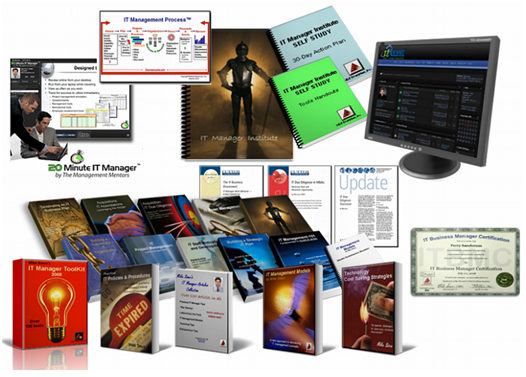
Many have requested we offer a multiple payment option for our highly successful IT Manager Institute Self Study. At $995.00, it is by far the best training value for IT managers in the industry. In most situations, our students have the program paid for by their company, , , but in many cases, it’s up to the individual to invest in himself.

Our goal has always been to make our practical IT manager training materials and resources accessible and affordable to all managers in the world who want to improve their operational management skills. The multiple payment option plan is another step in that direction.

Details of the IT Manager Institute Self Study are at www.mde.net/selfstudy

For the multiple payment option, go to  www.mde.net/selfstudy/installment

Brick walls are made to hurdle

Do you have challenges?

Are obstacles in your way?

If so, what are you doing about it?

I receive lots of inquiries from managers around the world who describe the “brick walls” they have in their situation that’s preventing their success. It’s anything from:

  • “How can I develop an IT strategy when our company doesn’t have a strategy?”
  • “We don’t have enough resources to do what’s required.”
  • “My career is blocked.”
  • “I have a problem employee and can’t get rid of him.”

Well, “brick walls” and life’s challenges are made to hurdle. To an extent, problems are just excuses. The reality of things is that we are in more control than we often think we are.

Do you remember when the 4-minute mile was broken, , , or the pole vaulter topped 18-feet?

The 4-minute mile was broken by Roger Bannister in 1954. Prior to that, scientists and athletes believed it was physically impossible for a man to run a mile faster than 4 minutes.

What happened after Bannister ran the mile in under 4 minutes?

You got it, , , it became common place for runners to run the mile in under 4 minutes because the mental barrier had finally been broken. In fact, the record time for the mile has been reduced by some 17 seconds since 1954, , , impossible, they said.

When you have a “brick wall” in your life, it makes your situation tough to be sure, , , but that doesn’t mean you can’t succeed. Learn as much as you can about this “brick wall” obstacle, , , prepare yourself, , , develop a plan, , , seek outside help, , , and determine how to get over the wall.

You may not succeed the first time. I know from personal experience that I’ve skinned my knees and elbows, , , bloodied my nose a few times, , , and still have a few scars from trying to hurdle some of the “brick walls” in my career and life.

However, my belief is that most challenges can be overcome given the right motivation and preparation. In some cases, you may need to simply walk away from the wall because it is unrealistic to get over it, , , but have you tried bursting through the wall, , , going around it, , , digging under it, , , doing something different to get over it?

The objective is to get to the other side – right?

Before you walk away, take some time to “think out of the box” a bit and maybe even collaborate with someone who has dealt with these types of obstacles before, , , or possibly has some insight into.

If getting to the other side is worthwhile, don’t give up easily, even if at first you don’t succeed. Keep at it and whittle away at the obstacle, , , perseverance is a powerful attribute and trait of many successful people who dealt with their own “brick walls” before they achieved success, , , people like:

  • Colonel Harland Sanders, creator of Kentucky Fried Chicken – over 60 years old before he franchised his chicken recipe.
  • Abraham Lincoln lost 8 elections, failed in two businesses, and had a nervous breakdown –  one of the most remarkable examples of perseverance who became one of the best Presidents in US history.
  • Thomas Edison reportedly failed over 10,000 times in his quest to develop a practical working light bulb – his comment, “every wrong attempt discarded is another step forward”.

“Brick walls” are made to hurdle. Take a hard look at the obstacles in your situation and tackle them with knowledge, a positive “can do” attitude, , , and persevere. You might be amazed at the result.

Managers earn respect; it doesn’t come with title

How many times have you heard a manager tell someone they have to do something because, “I’m the Manager.”?

I learned early in my management career as a young Marine that you can give an order and the troops will carry it out but when they respect you and understand why the order was given, it’s done with a whole lot more enthusiasm and quality.

A nice title gives you nothing more than to say you have a responsibility for something. Employees, especially bright technical employees, don’t just do what you ask because you are the “manager”. They take their cues and make their moves based upon how their leader motivates them and whether they have confidence in him or her.

Little things like showing respect for people, taking the “hit” when the organization or someone in it fails, stepping up to a difficult employee situation, and giving the team and individual staff members credit for successes are all subtle things that leaders do. It’s what makes people want to follow and go the extra mile for you.

Managers lead by example ever day of the week. Never forget that eyes are watching you to determine how they should react to situations and they are learning from you all the time, , , even when you don’t expect it.

I had a former employee share something with me many years after he had worked for me. There was an event to do with something I did in a staff meeting that I couldn’t even recall, but it had a profound impact on him and became something that he incorporated into his own management style years later.

They are watching, learning, and replicating your actions and behavior into their own approaches. Managers earn respect by action and successes, not words or foolish things called titles.

You owe it to every member of your staff to set the right tone and example in work ethic, treatment of others, and teamwork. It will repay you many times over.

Invest in yourself

Managers need to constantly learn and improve their skills just like all the rest of your staff. Big things can happen when you learn new concepts and techniques that improve your performance.

Some of the best lessons I have learned have been insights gained from watching and observing others. I have also gained a considerable amount of skill by attending formal classes. One of the quickest ways to improve your skill set is to get the “abridged” or condensed version from those who have already walked in the shoes you are walking in now.

The first time down any path can be confusing, vague, difficult, and especially challenging. How many times have you listened to someone explain an issue to you and the “light goes on”? There are all types of educational resources available to you if you want to take advantage of them, , , some formal and some not so formal.

Invest in yourself each year and you will see that the results of your efforts improve considerably over time.

Don’t underestimate the value of having a solid mentor, , , or two. A good coach can save you considerable time and frustration on any number of topics and situations. Good mentors are literally worth their weight in gold because of the differences they can make in your productivity and effectiveness by sharing their experiences that can help you in areas you are seeing for the first time.

Take the knowledgeable path with a mentor; you will have fewer bruises.

How do you pay top salaries to keep your best employees?

The short answer is, “You don’t.” The misconception is that money is the primary driver for employee satisfaction and it truly is not. If it were, you would see much more turnover than occurs in the technology world today.

Every study you will find lists money well down the priority list of issues that are important for employees to remain with their company, , , or why they leave a company. This doesn’t mean that compensation is not important. Certainly, your compensation packages need to be competitive in the local and regional market you are in. But competitive doesn’t mean “over paid” or “highest paid”.

Motivating an IT staff is somewhat an art in that “how you go about” your actions can be just as important as “what you do”. Employees pick up on sincerity (or insincere actions) very quickly. Try to introduce a motivational action and not be sincere about it and it can make things worse.

There are some key things employees want from their manager and their company that motivates them to work hard and stay with you:

  • Training and education – Technical employees have a big need to keep learning and to stay current.
  • Challenge – Motivated employees are busy and need to be challenged.
  • Success – Everyone needs to have successes. The more you can show the results of the work and how important it means to the company the more  your staff will be charged up to do more.
  • Confidence in their manager and company – People want to work with winners, both managers and companies.
  • Trust – Empower your employees to do their job and give them flexibility, tools, and support to get it done, , , then  watch the results, , ,  it might amaze you.
  • Being appreciated – This is a big one. Many IT employees do not feel they are appreciated for their hard work. It’s up to the manager to insure they are appreciated, , , and it starts with you.

Motivation doesn’t happen automatically. It’s up to the manager to do things that motivates your staff, , , you must lead them by doing some of the things listed above.

You want to pay your IT employees well, especially your best people, , , but there is a whole lot more than salary that motivates people to stay with you. Don’t overlook the intangibles such as challenge, respect, professional development, and appreciation, , , they are powerful components in building loyalty and in retaining your best people..

Be careful when cutting IT expenses you don’t cut “muscle”

The big movement in companies for well over a year now has been to cut expenses and reduce the cost of operations. The IT department has not been immune to this push from the top of companies nor should it be.

When revenues decline, stockholders still expect the companies they invest in to operate profitably and to keep the stock price up. What this means is that we have to find cost savings.

I’m a strong proponent of managing company expenses in line with revenues. I’m also a supporter of understanding the IT expense as a percent of company revenue and using it as a measurement guideline.

The problem comes into play when cost cutting initiatives cut into “muscle” as opposed to eliminating “fat”.  There are critical resource requirements to provide basic levels of technology support. In normal cases, a few areas need to have some amount of backup or depth in case a key member of the team leaves for some reason.

When you begin any cost cutting initiative, you should take a very close look at the support needs of the company and how you are organized to provide that support. Identify critical support requirements that must be in place to support core competencies of the company, i.e. the IT “muscle” that’s required.

You want to try to eliminate these key resources and expenses related to the support they provide from your list of potential cost cuts. By identifying the true “muscle” of your IT organization, you help ensure that the primary business support need will be taken care of. Be objective with this exercise and validate with senior management.

If you have “star” staff members in areas that are being looked at to be eliminated, consider shifting them to your core competency support areas, , , but when you do, you may still have to cut staff somewhere in the organization. The point is that the team you want to end up with should be the very best of the staff you have today and when you have to eliminate staff, you owe it to your team and the company to lose the weakest of the bunch.

You must stay objective when doing this – it is a tough assignment.

Always try to find business opportunities that allow you to make IT investments that will save the company much more than what will be saved by cutting IT expense. Most companies have these opportunities but if you wait until the “cost cutting” message comes down, it is too late.

One of your best assets is a track record of success and one that shows you constantly focus on things that provide business value to your company. The more you work in IT the more you will discover that the biggest cost saving opportunities are things you can do to help other departments in the company, , , not usually what you can save in IT. Don’t rule out technology cost savings, , , just be aware there may be bigger fish elsewhere in your company.

We are tops at IT Business Edge

Do you know who IT Business Edge is?

Maybe not, but I’ll bet you probably know TechRepublic, , , right?

Well, the same group of 4 people started both companies. They started TechRepublic from scratch in the 90’s and built it’s readership to one of the largest in the IT industry, , , then sold it to Gartner around 2002. They started IT Business Edge, I believe in 2003.

I’ve worked with both companies quite a bit. In 2001-2003, I wrote over 100 articles on IT management for TechRepublic, , , many of which are still published from time to time.

In 2004, I accidentally discovered IT Business Edge in a phone interview with a writer. We began a joint venture and they started promoting my IT Manager Development Series.

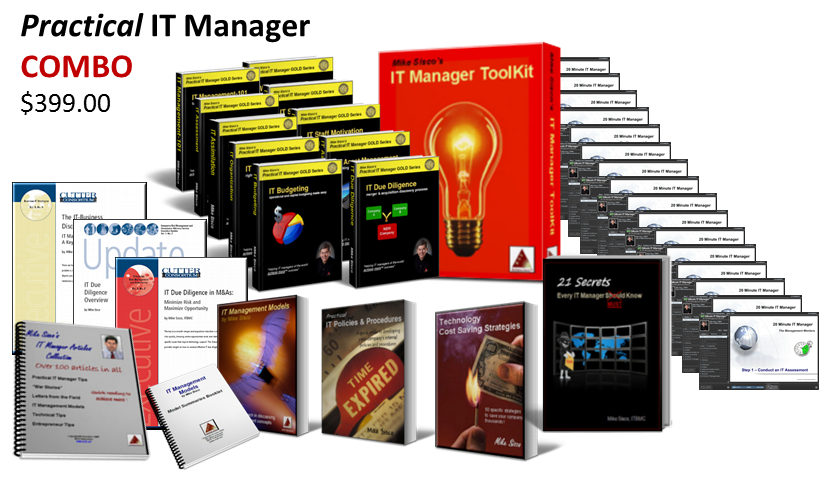
Today, I received an ITBE e-mail promotion and was excited to see that my IT Manager Development Series still tops their list of Premium Tools, , , they have done so since IT Business Edge (ITBE) began telling their readers about them, , ,  for 7 straight years.

Here is the excerpt from the e-mail message I received today:

“most popular Premium Tool we’ve ever offered”

“Our Best Value Ever — And Our Most Comprehensive IT Manager Training Package”

What a great feeling seeing comments like these from ITBE, , , but the best part is the thought of how many IT managers we reach through the efforts of ITBE and other partners like them. If you were to subscribe to one of ITBE’s newsletters, you receive a free copy of my e-book, IT Management-101, , , , just like you do when you subscribe to my newsletter. We know that ITBE has distributed well over 300,000 copies of IT Management-101 since 2004.

Interested in learning more about ITBE’s #1 Premium Product?

Go to ITBE’s web site —-  https://www.itbusinessedge.com/commerce/?c=168

Or go to my web site  —-  www.mde.net/cio

Interested in learning more about IT Business Edge?  Great resources for IT managers!!    Go to   www.itbe.com