Is age discrimination an issue for IT managers?

If you had asked me this a few years ago, I would have said, “probably”. The dot.com boom and the buzz about reengineering the corporation seemed to make senior executives believe that younger, entrepreneurial managers could make all their problems go away quickly and easily.

You know what, there aren’t too many shortcuts. Certainly there are things you can do to improve a business and if it’s in really bad shape, , , you can make big improvements fairly quickly, , , but ultimately, I don’t think there are any “silver bullets”.

All companies have challenges and always will. I have seen a few companies follow the lead of a “smooth talker” thinking that his/her ideas were innovative and that the company could take a major leap forward quickly by casting away all the “old ideas” that had been successful to that point but “slower than what we would like them to be”. We have all seen companies take this leap of faith and watch their stock price go from $50.00 per share to $2.00 because of the fall that occurs when reality sets in.

Since the dot.com blowout in 2000-2002 and this new depressed economy of the last couple of years, I would say that there is a renewed focus on company earnings. In many cases, companies are looking for the veteran CIO or IT Manager with solid credentials in managing IT initiatives cost effectively and a proven track record of achieving tangible results.

It’s now in fashion to have a credible track record and the “t-shirt” that says you have “been there and done that”.

I wouldn’t say there is not some prejudice against older managers but there is definitely more situations where a little gray hair is a benefit and not a liability.

The thing companies look for and need is someone who instills quick confidence and that they believe can come in and make a difference quickly. The better you are in articulating your capabilities and achievements that show you know how to align technology initiatives with business needs that are cost effective, the better your chances.

The real prejudice against an older manager is often that he or she normally costs more. That’s a legitimate concern. However, a solid manager of any age can be worth his weight in gold; and in most cases you get what you pay for.

How about the flip side, do you think there is age discrimination toward young managers? That’s a topic for a later day.
Is it a “bad employee” or something else?

I joined a small company many years ago as the new CIO and as I normally do began my own IT assessment. My approach in assessing a company’s technology situation is to begin with senior management, work my way through company departments that use the technologies supported by IT, and finally go to the IT organization to complete the assessment.

You need to understand what your client thinks about IT support before asking your IT people.

In this case, I heard several managers of the Corporate departments describe one of my IT employee as being unreliable, never sure where she was, slow to complete any project, and on and on. On the other hand, the operational staff in the remote offices had high praise for her.

Interesting, I thought, , ,  we had very different opinions from our client.

There was a big push from several of the corporate departments to fire the employee as she was just “no good”, had a bad attitude and could not do the job.

Be careful what you hear from your clients when you first start in a new management position.  What you hear may not be the facts.

Upon further review, it became clear that the problem was a management issue and not an employee issue. The problems the corporate departments were having stemmed from the fact that this one person was trying to do what three or four people would be required to accomplish. IT was considerably understaffed to meet the basic support needs of the company.

Because this had been an issue for some time, the IT employee simply got caught into a rut of doing all that she could do every day but finally realized it would never be enough so she “worked at it” every day as well as she could.

The employee wasn’t a manager and shouldn’t be expected to manage all the company’s department manager expectations. Her boss should have been doing that. A big part of the problem was that the former CIO wasn’t paying attention to the needs of the business.

My client was correct in expressing dissatisfaction about the lack of support they were receiving, , , they were just getting to the wrong reasons as to what was causing the problems. It wasn’t my employee, , , it was previous IT management not addressing the business support needs of the company.

When the support capacity was addressed to match the need, this employee flourished and users responded accordingly. My CEO even made it a point to mention to me the “turnaround in attitude” of this employee several times. That’s very funny, , , she had a great attitude and was very committed the entire time, , , there was just no way for her to succeed based upon how the previous manager had organized and focused the IT resources.

It would have been easy to get the wrong impression about this employee early on, but the additional due diligence paid off for us all.

Be careful what you hear from your client. Their frustration may be real but the cause of the problem may be entirely different than what they think it is.

Fail to plan, , , plan to fail

A key success factor for any IT Manager is the ability to plan for the future.

Most don’t !

Believe it or not, more IT managers fail to plan than do, , ,  because it’s hard work and much easier to react to issues rather than develop a concise plan of attack.

Executing well and being aligned with your business has a lot to do with how well you plan. Planning is the most significant part of high levels of achievement.

Planning literally puts you in the “driver’s seat”. It establishes clear expectations of  what you will do, when and how. Planning also sends the message to others around you that you are organized, decisive, and willing to make the effort to get the job done properly with minimal surprise and problems.

Many fail to plan because it is easier to “wing it”. When you “shoot from the hip”, surprise, problems, and ultimately failure are right around the corner.

It’s just a matter of time.

None of us are good enough to successfully execute projects and technology initiatives without a solid plan.

Can you imagine a construction company putting up a building without a plan? Or how about a heart surgeon replacing a heart valve without planning the operation thoroughly, , , down to having contingency procedures in place in case the operation doesn’t go well?

Managing an IT organization certainly isn’t heart surgery but the outcome of proper planning is just as predictable in the IT world as in surgery or building construction.

Key thoughts about planning:
–  Planning helps you anticipate major issues
–  Planning organizes your team for success
–  Planning is a leadership quality
–  Planning will enhance your career
–  Planning develops your management insight
–  Planning helps you create predictable results
–  Planning is a requirement and not a “nice to have”

The phrase at the top of this post is a truism, , , don’t allow yourself to fail by not planning. Do your planning work and success is much more achievable.

Great day – US Open and Father’s Day

Every year, my family and I celebrate Father’s Day by watching the US Open golf tournament. This year’s Open was held at Pebble Beach and brought back some very fond memories from 1992.

Our son, Eddie, was a pretty good golfer, , , a 3 handicapper at 15 and he was improving all the time. In 1992, Dorine, Eddie, and I took a trip to Pebble Beach to watch the ’92 US Open. Eddie was 15 and this trip was a very special time that I’ll never forget.

Just six months later, Eddie had a terrible automobile accident and we very nearly lost him. Fortunately, he survived but golf and the bright future he had were taken away. Eddie still likes to watch golf and I’m so thankful that he can understand what’s happening and can communicate about it, , , for a long time during his recovery, he couldn’t. Eddie had to learn everything all over again.

Eddie is one of the most positive people you will meet and he never has a bad day, , , although he deals with pain every day and many other challenges. He is truly thankful that he survived the accident, even though he misses out on so many of the things he would normally be able to participate in.

Eddie is 33 now and today was very special, , , watching the US Open, , , reminiscing about our trip to Pebble Beach in 1992, , , discussing what we thought about Tiger, or Ernie, or Phil’s good and bad shots.

Today was truly a special Father’s Day.

Why do I share this?

In life and in business, we all have ups and downs. How you handle the bad times and what you do about them tells people a lot about your character and your belief system.

Eddie has recovered about 60-70% from where he would be had the accident never happened, , , but the fact that he enjoys life and people he comes in contact with, , , and they enjoy him, , , is a profoundly good thing. Our lives changed forever on January 2nd, 1993 when Eddie had his accident, but because of it we have been blessed by so many things, , , people we have met, , , my career change, , , living back in middle Tennessee, , , so many things to count.

The point is that even though terrible things happen to us all from time to time, it is important to look at the positives that come from them rather than dwell on the negatives. Dorine and I always saw the positive steps Eddie was able to take when many could only see how terrible his situation was.  I don’t say this to suggest Dorine and I have any answers or that we are strong people, , , more appropriately, I think that Eddie’s progress (even though limited) in some part comes from the positive energy and encouragement we were able to create for him.

I remember when he was able to put a baseball cap onto his head by himself for the first time, , , it was an exciting day.

I remember running to the refrigerator when he asked if he could have some apple juice after not drinking any liquids for two years, , , an unbelievable step forward for him.

Life is what you make of it. Our life is different from what we thought it would be, , , but we are so grateful we are able to have the life we have with Eddie.

In business, look beyond the negative situations you may have and to the bigger picture. If your situation is bad, maybe even terrible, , , it will get better, , , plus you don’t have to look very far to find someone who has a much more difficult situation than yourself.

Stay positive and look to the future, , , and enjoy the special days with your family.

By the way, for Father’s Day, Eddie and Dorine gave me a hammock, , , planning to give it a trial run this week. I hope you had as special a Father’s Day as we did here at the Sisco’s.

Lines of fire

One of the management models I’ve used plenty of times comes from my days in the Marine Corps. It has significant application to managing an IT organization and providing focus for your team.

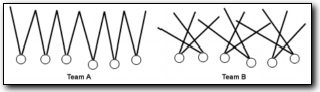
In the graphic above, you see two sets of Marine riflemen positioned with their range of fire set for them. One of these teams is by far more effective in a real “fire fight”.

Can you guess which one and why?

At first glance it looks like the left group, Team A, has a very organized and efficient approach that covers the whole field. It actually does until one Marine stops to reload or gets taken out of action. Then, there is a gap that can destroy the entire team.

On the other hand, the group to the right, Team B, looks like they are all over the place. The fact is that this setup has much more field coverage because of the overlap in one another’s fire lanes. When one Marine reloads or goes out, there continues to be more of the field covered by the other five Marine’s fire lanes.

Managing an IT staff is similar. I’ve seen many organizations operate inefficiently because people are running all over the place trying to react to today’s latest crisis. When I encounter such a group, one of the first things I do after assessing the needs of the business is to establish a “field of fire” or specific responsibility area for each individual.

When you have staff jumping through hoops to take care of business, it’s a good sign in that it shows that they care, , , but their approach can be very ineffective. Once you get them focused with specific areas of responsibility, coach them to stay in their position and take care of “their job” and count on the rest of the team to take care of theirs, , , the results will be much better.

Focus each team member to achieve the results you need and that they are capable of achieving, , , and go “take the hill”.

Education is key, , , even for an IT manager

Knowledge is power and positions you to achieve greater levels of success. Over the years, I’ve watched the light bulb go on for a young IT manager I was coaching on a particular  management issue. I’m sure that my mentors saw the same thing happen with me.

Managing effectively at a high level is something most of us can do if we know what to do and how to go about it.  Management techniques and processes can be learned just as a programmer learns how to incorporate a new routine of code into his coding arsenal.

I’ve seen other managers look amazed at the fact that I can submit an IT budget for a large organization in record time and I always achieve my operating budget.

I’ve seen employees light up by being part of a successful and motivated organization while others on the outside were looking in wishing they were part of our winning team.

These things are easy when you know what to do and how to go about it. I didn’t invent all of these tips and techniques, but I’ve done one of the best jobs in the industry in packaging practical processes and tools in training programs, books, and tools that help IT managers achieve more success.

I remember learning how to install a new mini-computer system with business application software for a new IBM customer. It didn’t take me long to incorporate a systems installation project template that I could use for every new installation. All I had to do was identify the responsible person for each task, put in dates for the tasks to be completed, add a few new tasks and it was ready to go.

This simple process saved me countless hours of work, organized each project, and gave the client a tremendous feeling of security because of the specifics all laid out and the confidence I had in knowing my projects worked. And this was long before structured project management programs came into vogue.

I certainly didn’t invent the new installation project plan IBM taught me, but I learned quickly how to use and improve it to boost my productivity and to insure we accomplished the mission.  I consider it one of the keys to why I successfully installed 13 systems my rookie year at IBM and received a Regional Manager’s Award. Knowledge truly helps you succeed.

My books and tools are used by IT managers all over the world and the IT Manager Institute is the most practical training in the industry to focus on the “business aspects” of managing technology resources. Check out the tabs at the top of this page to learn more.

Why is the new CIO revisiting all projects?

“We have a new CIO and he wants new cost justification for all existing projects. What is this all about?”

I’ve been that new CIO before and I’ve done exactly the same thing  –  asked for the cost justification and benefits of all existing projects as well as planned projects. The reasoning is pretty simple:

  1. Is there cost justification?
  2. What is the business value we will get from the project?
  3. Does the project fit within the company’s business needs and issues?
  4. Does the project have the appropriate priority?
  5. Does the project have a business sponsor?

I’ve seen IT organizations work very hard and spend thousands of dollars on projects that provide no value to the company. It’s not that uncommon actually because a real problem exists when “technicians” develop IT strategies without doing their homework and gain agreement to insure their initiatives are in sync with company needs.

Your new CIO’s main obligation is to the company that hired him. His first priority has to be to assess the company’s needs and to inspect every project that spends money or uses technology resources to determine if the IT organization is working on the “right” priorities.

Many studies suggest that over 50% of all IT organizations are out of sync with their company needs. If that’s the case, there is a very good chance the previous CIO was focusing on some inappropriate things.

Jump in and help him size it up quickly. It’s not a personal issue so don’t be too attached to your project even if you are almost done. For example, if you are working on a systems conversion for a subsidiary of the company and the parent company intends to sell that subsidiary, you are wasting time and valuable resources. Even if you are 60% complete, it may be the best solution to cancel the project for the company’s best interest.

Help your CIO refocus the IT organization so it provides the most value possible to your business client. Everyone wins when you do, and all lose when you don’t.

If it isn’t broken, , , don’t fix it

I can’t tell you how many times I’ve seen an IT organization conjure up a project just for the sake of doing something they wanted to do. Never mind what the company or their clients really need, “let’s go do something really ‘neat’ or ‘cool’ ” sometimes seems to be the theme of the day.

Let me give you a specific example. I conducted an IT assessment for a small manufacturing company a few years ago. The CEO called me in because his IT organization was proposing a $380,000 network upgrade. The CEO had questions as to whether he really needed to spend that kind of money on their network, but he wasn’t sure. He wanted to believe in his IT staff and to do the right thing, but he was uncomfortable with this proposal and just couldn’t put his finger on it, , , his gut told him something was not quite right.

This scenario takes place thousands of times every day all over the world. CEO’s often do not understand what their IT organizations are doing and why they need so much money. Bringing in a consultant is not what the CEO really wants to do. For one thing, it casts doubt on the IT organization. Another issue is that it’s expensive, , ,  or is it?

Getting an objective opinion could be one of the best investments a company can make and may turn out to be your most inexpensive option. In this particular case, we saved the company over $300,000 by doing a simple 2-week IT assessment.

The situation
The problem was that the IT staff was managed by a manager who had minimal experience in management but lots of knowledge and experience in networks and systems, , , infrastructure experience. As a result, the projects he focused the IT group on tended to be infrastructure related.

The good news here was that the network infrastructure was outstanding, especially for a small company. The data center was as organized and stable as any I have ever seen  –  truly excellent. The users of the company could not remember when  they had experienced any unplanned downtime.

The infrastructure network and systems also had significant scalability due to the fact that the company had recently closed two of its five manufacturing plants and downsized its staff by over 30% due to poor economic conditions.

Sound familiar?

All things were not all that rosy within IT, however. Users were very unhappy about IT support. This dis-satisfaction was uncovered in just one day of interviewing the key department managers of the company.

The problem was simple and so was the solution.

IT placed priority on the technology (networks and systems) and did not focus on the user’s needs and issues which were in the business applications and Help Desk areas. IT could not tell me what their client’s key needs and issues were, , , although I was able to find out in only one or two days of interviewing them.

The small Help Desk couldn’t tell me basic things like:

  • How many active calls are in the backlog?
  • How many calls a week do they receive?
  • What’s the mix of the type of calls they receive?
  • Where do the majority of calls come from?
  • Is the call activity steady, growing, or declining?

When IT couldn’t tell me these things, it validated what I had heard from some of the department managers who said, “Our questions get lost, we never hear back from IT, and we don’t feel that IT is focused on our issues.”

Why is it that IT is focused on infrastructure which has absolutely no noise level, yet the obvious issues and needs in the business applications area and Help Desk are not getting addressed at all?

Simple, IT wasn’t communicating with their customer. They were focusing on what they know. The manager came from the infrastructure side of IT so that’s what he focuses on. In his mind, he was doing exactly what the company needed, , , and his recommendation was an elegant solution. The problem is that it missed the mark on what was needed and wasted a valuable company asset during tough times, , ,  money.

When asked why so much focus on infrastructure, , , the answer I was given was that it would help the IT organization better support the company’s systems and networks. I guess that’s great, but there was no indication from the business that these components were not already getting supported extremely well, , , the pain is in business applications and Help Desk.

The recommendation
My recommendation was to scratch the network upgrade and focus attention on the two areas that needed it:

  1. Address business applications issues and needs where the company could gain real value from its IT investment.
  2. Improve the Help Desk processes and tracking systems, , , and focus IT on better communication steps.

The bottom line is that we didn’t fix what was working, saved the company significant dollars, and focused the IT group in areas that improved the company’s productivity in a very short period of time.

To be fair, the IT manager in the example wasn’t recommending things because they were “cool” projects to work on. He was actually making a recommendation that he truly thought was the right thing for his company. He just didn’t know how to communicate properly with his client in order to identify the real issues IT should focus on. It happens all the time.

Remember, “If it isn’t broken, , , don’t fix it”.

Take a day off

I took most of today off after a conference call first thing this morning with a potential business partner in India. We used SKYPE so the call was free and spent about an hour on our “Internet phone”.

Technology is certainly making things easier for us and bringing us closer together. Just 10 years ago, many of the things we take for granted today were not possible.

Just 20 years ago, the Internet was an infant, , , just a baby with so much promise. Well, the results are significant and I think all the time about, “what a great time to be alive”.

Yes, it’s great to be part of what’s going on with technology, but it also creates some pretty challenging issues for CIO’s and IT managers. Any of you have clients or users who want the latest and greatest and they don’t seem to care how much it costs? There is a fine line between being aggressive and state of the art versus fiscally conservative and “just enough is good enough”.

There are times when you need to get away from the grind of supporting the technologies in your company. We all need diversions from time to time. Vacations certainly help. You might also consider sprinkling in a 3 or 4-day weekend from time to time.

I took today off to play in a charity golf tournament to support my 1st cousin’s high school football team, the Riverdale Warriors. I played with his Dad (my uncle) and two of his buddies. I was the youngest in the group and we had a great time even though it was mighty hot out there. My golf game hasn’t been all that great lately if you’ve been reading, but it’s starting to come around, , , hit more good shots today and made more putts than I have been doing. Maybe there is light at the end of the tunnel.

The nice thing about my work is that I can work at night, weekends, or essentially whenever I need to. The downside is that the work is always there. I love what I do, but too much of a good thing can also become a problem. Soooo, , , I’m better now about taking a break, , , a day off here and there, , , to give myself a breather. It helps me stay fresh and improves my focus, , , plus after 30 years or more of working in the technology field, , , I have come to believe I’ve earned some time off now and then.

I highly recommend it. Take a day off when things are getting too tough or too stressful, , , your IT staff and your family will appreciate the fact that it helps loosen you up.

As a young manager and IT professional, I rarely took time off. Even when I did, Dorine will tell you that I spent a lot of our vacation time working , , , or even ending it short to make a special trip to support something going on in the company.

Be careful with this type of mindset. Your company can get along without you; if it can’t, you have built the wrong type of IT organization and you need to rethink some things.

Today was great, , , and tomorrow I will be ready to hit the project I’ve been working on with renewed energy.

Are you organized?

Are you organized?  Do others think you are organized?

If not, you need to get there if you want to improve your productivity and success.

I carry three key items with me, , , along with my laptop :

  1. Cell phone
  2. Notebook
  3. Calendar

Can’t live without a cell phone, , , although there are times when I wish we could. Actually, cell phone technology has come a long way. My preference – an iPhone.

The notebook is simply for taking notes and has a document flap to hold my small pocket calendar, a few brochures, and some business cards. Lightweight and small is what I prefer, , , when I travel it needs to fit in my brief case and take up minimal room.

I have tried to use a PDA (personal digital assistant), but just didn’t like it as much as the pocket calendar, pen and paper notebook system  I’ve used my entire career.

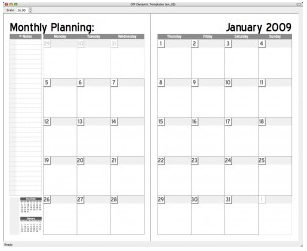
A small pocket calendar is used to schedule appointments and I have a technique to track travel miles for tax purposes. I prefer a monthly presentation scheme so when I open it up, I see all the days and appointments for an entire month. Many people prefer weekly formats because they have more room for notes, , , but for me, it makes the calendar too big and bulky. I want everything I use to be small and lightweight.


I update my contact list once a year and print it out in alphabetical order. You never know when you might lose your cell phone or destroy it, , , I’ve killed several phones in my career including one 18 months ago when my canoe tipped over, , , not fun if you have to restore all your contact list. My key contact phone numbers are also maintained on my phone, but we have a backup with the printed list if and when we need it.

It comes down to a matter of preference on how you like to manage your calendar and addresses. For me, retrieval is quick using the old fashioned paper system, , , although my iPhone has a quick and flexible retrieval process I find myself using more and more.

I create a weekly to-do list every weekend to help me focus my attention on what needs to get done in the week ahead.

Project  folders and Client folders keep information that I want to save and are filed alphabetically in my desk. Archived files that I need to keep are filed in a file cabinet in alphabetic sequence for easy retrieval.

I also maintain a “Manager’s Notebook” where I keep information I need to access from my office from time to time, , , things like:

  • Master contact list
  • Company financial summaries
  • Strategy documents
  • Resources

I don’t carry this with me when I travel due to its size, but I know where to go when I need something quick.

Keeping yourself organized is a discipline that you need to develop. Use a process that works for you and is easy for you to maintain, , , keep it simple.

Determine what’s important to track for your business and use the tools that work for you and your way of doing things. Play around with some tools to see what you like best.  I’ve probably used a dozen different types of notebooks and portfolios over the years, but find myself always coming back to the type described above.

For me, I like simplicity and lightweight tools that are easy to carry when I travel. The key is to have a system that allows you to retrieve contact information when you need it and that you can make notes for follow-up so your clients and business associates can depend on you.

Whatever your choice of tools, you really can’t go wrong when organizing yourself.

One last tip, , , don’t forget to carry a pen or two, , , you always need something to write with.  🙂