Category Archives: IT Manager Tips

Helpful articles and tips

A company album to be proud of

Remember when you were in school and they created a class yearbook? They are great for retaining memories for a lifetime. One of the things I wish I had are some of the memories of my professional life. I have a few but not as many as I would like.

Right now, you may be experiencing one of the best times of your entire career but don’t yet realize it. I can remember three specific situations that I consider to be the “best of my career”. Unfortunately, I have only my personal memories.

It would be nice to have more photos and memorabilia from these special times.

Have you ever thought about creating a company album? I’m not talking about a photo album where you insert photos in plastic pages, , , I’m talking about full color high quality “coffee table” books made up of whatever topic and design you choose to create.

The publishing business has turned upside down with the innovation of technology, , , I mean completely upside down.

In a matter of a few hours, you can create a high quality photo book of any subject you like and have it sitting in your office in a few days, , , and at an unbelievable cost. All you need are the photos or images and your creative imagination.

I did this one of my son in less than an hour.  I wasn’t trying to be very creative, , , we just wanted a hard copy of a few of his photos to share with friends. It made great Christmas presents. CLICK HERE to view.

With digital photography, it is simple and easy to do, , , and extremely economical. Plus you can make your book available online to anyone for free, or they can order a real book for themselves.

My wife and I have created 5 or 6 of these “photo books”, and they are very special to us. My brother created three books about his 2-week trip to Italy. I’m about to create another for a very special gift to my wife. In fact, creating one for a Christmas gift is what got me interested in them.
I have one to remember my IT Manager Institute classes, , , a very special time in my life. CLICK HERE to view the book I created for the first five years of the program. At the end of 2012, I plan to create another for the next 5 years.

I wish I had one for each of the great company experiences I’ve had in my career.

Check out the book we created about our Buffalo River camp we call Camp Liberty. CLICK HERE

Why do I tell you all of this?

Our friends are amazed at our ability to do some of the things we do, , , like create nice photo books we can share with them. They don’t know how to even start to do this but would really like to.

As an IT organization, your clients and users are often in the same predicament as my friends, , , they don’t realize what can be done and even if they did, they wouldn’t know where to start or would be too intimidated by the technology to do it.

I tell my friends, “If I can do this, the technology can’t be that difficult.”, , , but because they know my IT management background, they think I’m very technical. It’s the farthest from the truth, , , the fact is, they are intimidated by technology so they don’t try.

Your CEO might be very interested in something like this as a way to create company cameraderie or give as a gift to employees, , , or to sit in the lobby for guests to browse through.

We use MyPublisher.com, but there are many to choose from. Simply do a keyword search on “photo books” and you will find several.

I chose MyPublisher because of the creative flexibility with the layout and the price. They are always promoting special discounts and that’s when we usually order. For example, they are running a Father’s Day special right now that would cut the cost of my IT Manager Institute book by two-thirds.  It’s a 96-page, full color hard bound book with dust cover, , , my price to reorder would be about $40.00. Now that’s a great bargain.

The other great thing is that when you publish a book for yourself, they give you a link to share the online version with your friends. They do this to advertise their service, but what a great deal. Who knows, , , this concept might even be a promotional idea your company could use.

When people view an online book, they can view the entire book for free or order a hard copy for themselves if they wish. This is nice if you don’t want to be in the order taking and fulfillment business.

A product like this would have cost $500.00 or more ten years ago. Today with the innovations in the publishing industry, it’s very inexpensive.

Take a look at the albums I shared with you and consider developing a Company Album, , , it might go over extremely well with your senior managers and marketing people.

You have to see one to believe how great the quality is, and it is a treasured product that will last a lifetime.

Are you a leader or follower?

Do you prefer to take the lead and put yourself out front and willing to take a risk if what you do does not succeed?

Or do you prefer to avoid taking risks and follow someone else’s lead?

It is OK to be either type, you know, , , even in a management position. Some managers are better executioners of project initiatives than being able to develop strategy and getting senior managers to buy in.

It can be due to a lack of salesmanship, , , lack of confidence, , , or just not knowing how to go about it. A follower can become a leader if he wants to.

Becoming a leader is simply a matter of learning what to do, how to go about it, , , and having tools that help you lead.

Confidence comes with knowledge, , , and knowledge comes either from gaining experience or by investing in learning from others who have the experience.

Leadership traits are not something you just flip a switch and “turn on”. We wish it could be so easy.

What I believe happens is that you start investing in your knowledge and learn about leadership techniques and traits of leaders, , , and as you begin using this new-found knowledge in your work, , , you wake up one day and you are leading instead of following.

It’s not magic, , , it just happens as you begin doing things that leaders do.

Others are following your lead, , , and no one knows when the change took place in you although everyone realizes you went from following to leading.

Some people make the transition faster than others. I don’t know that there is a time line that matters.

The key here is that to become a leader, you make a decision to become a leader, , , you invest in learning how to take the lead and start doing things a leader would do and begin using tools that helps you lead.

It is always your decision in the long run, and like I said earlier, , , it is OK to be a follower, even in a manager role. If you decide to become a leader, , , invest in a mentor who can assist you in your transition.

Should you care about employees browsing the Internet?

Technology developments make us more productive than ever before – right?

Well, let’s consider a few things and think about this from a management point of view:

Pros
–  Information about virtually anything is much more accessible via the Internet.
–  Ability to communicate with one another is much better via e-mail and cell phones.
–  Every company can afford computer equipment and more productive processes.
–  Work is completed faster and easier with innovative software and equipment.

Cons
–  People productivity is reduced by so many distractions.
–  With greater communication accessibility comes more interruption.
–  Many people are not disciplined to avoid non-productive distractions of the Internet.

Great technology can be a double-edged sword, , , advantages that also come with many disadvantages. So, what this means is that it all comes down to how you manage technology in your company.

Do you have an Internet Usage Policy in your company?

Should you have one, , , or do you really want to manage the use of the Internet in your company in that way, , , by telling your people what they can and cannot do with the Internet at work?

This can be a delicate issue.

My sense is that you want people to be focused to do their jobs when at work. How they get the work done, I’m not so sure I really care about  as long as they accomplish our organization’s goals and objectives.

Well, here is the rub. Maybe your team is great in supporting your client but if they are seen playing solitaire or browsing the Internet on their PC much of the time, , , it sends the wrong signal to the client.

Even if the client does this as well, when they see an IT person “goofing off”, it’s a bigger deal to them.

One of the earmarks of a successful IT organization is professional conduct. Playing games and simply browsing the Internet is not professional conduct. No matter how good your IT organization is in supporting your client, , , there are positive things you can do in supporting your business if your people have lots of spare time on their hands.

Lots of spare time would at a minimum suggest you are probably spending too much money in IT staff, , , and that’s a negative.

As a manager, I don’t care that people browse the Internet as long as it is work related and something that benefits their efforts to support our client. The Internet in this regard is a tool to help us succeed.

What I do mind is when people are distracted from our support work and browse the Internet or play games that don’t benefit our company.

This again is a double-edged sword. IT professionals do things in their non-work hours that benefit the company and often use the Internet to help them in these efforts. It is difficult for me to be bothered if they are not 100% productive at work and expect them to do things outside of work to improve their skills and support our client.

What would be great would be if we could create very objective measurements as to whether IT people are successful in doing their jobs like you can for a salesman.

In sales, it is cut and dry. The salesman makes his monthly sales quota and we are happy, , , he doesn’t  and he fails in his job, , , it is that simple.

We don’t care how the salesman spends his time as long as he achieves his quota. In fact, management might even look at such a situation that if a salesman can make his quota and work only 10% of a normal week, , , we would be happy.

The key with sales  is that we can create a specific quota objective and hold the salesman accountable. What makes him more accountable is that he doesn’t get paid unless he sells. He either succeeds or the sales management process and how we pay a salesman weeds out the losers.

It’s more difficult in IT to develop such clear cut objectives, , , but what this says is that we need to develop very objective performance plans that include specific goals and objectives and hold our people accountable.

In reality , you don’t really care how an employee spends the day as long as he is successful. The problem develops if your client perceives members of your team are “goofing off”. This really is an issue to be concerned about.

Coach your employees on the “proper use” of the Internet, phones and other technologies that help their productivity but are quick to take them out of productive work mode.

Remember, client perception is a big deal when you are a support organization, , , no matter if you are the IT Organization or Human Resources.

Friday the 13th

Today is Friday, the 13th. It is supposed to be unlucky so be careful.

Are you superstitious?

I never have been but some people are, , , even some on your IT staff are truly concerned about certain things happening that might cause them bad luck. My belief is that you create your own “good luck” by working hard and preparing for what you need to do.

Athletes can be very superstitious, , , especially baseball players. Are any of your people superstitious?

Here are a few superstitions people worry about. Got any from your part of the world? Leave a comment to this post and let us hear them.

Black cats crossing in front of you – Not an issue in our house. Our cat, Boo, is as black as can be and she only brings us good luck.

Walking under ladders – I can see how this could be unlucky. My Dad once tried to move a long extended ladder that was leaning on the side of a cabin and forgot he left his hammer hanging on the top rung. It nearly knocked him out when it slipped off and hit him in the head. Bad luck?

Break a mirror and it is 7 years bad luck – I’ve broken a mirror before and didn’t experience any bad luck, , , but who knows, , , it might have cost me millions of dollars.  🙂

Step on a crack, , , break your Mother’s back  –  This is a weird one I’ve heard all my life, , , not sure I understand it fully.

Have a great day, , , maybe this is your lucky day!!!

Hundreds of free IT Downloads at IT Business Edge

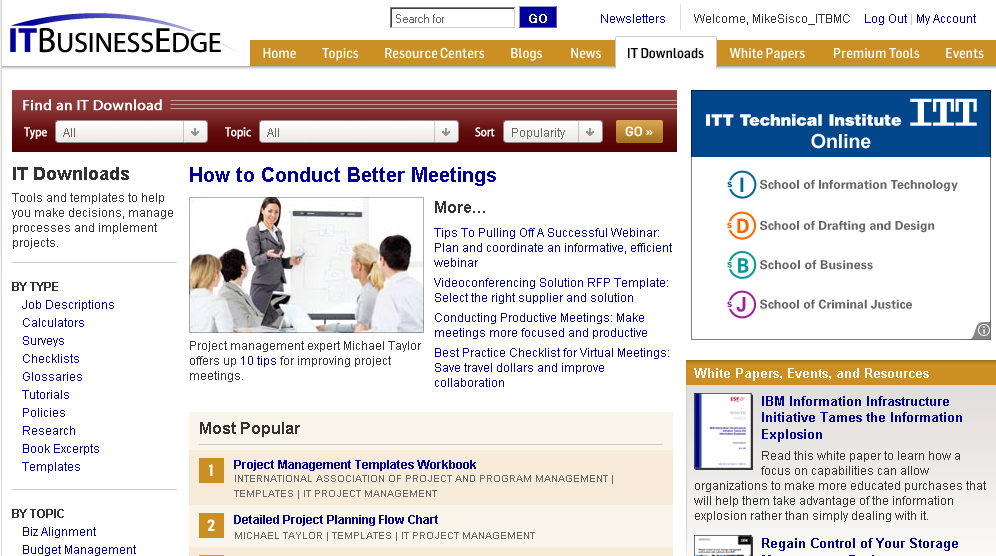
Do you know about IT Business Edge (www.itbusinessedge.com)?

Have you seen their IT Downloads section?


If not, you are missing one of the best values and IT manager resources in our industry, , , hundreds of free IT tools and templates downloads.

Lots of informative tips, insights, and tools, , , and easy to find what you are looking for with a search. Search by keyword or browse through the Type or Topics lists. You can even see what the most popular downloads are and what people are downloading.

I have provided several downloads for ITBE’s site including the following:

  • Cost of Downtime Calculator
  • IT Initiatives Portfolio
  • Annual IT Accomplishments
  • Annual IT Survey
  • Client Rescue Guide
  • , , , and many more

IT Business Edge has been a great partner since 2004. This week, I agreed to work on a special project for them as they launch a new product to enhance the content on their site, , , look for an announcement soon.

ITBE is a free subscription and offers the IT manager community a significant amount of insight and tools to help you manage your business.

Check ITBE out at www.itbusinessedge.com.

Clear your calendar and block out the time

You haven’t heard from me for a few days. It’s because I’m working on a major project and have been “heads down and in the weeds”.

Remember me suggesting you “have to block out time to focus on a major project”, , , like developing your budget, , , building a strategic plan, etc.?

Well, it’s no different for me. I have been trying to work on a big writing project for some time and haven’t been able to focus like I need to, , , so I cleared my calendar and have been focused like a laser beam for the past couple of weeks.

No travel, pulled back on my IT Manager Institute class schedule, , , and focused time and energy to the project work I need to work on. Guess what, I’m seeing some results.

The project is going well although slower than what I would like. Isn’t that always the case?

Look for my announcement in a few weeks to let you know what’s coming.

Another “industry average” to be careful with

Many CEO’s monitor IT spending by taking a look at a calculation called the IT Expense as a Percentage of Revenue. A good CEO knows about what his IT organization should spend, , , he may even have an industry average he uses to compare your spending with the rest of the industry.

Using this calculation is a good thing if used in the right context, , , but you need to be careful.

Let’s say your industry average is 2.5%. In other words, an average company in your industry spends 2.5% of revenue on IT. If your company has $500 million in annual revenue, that means your IT organization spends about $12.5 million a year if you are at the “industry average”.

What if you are spending $17.5 million (3.5% of revenue), , , or maybe 5% of revenue, twice the industry average? Does this mean you are doing a poor job in managing your IT organization?

No, , , definitely not. It certainly could mean you are doing a poor job, but the IT spending percentage of revenue alone does not tell the whole story.

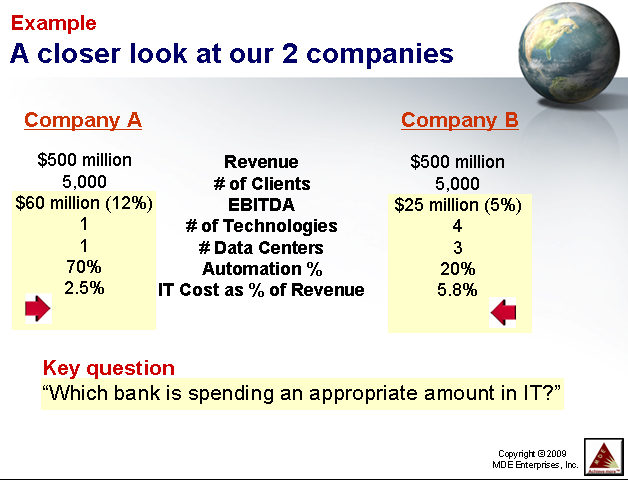
Take a look at this example I use in my IT Manager Institute class.

In this example we have two companies with about the same revenue and the same number of clients, , , but that’s where the similarities end. EBITDA (earnings before interest, taxes, depreciation and amortization) is quite different. Some call this operating income.

Company A is much more profitable than Company B. Why is that?

Well, there could be many reasons, but two reasons show up on the slide. First, Company A is much more automated. Automation tends to indicate the company is much more productive and has fewer clerical functions and processes less paper, , ,  which reduces cost.

The second reason is because Company B is spending a lot more in IT. In fact, they are spending over twice as much money in IT than Company A spends.

Why?

The slide tells you the reason. Company B has many more technology platforms and multiple data centers. The background you don’t see that’s provided in the class is that Company A grew by simply adding new business. Company B grew by acquisition and has not consolidated the technologies.

Both companies are the same revenue size but have very different situations.

In class, I ask a key question, , , “Which IT organization is doing the best job?”

Take a look at the graphic below again and answer the question before moving on. Which company is doing the best job, , , Company A who is spending 2.5% of revenue for IT (let’s also say this is the industry average), , , or Company B who is spending 5.8% of revenue for IT (over twice the industry average)?

In every class, most will say that the CIO in Company A is doing a better job. This is the answer I get almost every time.

The answer is, “I can’t tell who is doing a better job in managing their IT organization, , , until I conduct an IT assessment and determine what’s going on and what the issues are.”

Certainly Company B is spending a lot more money than Company A, , , but even on the slide with very little information I can see that this IT manager has more to deal with.

Once you conduct an IT assessment on both companies, you might determine that Company B should be spending 7% of revenue to attack the issues it has. Company B’s CIO might actually be doing a much better job than Company A’s CIO, even though he is spending over twice the money for the same size business.

The point
The message here is that you have to be careful with industry averages. They tell you what the average is for all companies in the industry, , , but your company’s situation determines at what level you should be performing. You have to understand the variables that exist before coming to any meaningful conclusion.

Company B will need to spend more in IT than Company A for some amount of time until more of the opportunities are achieved and Company B begins to catch up with Company A.

Over time, Company B becomes more profitable as IT spending decreases and more automation is developed.

Mike Sisco attacked by alligator

Did the headline get your attention?

No, I wasn’t really attacked by an alligator, but I wanted to have some fun with this post, , , and also bring to your attention of the need in using an “attention getter” when making a presentation.

Your first sentence and first two minutes have to get your audience’s attention. If you don’t get it, your presentation is likely to fall flat.

One of the things I do in my IT Manager Institute is to tell my students, “You have the toughest management job in your company!”

And then I explain why, , , which leads me up to the processes and tools to help them overcome these obstacles that face an IT manager.

Back to the “alligator attack”, , ,

Last week I was doing some yard work at our Camp Liberty on the Buffalo River, , , nothing major, just some cleanup and doing a few things I’ve been meaning to do for some time.

In one of the landscape islands is a small concrete alligator, , , one of those decorative pieces people put in their yard. Dorine was out taking photos of my Uncle Bob and me working so I thought I would have some fun. Here is the photo she got.

Nice tennis shoes

To take it a step further, I decided to make a newspaper article about it and this is what I came up with.

Click on the image and you can read the story

Sometimes you actually need to use a bizarre or shocking headline to get your audience’s attention. When you do, be sure to give them something valuable to keep their attention.

“Net it out”

When you communicate with your client whether it is senior management or department managers, you need to “net it out”.

What I mean is that you need to give them the bullet points, , , the answer, , , the abbreviated or abridged version, , , , , , , , , , not the paragraph, highly detailed version.

Business people start turning you off within two to three minutes if they hear lots of detail, , , and especially if they hear “technology”.

Senior managers want the answer. If they need more detail, they will ask questions and get to the detail they need. Middle managers of business are similar although many can be a bit more detail, , , but when it comes to technology, they don’t want to hear very much about how, , , only why we need the things you are recommending.

“What’s in it for me?” That is the question you need to answer as you communicate with business people.

The challenge we have as IT professionals is that because we are so detail oriented, we think others want and need to understand the detail.

They don’t usually want it, need it, and are usually not interested in all the detail. You are wasting your breath when you discuss many of the things in technology at a detail level and you are wasting their time.

Give them the answer and be prepared to discuss the issue at lower levels as needed.

Beware the “industry average” trap

I love it when my CEO returns from a trip and discovers something from the airline magazine to question me about. Let me give you an example:

In Delta Magazine, he reads an article that suggests the average number of users to Desktop Technician ratio is 150 to 1 in most companies. (I just made this number up to illustrate a point)

When he gets back to the office, he calls me in and asks me, “Mike, what is our User to Desktop Technician support ratio?”

I do a quick mental math calculation of total users divided by my number of desktop support resources and say, “It is around 100 to 1.”

My CEO looks puzzled and concerned, , , then he asks the magic question, “Why is our IT organization not as good as most?”

Upon finding out what he is talking about and where he is coming from, I have to explain why our number is not as good as what he read in Delta Magazine.

When you see an industry average of anything, you have to remember, , , it is an industry average. What this means is there are many companies who will have much better numbers and there are many companies who will have worse numbers.

Having a worse number than an industry average does not necessarily mean your IT organization is doing a poor job.

There are a lot of variables that affect this particular type of measurement such as:

  • Age of the equipment being supported
  • Distribution of the equipment in the company
  • Complexity of what you have installed on the desktops
  • Amount of change your company is going through
  • Special projects underway
  • Capabilities of the support staff
  • Responsibilities of the support staff
  • Capabilities of the users
  • , , , even how you define a “Desktop Technician” and what he does

Lots and lots of variables.

You can have a worse number than the industry average and actually be doing a better job than someone who has a much better number. You have to understand the situation before coming to any meaningful conclusion.