So proud of my wife

After months and months of encouragement, , ,  my wife, Dorine, has started a new Blog called DorinesPlace. Check it out at http://www.dorinesplace.wordpress.com/.

Family is a very important thing to me and I’m extremely fortunate to have such a supportive wife and a super, fun loving son. If not for Dorine’s support, there is no way I would be doing the work I do now, , , and I love my work more than ever.

She has been there every step of the way, , , in good times and bad, , , and always sees the positives of things. Last year we celebrated our 40th year of marriage. Hard to believe.

Why did I want her to Blog? Pretty simple, , , Dorine is very talented and can do just about anything , , , much like her Dad could do when he was alive. Dorine paints, decorates, sews, quilts, and can create a wonderful array of things people like. Did I mention what a great cook she is?

I wanted her to start a Blog because I think she has a lot to share with others and she is also one of those people who laughs a lot. Just a fun person to be around. Granted, much of her laughter is probably because of something silly or shall I say “dumb” things I do, , , but hearing her laugh is a neat thing.

CLICK HERE to check out DorinesPlace, , , and feel free to leave her a comment telling her you heard about her BLOG from ITLever.

Preparing for an IT Manager role

I receive quite a few inquiries about how to prepare for an IT manager role.  Often, these inquiries come from a parent who wants to help a son or daughter position themselves for a successful career.

Here is a message I received just this week from a supportive parent:  “My son is studying computers and he is in his early year of computer engineering and later on he will decide which branch of IT to specialize in. I want your help to give him tips and a head start to become an IT manager one day.”

In many cases, the parent has little or no knowledge of technology or how to prepare for IT management. What they do have is concern for their child’s future and a strong  interest in helping them prepare for the future. Often I will hear, “When he (or she) gets the opportunity to manage, I want him to be prepared so he will be successful.”

It’s something anyone who wants to be an IT manager one day should think about and devise a plan to prepare for.

My response:

——————————————-

Here is the path I would suggest:

1.  Read the free book you receive when signing up for my Practical IT Manager Newsletter – IT Management-101: fundamentals to achieve more. This book is a good foundational starting point. Sign up at www.mde.net/free

2.  Have him subscribe to my ITLever Blog at www.itlever.com so he receives free weekly tips and tools directed to helping IT managers achieve more success. There are hundreds of free articles, tools to download and other items to help an IT manager and I add new content every week.

A recent ITLever post will be of particular help titled, Solve the IT Management Maze with an IT Management Process. CLICK HERE to see it.

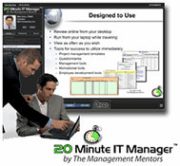
3.  Watch the 20 Minute IT Manager session titled Fast Start for a New IT Manager  at  http://www.20minuteitmanager.com/sessions/060602FASTSTART

There are 162 sessions in the 20 Minute IT Manager series, , , purchase all for $249.00 or $9.99 each. Details at www.20minuteitmanager.com
CLICK HERE for a special 50% discount offer for ITLever Blog readers – only $249.00. Included in this bundle are 12 sessions of a series titled, “12 Secrets to IT Success” that outlines the IT management process I use in managing technology resources.

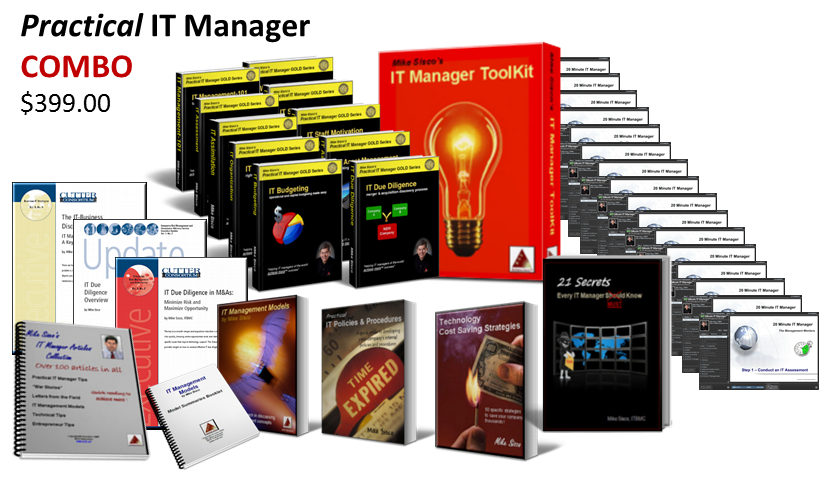
4.  He will need to establish a positive record of delivering projects successfully in his technical role. My IT Project Management: a practical approach book is a simplified methodology that can help. There are 14 books in my library, , , available for $29.95 each or $279.00 for the first ten, , , $399.00 for the entire library that includes my IT Manager ToolKit.  Details are at www.mde.net/cio

5.  If and when he truly decides to position himself for a manager role, he should attend the IT Manager Institute. It is available in classroom and online self study and includes Bonus items of all my books and tools.

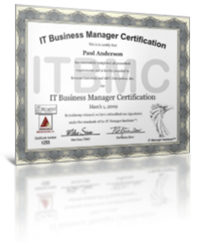
This class will do more for his preparation in becoming an effective IT manager than anything he will find. Both the classroom version and the self study are exactly the same material and lead to an IT Business Manager Certification (ITBMC) that was co-developed by Belmont University and my company to focus on the importance of IT organizations to provide tangible business value for their company.
    Self Study  –  www.mde.net/selfstudy
    Class schedule   –  www.mde.net/institute 

6.  Find an IT manager mentor, , , someone who is interested in helping your son learn about aspects of managing technology resources and a resource to go to for questions and discussions of interest. It is helpful to work with someone local who is willing to be a mentor at no cost, , , as long as the “mentor” knows what he is doing and has a successful track record. Poor or weak resources can actually damage your son’s career.

I have plans to provide a monthly IT manager membership program to provide mentoring services and IT manager development training because of the need we have seen. Watch my ITLever Blog or Practical IT Manager Tips Newsletter for a future announcement. Contact me at info@mde.net if you are potentially interested in a monthly IT manager mentoring program. I must warn you beforehand, , , it will not be cheap due to the effort required to set it up and it will be limited to a designated number of members.

7.  Your son can gain a sense of management by managing a project. In doing this he will be exposed to people management, managing client expectations, and budgeting. If he learns to manage projects well, it is good development for future IT management roles.

I hope this is of help and wish your son the best of success in his young career.

——————————————

The important thing to do when preparing for an IT manager role is to start learning from someone who knows how to manage technology resources, , , and to learn about what a successful IT manager really does, , , it is not all about technology actually. Focus only on technology and not the business and you will have major difficulty in becoming a successful IT manager.

One last piece of advice is to observe others and incorporate the best of what you see into how you go about doing things. I’ve done this throughout my career and know it has made a big difference in my management career. It’s another reason why having a good mentor is so important.

“The more I practice the luckier I get.”

Lee Trevino was a great golfer and one of the best iron players and drivers of the ball ever. He came from meager beginnings and really honed his golf skills while in the Marine Corps. He was known to play for more money than he had in his pockets, , , and told people, “This is real pressure and much tougher than the tour.”

It’s said that he won a golf bet one time playing with a wrapped Dr. Pepper bottle as his only club.

The point with this article is that the reason he was so good and played so well under pressure was because he practiced for it. He beat Jack Nicklaus in an 18-hole playoff to win the US Open when Jack was in his prime.

Some called him lucky when he holed out from off the green on one of the final holes of the British open to win that one. I can tell you for certain that it was not luck. Lee Trevino’s short game was unparallelled at the time, , , he was just as likely to hole a chip from off the edge of the green as he was to make a putt of the same distance.

“The more I practice the luckier I get.”

Managing an organization works the same way. The more you work on your skills the better they become, , , whether it be developing a presentation, delivering the presentation, budgeting, coaching employees for improvement, , , any aspect of management.

You don’t just wake up one day and decide you will be good at something, , , and there you are. To be good at anything takes some work, focus and determination, , , and you guessed it, , , practice.

Practice and you will improve, , , and maybe “get lucky”. The reality is that it is not “luck”, , , you succeed because you prepare to succeed.

Solve the IT management maze with an IT Management Process

Does this look like what you found when you first became an IT manager?

If so, it’s not really surprising, , , it’s what I discovered and millions of managers around the world discover when they first get their BIG OPPORTUNITY.

Managing an IT organization can seem like one big complicated maze.

Well, it really is unless you have a process to follow and tools to help you achieve the things that are necessary for IT management success.

In my case, I had to learn the hard way about many things, , , but I was also fortunate to have some very strong managers around me to learn from. Not all of them were IT managers, , , some had very little knowledge of technology or in understanding IT employees, , , but they possessed excellent management skills and were good resources to learn from.

Don’t limit yourself to learning from only IT managers, , , it limits your possibilities. It’s going to be helpful to your career to learn things from company executives, sales and marketing, , , Human Resources, , , your client department managers, , , even vendor managers.

What you also need is a proven management process, , , a path to follow that will help you find your way through the maze. There are obstacles at every turn in an IT manager role, , , some can even be deadly impediments to your career.

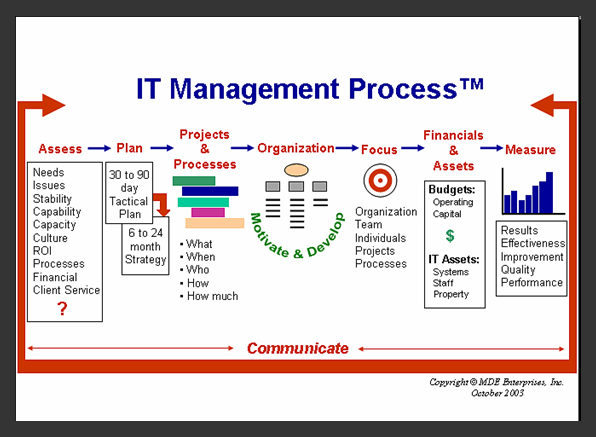
Here is the management process I use in managing an IT organization.

There are 8 key components:

1.  Assess – Conduct an IT assessment to determine what the business needs and issues are plus what your IT organization’s capabilities and capacity is. Once you understand the “demand and supply”, you can develop a plan of attack.

2.  Plan – Develop an immediate 30-90 day tactical strategy and once you get your people focused on it you can start working on developing your long term strategy.

3.  Projects and Processes –  Delivering projects successfully is the key to credibility and there are key support processes you must put into place in order to support your clients effectively.

4.  Organization – You must build an appropriate IT organization and when you have people, you need to motivate them and develop their skills to create a world class support organization.

5.  Focus –  Evert aspect of your organization needs clear focus, from the individual employee to the entire organization.

6.  Financials and Assets –  Managing the financial side of your business and keeping track of technology assets becomes a key part of managing a successful IT operation.

7.  Measure –  To improve, it is important to know where you are and whether you are making positive strides, , , practical measurements will spell it out for you.

8.  Communicate –  What ties it all together and makes such a powerful difference is being able to communicate well.

CLICK HERE to purchase the 20 Minute IT Manager video for only $9.99 to learn more.

Or, purchase the entire library of 162 sessions of the 20 Minute IT Manager
CLICK HERE for a special 50% discount offer for ITLever Blog readers – only $249.00.

Attend an IT Manager Institute class or access the Self Study program to learn step by step how to become a successful IT manager.

IT Manager Institute classes — www.mde.net/institute

IT Manager Institute Self Study  — www.mde.net/selfstudy

Manage your manager

One of the things you must learn in order to become a great manager is how to “manage your manager”.

I can tell you I was not very good at this early in my career, , , primarily because I didn’t understand it, both from the point of needing to do it and also in understanding how to go about it.

Managing your manager’s expectations is just as important as managing client expectations. As with a client, you want to try and position your manager so you and your team always over deliver what the manager expects from you. No one gets upset when you over deliver, , , it’s certainly not the case when you deliver less than what is expected.

Managing your manager means you do things that shows you are:

  1. Organized
  2. Have a vision of what you are trying to accomplish
  3. Predictable and reliable
  4. Have a successful track record of delivering what you say
  5. On time
  6. Understand the financial consequences of your actions
  7. Support and develop your employees
  8. Meet your budget forecasts
  9. Support your clients effectively
  10. Role model for others to follow

When your manager brings you a more urgent project, you know how to balance this new initiative with the other projects already committed to. Something has to give so you manage your manager’s expectations so he expects one of the older projects will be delayed or maybe even canceled in order to focus on the new initiative.

Managing your manager also means you are proactive in developing a strategy for your organization and getting it approved. It means working on things proactively that are understood and agreed upon by your senior management team, , , no way to be out of sync when you do.

Managing your manager means you provide your manager material that helps him understand your organization’s accomplishments and essentially “wind him up” with information he can share with other senior managers of the company.

The bottom line is that managing your manager means you constantly position yourself and your team to be able to deliver what you say you will do and when you say it will be completed. When you establish a predictable track record, you will find a huge amount of trust develops between you and your manager, , , and with trust becomes “partnership” status.

Learn to manage your manager well and it will help your career.

Dodge the bullets and arrows

In your IT manager role, there are lots of bullets and arrows whizzing by, , , and they come from all directions. In many cases, there isn’t much you can do to avoid getting hit by an arrow.

For example, if a tornado knocks out your Data Center, you definitely get hit by an arrow, , , same thing if the utility company cuts the electrical lines leading into your office building and you have no generator for auxilliary power. OUCH, , , hit again.

The best way to dodge bullets and arrows is to have a strategy in place that you are executing so your team is working proactively versus reactively.

The next thing is that you have to be prepared for when the “event” happens. Things like tornadoes, flood, electrical feeds being cut, etc. One of the things you should do here is to identify what kind of “arrows” and “bullets” could come whizzing by your head and determine how you prevent them, , , or at least minimize the damage if they were to occur.

“Take care of my people and my clients.”

In the 1990’s I was the CIO of a very fast growth company. We grew from $30 million in revenue to $700 million in 5 1/2 years, , , and we did much of it by acquiring other companies.

In all, we acquired over 35 companies, , , that’s an average of 7 new acquisitions a year. We were an acquisition machine.

In one acquisition, we acquired a company who had also been purchasing companies, but they had not done very much to consolidate the companies they bought. Our due diligence showed us we were buying a company that was actually running like 10 separate companies, , , all using different technologies and all in different cities around the US. The only thing standard among them was Payroll, Purchasing and Accounts Payable.

One of the ten entities had a totally different business model than the rest, , , and it did not fit our business model. This company entity provided service bureau services to our competitors, , , something we certainly did not want to continue doing after the parent company was acquired. The other nine entities, , , great, but the one that was different needed to be eliminated.

Because this company entity provided a technology service, it fell on me to handle the closing of the office and the services offered to their clients.

Early into my due diligence, I began sizing up what our transition plan should be and quickly realized that for it to work smoothly I would need the help of the general manager. His name was Dan.

I decided to confide in Dan and seek his help in developing the transition plan, , , a potential risk if he did not handle the information properly.  After all, our plan was to announce to his team the week after the acquisition would be announced that we were going to close their office. That meant 15-20 people would eventually lose their jobs and some number of clients would no longer have the software capabilities they had been using.

There is also big risk to our company if we do not handle such a transition well. Fortunately, our company’s CEO and senior management team operated with the philosophy that if we take care of clients and employees as we acquire companies, , , good things will happen for us. If we don’t we will encounter big problems.

Taking care of clients and employees does not mean continuing to operate a business that does not make sense for our company. Stepping up and making tough decisions is still required, but how we go about implementing these decisions is key.

Back to Dan.

When I confided in Dan what our plans would be and asked for his insight and help in developing a workable transition plan, , , he asked me two questions:

  1. “What are you going to do to protect my clients?”
  2. “What are you doing to support my employees?”

WOW, , , I was impressed by such a mature approach. Most managers in this situation would be focused on themselves. I never heard, “What are you going to do for Dan?”

Dan and I developed the transition plan and after the acquisition was announced we delivered the message we were going to close the office, , , to both Dan’s employees and his clients.

The good news, , , there were no employees who went without work and no clients went out of business. We gave everyone a reasonable amount of time along with transition support and options that helped protect their interests. We took care in how we implemented the decision to close Dan’s business.

Even though the clients were essentially our competitors, , , if we had handled their transition poorly it would have sent a negative message around the niche industry segment we were in and could have caused us many challenges down the road.

Later, I hired Dan to help me assimilate the IT support of the other nine entities purchased in the deal, , , and over time he has become a valued colleague and friend. In fact, our families try to get together once or twice a year and Dan has even traveled to Johannesburg, South Africa with me on two IT Manager Institute trips.

Dan has published a book titled, The Rain. CLICK HERE for details.

In discussions about mergers and acquisitions, I’ve heard Dan say things to the effect that he and his people did not like our decision to close the business at the time but understood it, and the way we handled the transition really helped everyone make the adjustment.

The lesson here is that when you have to make tough decisions, be sure you think through how you take care of clients and employees.

“You really know how to work with an Administrative Assistant”

In yesterday’s post I mentioned that a senior Administrative Assistant I worked with in a consulting engagement told me, “You really know how to work with an Administrative Assistant.”

My answer was something to the effect of, “I’ve worked with and have been trained by some very capable Administrative Assistants.”

I didn’t tell you in yesterday’s ITLever post why I think some believe I know how to work well with Administrative Assistant professionals, , , so here are some thoughts that may explain.

First, I respect what they do and understand how important their role is for an IT organization. An Administrative Assistant can literally make or break your organization.

Respect is a two-way experience. You won’t get respect unless you respect the other person and genuinely appreciate what they do for your team.

Second, what a good Administrative Assistant does will boost your productivity and with that in mind, you want to do everything you can that helps your assistant do their work well.

What this means is that managers need to follow a few guidelines:

  • Give clear definition of what you expect when making an assignment.
  • Provide simple and straightforward instructions.
  • Give your assistant examples if it helps her, or him, understand what you are looking for.
  • Don’t assume your assistant knows what you want, , , explain it.
  • Provide feedback and coach your assistant on what should have been handled differently or what can make the end product of the work better, , , coach.
  • Be supportive and give your assistant the tools to do the job.
  • Provide training and education to boost your assistant’s skills.
  • Ask your assistant for recommendations to improve your IT processes.
  • Ask your assistant what you can do to help her do a better job.
  • Give your assistant ownership of certain areas of work such as developing monthly reports, maintaining asset inventories, etc.

I guess my real message is that it helps when you “work with” someone and treat them like a partner rather than looking at your assistant as someone who “works for” you. Obviously, the reporting relationship is that she or he does work for you, but when you treat them like a “partner”, it affects how you work with the person, how you communicate with them, and even how much effort you place into providing instructions about a new project.

Take the time and make the extra effort like you would with a partner and you will probably see much better results from your assistant’s efforts.

Your Administrative Assistant makes a difference

I’ve been blessed in being able to work with several strong Administrative Assistants, or Secretaries, in my career. Two in particular were tremendous support resources.

In a recent consulting engagement, the Vice President’s administrative assistant who supported me told me, “You really know how to work with an Administrative Assistant.”

My response was easy, , , “I worked with two of the best who taught me how to work with an administrative support person.”

It may not occur to you, but a good administrative assistant can help or hinder your success. In many ways this person is the face and voice into your organization. If you are fortunate to have a positive and extremely effective person supporting you and your organization, it will make a big difference.

Here is a quick list of what a good Administrative Assistant can do for you:

  1. Improve your productivity, , , BIG TIME
  2. Maintain your schedule and get you where you need to be
  3. Make your presentations more professional
  4. Help you maintain technology assets inventories
  5. Draft many of your correspondences
  6. Coordinate and organize meetings
  7. Develop standard weekly and monthly reports
  8. Organize and supervise an office move
  9. Coordinate the orientation of newly hired IT employees
  10. Screen your mail, calls, and visitors

Good secretaries can be hard to find, , , when you do find a good one, treat them well, , , they are worth their weight in gold.

Do you have examples of what a great Administrative Assistant can do to help your IT organization succeed? Post a comment below and share your experiences with others.

Fight your urge to “fix” things

One of the challenges most of us in IT have is that we want to fix things. This in itself is not a problem, but be careful that you don’t over manage your people when they encounter challenges by simply telling them what to do.

Developing your people requires more patience and using these opportunities to coach, , , not solve by simply giving them the answer. By this I mean you should work with your people and guide them so they come up with the solutions on their own, , , or with your help.

It’s easier and quicker to just tell them the answer, , , but that doesn’t develop their problem solving skills as much. Working with employees so they come up with the correct answers has much more effect long term and will help empower your employee, , , and empowered employees do more.