Our iPad winner is Andrew Carter

Congratulations to Andrew Carter of Toronto, Canada , , , he has won our Apple iPad contest to help celebrate our company turning 10 this year.

Andrew was surprised when he heard he had won an Apple iPad from our ITLever Blog contest. He replied, “Thank you so much.  I must admit that this comes as quite a surprise and a bonus.  The information that you offer in your blog, in truth, is reward enough.”

He added, “My thoughts on your ITLever blog…where to begin?  I like your candid approach to dispensing advice.  Many times I find myself thinking ”Hey, that’s me…”!  Your blog entries provide a reminder that not only do you need to manage the people, situations and deliverables around you, but you also need to manage yourself!  Your writings are folksy and personal—it’s like getting a behind the scenes look/insight at management from the strategic and tactical day-to-day to the political undercurrents of which you must be aware.  I really appreciate your ability to draw upon your professional, but especially personal, experiences to demonstrate the attitude/altitude adage—it’s not what happens but how you react to what happens that determines how far you will go.  Your perspective covering some 40 years in IT adds an element of “tried and true” wisdom to the gems that are your blog entries.  I look to you as an IT management resource and mentor.  Very helpful and much appreciated!”

Thanks Andrew, , , positive comments make my day, , , and it’s even nice to be able to give something like an Apple iPad to someone I don’t even know. My job is one of the best you can have and so rewarding in being able to meet people like Andrew (albeit virtually by email) and others who strive to become better and more effective IT managers.

We continue our weekly IT Manager ToolKit giveaway, , , 4 more winners to go from our list of ITLever Blog subscribers. Recent winners include:

  • Glen Sabatier – Edmonton, Canada
  • Steve Huff – Topeka, KS
  • Brian Grafsgaard – Minnetonka, MN
  • Susan Engelbosch – Durham, NC
  • Steven Reid – Fortitude Valley, Australia
  • Duncan D’abreton – Pretoria, South Africa

CLICK HERE to see a list of all winners.

Inspirational story puts it all in perspective

Our local high school football team, the Columbia Central Lions, played in the 5A State Championship game last night and won, , , first time in 58 years. It was a huge accomplishment after losing in the finals with last year’s team, but it was not the real story of the day.

I should point out that I’m not really a Columbia Central fan and haven’t been to any of their games, , , and knew very little about the football team other than that they had a good one. But something drew me to them as I surfed through the TV channels last night and saw they were about to play in the State Championship Game.

As I began to watch, I learned about Dylan Rebeor and his story. He was 16 and a member of the Central Lions football team.  Dylan passed away that very morning from colon cancer complications.

Maybe it was compelling because he was 16 and that’s the same age we almost lost our son, Eddie, from an automobile accident. We were fortunate.

Dylan attended all the games this season he could even though his health and strength kept declining. He was barely able to attend last week’s semifinal game and continued to do anything he could to be part of the team and support his teammates. To say he was an inspiration to his team and community is an understatement.

Yesterday morning on the day of the big game and in a weakened state, Dylan asked his Mother if his grandmother was with them.   She told him to “Go be with her if you want to”. You see, his grandmother was no longer living.

He asked one more question, “Did we win the game?”

Her answer was simply, “Yes, we won the game.” It was soon after that moment Dylan passed away.

Well, Columbia Central did eventually win the game later that night and became State Champions.  Dylan wasn’t at the game physically, but you could tell everyone believed he was with them, , , doing everything he could do to help his team.

How does this tie to IT management?

It comes back to my personal perspective of things. As I mentioned, we almost lost our son at 16 in 1993. It was one of the toughest times a parent can go through, so I understand a little about what Dylan’s parents dealt with over the last 9 months.

These situations also help you grow, albeit painfully. Now, when I have a difficult situation, it’s easier for me to understand that there are far worse things that could happen. Dealing with a problem employee, working with an unappreciative client, or even being nervous about the big presentation you have to deliver, , , they are trivial in the big picture of things, , , and certainly not life and death situations.

Even in our most difficult moments with Eddie’s recovery, we didn’t have to look very far to see people and other parents who had far worse situations to deal with. Eddie still has his challenges, but you know what, , , we all have our challenges. His issues and challenges are unique to him just as your challenges are unique to you. It’s all about how we deal with them and become a stronger person in the process.

So, the next time you have to handle a difficult situation, put it into perspective. It may still be difficult but maybe not so stressful when you have it in context with your life and what’s truly important.

A nice file transfer tool

Profile Magazine is writing an article about my company for a future edition and they need some high resolution photos. As you know, sending large files can be a pain. Even when zipped, image files are still quite large and can hang up an email system.

What do you do if you need to transfer a 120MB file?

Well, the people at Profile Magazine turned me onto a super utility that helps facilitate this process. It’s a free online service called WeTransfer.

WeTransfer gives you the ability to transfer one or more files up to 2GB to anyone with an email address.

The user interface is as simple as can be. After selecting the files you want to transfer and the email addresses you want to send them to, you can include a text message.

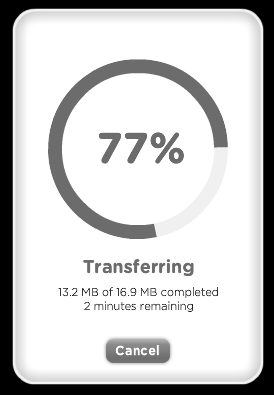
Select Transfer and you see a nice monitoring window that tells you the status of your file upload as it sends the file(s) to a temporary Internet storage facility.

Once the file transfer is completed, your targeted recipient(s) receives an email message with a download link to retrieve the file(s). This way no one’s email server gets hung up. In addition, you receive a Thank You email message that includes an option to share the file(s) with more people or to download the file(s) yourself.

When the recipient actually downloads the file(s), you as the Sender receive a nice email message telling you your recipient has retrieved the file(s). This is a very nice touch so you know everything went through.

Simple tools like WeTransfer can help your productivity. More importantly, they reduce the “hassle factor” in your life, , , and that’s a good thing.

WeTransfer is a free service at www.wetransfer.com

Do you have tools you would like to share, , , either something you created yourself or you discovered like in my case with WeTransfer? Comment on this post and let me know about your favorite tool(s). If they are helpful, I’ll create an article to share with our ITLever readers and give you credit for your submission.


Key to IT credibility

Very simple – Do what you say you will do!

More specifically, , , Deliver projects successfully.

A bit more defined: Recommend only things that contribute tangible business value, that are always cost justified, , , and then deliver what you say you can do.

If you’ve read my articles, you should know I define “business value” in specific terms:

  • Increase revenue
  • Decrease cost
  • Improve productivity
  • Differentiate the company
  • Improve client satisfaction

If your projects do not target one or more of these, you need to seriously consider whether you really need to spend time and money on it. It could be possible that you think your “pet project” is the right thing to do, but your business client doesn’t understand it at all. If that’s the case, there is a good chance it’s the wrong thing to do.

Managers who are tagged for promotion and more responsibility “get it”, , , they understand that all service organizations (IT department being one of them) are useful only if they compliment business operations and do things that helps the operations deliver the core products or services to the company’s ultimate client, , , those who buy from your company.

The best project management resource I know

I have managed hundreds of projects in my career and even worked for a project management company at one point, , , but the company with the best and most practical resources I’ve seen is Tom Mochal’s company, TenStep, Inc. (www.tenstep.com)

I’ve known Tom since 2002 when we discovered one another writing articles for TechRepublic. Little did we know that we lived just 20 miles from one another in the suburbs of Atlanta, GA. Thankfully, we met for lunch and got to know one another because not long after we would move “back home” to Tennessee.

Tom Mochal

Tom is one of those rare people that when you meet him, you know immediately he is someone you want to work with. Over the years I have gotten to know Tom quite well and invited him into my inner circle, , , we try to meet quarterly to discuss business issues and to collaborate as we strategize the future of our companies.

TenStep provides pretty much anything you want for project management, from training you to managing a project for you. Tom is one of the foremost authorities on PM methodology and Program Management in the PM space.

TenStep has an unbelievable amount of training for all levels of project managers including classroom, webinar, and e-Learning, , , probably as much or more than any company in this space.

TenStep also has international partners who carry the TenStep brand, , , you can find them on the TenStep web site at www.tenstep.com.

I’ve worked with dozens of project managers over the years, and Tom is at the top of the list. I’ve seen him in action on a few projects and no one handles PM issues any better, , , he is truly world class.

In looking back, I think Tom was absolutely the best choice to partner with when developing the 20 Minute IT Manager e-Learning series. He and I delivered 162, 20-minute sessions, , ,  a new session every week for 3 years. See the list at www.20minuteitmanager.com.

I am a funny man !

I try to be fun, , , even funny , , , and at times, I’m extremely funny. The problem is that maybe no one else realizes it except my wife. She laughs at me all the time because she gets my sense of humor.

The challenge I have is that I have a very dry sense of humor. But I have a secret for you. If you ever met Tom Mochal, you would realize that I am extremely funny.

Just kidding, Tom.

You see, Tom and I both have a dry sense of humor. I can listen to Tom and pick up his very subtle humor, , , and when you “get it”, he is terribly funny, , , I mean very, very funny.

A few weeks ago I said something to my wife and son that literally “cracked me up”. I started laughing at my own comment and couldn’t stop. It was so funny, I was crying. No one else was laughing, but I was totally caught up with how funny this comment was.

Wish I could remember what it was, , , ,

Oh well, the point is that I learned about humor from my Dad and from my son, Eddie.  Daddy Gene (as we called him) and Eddie were born on the same day – November 23rd. Both of them had (my Dad) and have (my son) a great sense of humor. They truly understood how to enjoy life.

Most people who know me would say that I’m a pretty serious guy. Yeah, that fits, , , but there’s a Johnny Carson in me dying to get out and make everyone laugh.

My Dad taught me how to enjoy life to the fullest. He never had a lot of money but what he had was a love of life and the people around him. I’ve often thought he was one of the richest men alive because he enjoyed his life so much. As I get older, I’m hoping I become more and more like him.

I’m pretty certain I’m getting just a little funnier every year.

The lesson: Learn to love your life or make changes so you can. Life is too short to be miserable and not be able to enjoy each and every day. What you will find is that the people around you become more positive forces as well, , , and that’s a good thing for you and your IT organization.

Use PowerPoint to store your images

I use lots of images in my ITLever Blog, the Practical IT Manager newsletter, the books and articles I write, web sites, training programs, , , almost everything I do.

You might say I’m a visual person, , , and you would be correct.

I’m visual for two reasons:

  1. Helps me convey my point
  2. Breaks up the text and makes it more interesting

Over the years I’ve bought thousands of royalty free images and have them on CD’s in a shelf beside my desk. The problem is that I won’t use all of these images, looking at them in the image books that come with the CD’s is hard to see, plus loading and unloading CD’s is quite frankly a hassle.

Let me say, , , a real hassle !!

I’m visual all right, , , but I’m also impatient. I needed a way to get to the images I use for work projects quickly. Loading thousands of images into a file folder on my PC didn’t seem plausible because I won’t use 90% of them. Also, when I’m on the road and want to do some work, I need my images, , , so I needed something that was not only practical, but also portable.

My solution was to use PowerPoint.

About two years ago I created an “Images.ppt” file. Initially I went through the file folders on my PC I knew there would be images I use often, , , and copied them to the PowerPoint slides. Then, I went through most of the image CD’s I had purchased and copied many of the images I liked to the PowerPoint slides.

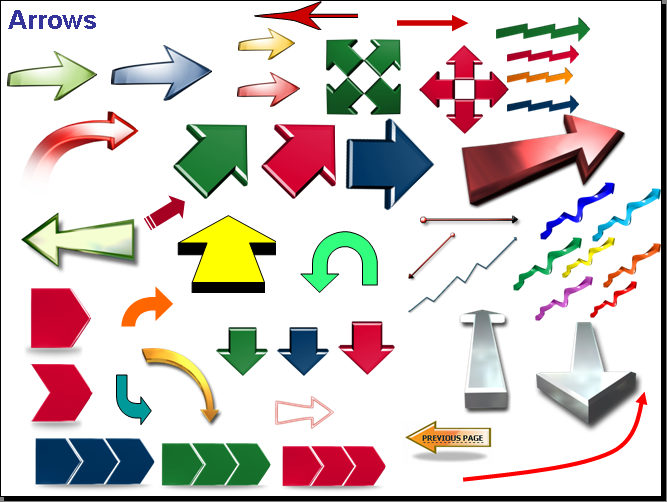
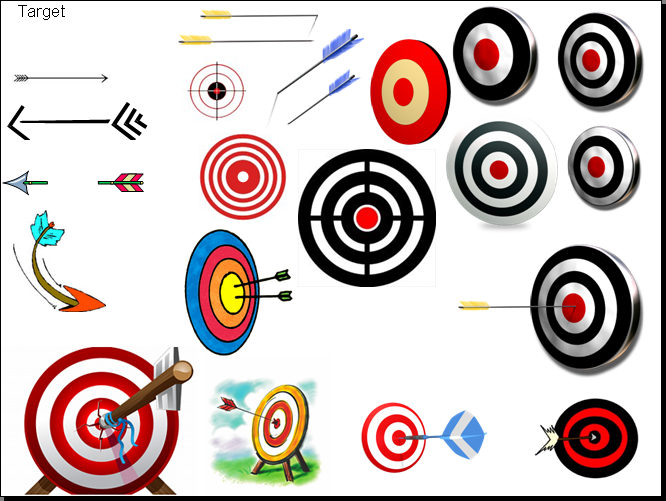
One of the things I did initially and now quite happy about is that I put text in the top left part of each slide to categorize the images. For example, I have categories that include Arrows, Targets, Money, People, Technology, Worlds, etc. When I need to find something, I can search the file on a keyword and usually find the image quickly.

When I buy new images, I go through the file and copy the ones I think we might use later on to the PowerPoint slides, , , and always try to put them on the proper category slide.

My Arrows slide has grown to 4 slides and the entire file is over 400 slides of images.

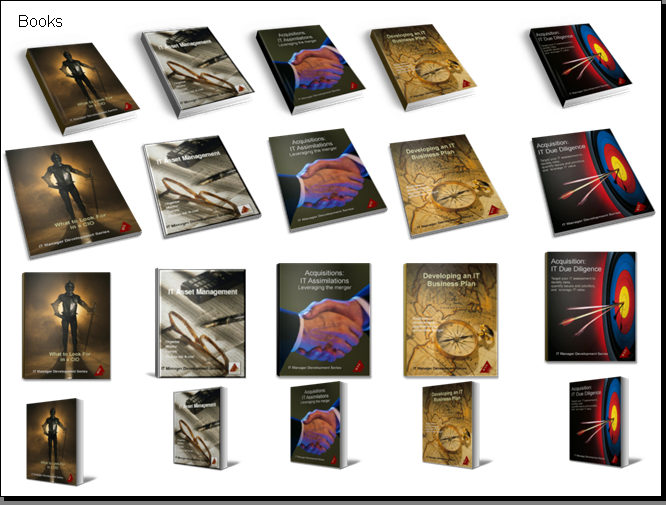
I also included photos of myself, logos, images of my books, etc. that I might need when I create a product promotion or when I announce something new.

I rarely have to look outside of this images.ppt file to find an image I can use for a project I’m working on.

The whole point to this is that now when I need a good image for something I’m working on, , , I know right where to go. It’s quick and easy, , , helps my productivity quite a bit, , , and the images are always with me as long as I have my flash drive.

I did this for convenience, not because I like to do lots of extra work. This file saves me a tremendous amount of time and aggravation. You will find that all my tools are geared to help me do something a little more efficient.

Another nice thing about using PowerPoint is that it makes it easy for me to combine images to create a different look. Many of my images are png files and eliminate the background color surrounding the object. PowerPoint works well with png’s to create a new image, , , and it’s easy to add a new slide anywhere you want to have a blank space to do the work.

The example on the left used 3 images.

Here are a few samples of the image slides in my “Images.ppt” file:

My images.ppt file is open virtually all the time, , , makes it quick and easy for me to grab something or to save an image when appropriate.

If you work on things where you constantly need to use images, you will find this approach is a great way to collect and store your images. It sure makes a big difference in the work I do.

Are you a perfectionist?

Over 90% of us in IT are high detail people. That’s a good thing.

However, being a high detail person comes with some drawbacks that you need to be aware of.

One challenge is that high detail people tend to be perfectionists.

Now, when you are a Systems Administrator, a DBA, a Programmer, or some other type of technical resource, , , this high detail aspect is not only desired, , , it is necessary to a great extent. What happens if your Systems Administrator updates one of the servers and selects an inappropriate parameter setting? You got it, , , he or she can crash the server, , , so being precise is important in our technical roles.

As a manager, being precise can be a tremendous disadvantage.

Being precise means it may take too long to make a decision.

Being precise may mean no decision will be made until we have enough information, , , which may or may not ever be obtained.

Being precise may mean we do things right but fail to do the right thing, , , a big problem for an IT manager.

Be aware that if you are a high detail person, it may be appropriate and necessary for you to “pull it back” to a level when you become the manager. Now is the time to depend on others to wade into the detail and understand all the technical issues of a situation. Now is the time to manage and delegate, not to try to do everything yourself.

It’s difficult to back off your innate desire to get to the bottom of an issue and to be the problem solver like you have been for so many years, , , but if you don’t, your team and you will suffer.

Take a hard look at yourself and ask yourself the question, “Am I a perfectionist?” If so, make a conscious effort to let go of some of the detail and rely on the expertise of others you work with to be the experts. Your role as manager is to focus at an issue level, not necessarily the detail level.

Happy Birthday, Eddie

Do you believe in the concept that “things have a way of working out in the long run”?

Even when an event seems like the most terrible thing that might happen to you?

We are big believers in it because we have seen it in our personal and professional lives, , , many, many examples.

I also believe that a lot has to do with your mindset and how you look at things. For example in past posts and articles, I’ve mentioned the idea of looking at a glass as “half full” or “half empty”.

Our son Eddie turns 34 today. Forty days after turning 16, he had a terrible auto accident. He was driving the car by himself (thankfully) and driving too fast in our neighborhood. His inexperience caused him to lose control of the car when he entered a sharp curve too fast.

The car flipped and he suffered a traumatic brain injury (TBI).

Eddie’s life and ours changed dramatically in those few seconds and continues to impact our lives on a daily basis.

Some would say, “Oh my, what a tragedy!” or “What a loss!”. Certainly, Eddie can’t do some of the things he did so easily before the accident. And if you know of his story, you know he has had to relearn everything all over again.

Things like learning how to drink and eat, , , how to talk, , , how to walk, , , even how to sit up in a chair on his own. Dorine and I remember the day in the hospital when he was able to put a baseball cap onto his head by himself. It was a major breakthrough.

Bigger yet was the day he was being observed by his Neuropsychologist, and I asked him to throw a wadded up piece of paper into the waste can. Eddie picks it up slowly from his tray and flips it toward the waste can. She was ecstatic and explained how complex it was for the brain to hear a command, recognize it, and then actually respond and do what was asked, , , especially with a brain injury as severe as Eddie’s.

Today, Eddie’s communication skills are very good. He can do many things on his own but he will always be with Mom and Dad for the support he needs. His hand/eye coordination is excellent, , , he wins Solitaire and Wii games much more than Dorine or I can. Being able to watch a baseball game with him and discuss it intelligently with him is such a big thing, , , it was many years before we were able to do this.

The big issue is that he’s happy, , , and so are we because he is still with us. Doctors told us he wasn’t going to make it and if he did, he would be a vegetable, , , not able to do much of anything.

Boy, did they miss that one !

I tell you this story for the positives that have come out of it, , , not to make you feel sorry for Eddie, Dorine, or me. The point is that a terrible thing can happen to you in life, , , but how you deal with it and what happens after is still up to you and what you make of the situation.

In our case, we kept looking forward and thinking how great it was that Eddie was able to put that baseball cap on his head by himself. Little things became big positives to build upon in our lives in those early recovery days.

My Dad was there that day and it broke his heart I was told later. You see, he was focused on the negatives of the situation and feeling sorry for Eddie while Dorine and I could only see the positive progress that had happened, , , all about how you look at a situation.

There is another reason I wanted to share Eddie’s story. If you have teenagers who are learning to drive, you might want to share his story. More details are at www.eddiesisco.com. When we are young, we think nothing bad can happen to us, , , but that’s obviously not the case. Eddie was a very mature teenager, always did well in school, liked by everyone, , , but he made a mistake while driving that car on January 2nd, 1993 that almost took his life and certainly changed his life forever.

We would give anything if the accident had not happened, but we are so thankful we have Eddie around to make life interesting and fun. He is very funny and takes no prisoners, , , if you have a weakness, he finds it and exploits it by jabbing you, , , all in fun and with a positive sense of humor. He definitely likes picking on Dad, , , and we are all so thankful he can.
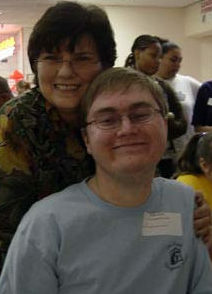
The biggest gift of all is that Eddie makes everyone around him feel good because he is such a positive person, , , a real inspiration we think.

Tonight, we will all go to dinner with friends to celebrate Eddie’s big birthday, and I promise it will be a fun and memorable experience.

Look for the positives in life and try not to dwell on the negatives, , , hard to do at times, but the results of staying positive and looking for the possibilities of what can happen can be pretty amazing.

So, , ,

Being promoted can be a tough proposition

CONGRATULATIONS, , , you finally received that promotion you have been looking for , , , smooth sailing ahead – right !!

Hopefully when you get promoted it will be smooth sailing and lots of opportunity ahead. But, it could also be a big challenge for you, , , especially if your promotion means you will be managing some of your peers.

Managing peers can be a huge challenge. When I was with IBM many years ago, they had a policy of moving you to another city when you got promoted because they understood how difficult it is to manage your peers.

That’s right, at the end of the week you are big buddies with everyone you work with but come next week when you start your newly assigned management role, things are going to be different.

Very Different !!!

The dynamics change drastically and they change immediately when you become the manager after being one of the employees. Whether you think so or not, your former buddies you worked alongside view you differently now. You are management, , , not “one of the guys”.

Most will be more cautious around you now, some may wonder why you got the job and what makes you qualified, and one or two might even be jealous that you got the promotion instead of them. Regardless of how they see the situation, they will react differently to you from now on, , , because you are the manager.

Now that you have the job, you have to be careful and avoid micro managing your employees. Most of us in IT are high detail and we like doing things “our way”. You may have gotten the Programming Manager position because you were the best programmer.

As the senior programmer, you probably had your way of doing things and was very effective. As manager, your tendency will be to require all programmers to do things the way you did them. I’m not saying this will be wrong but you need to have good reasoning when you make changes in the way things are being done, , , especially if the team is already effective.

You had credibility as a programmer, but you don’t have it as the manager, , , you must earn your management credibility. You do this by delivering results and in treating your employees and clients with respect.