Category Archives: IT Manager Tips

Helpful articles and tips

Board of Directors interview

When I was to interview for the CIO position of my last company, it just so happened the Board of Directors Meeting  was taking place that week. The CEO asked me if I would meet with the Board of Directors, and I welcomed the opportunity.

The interview began with a few of the typical questions you get in an interview and then there was a great question, “Tell us why you will be a good fit for our company.”

I gave them a short list of accomplishments in a similar business and then made a comment I don’t believe they expected:
“If you are looking for a technical manager who focuses on technology, I’m not your guy, , , but if you are looking for someone who can quantify business needs and issues and focus IT resources to address them and to deliver business value for the company with your IT investment, that’s who I am.”

There were a few other questions and later that night I received a phone call with an offer to join the company.

The CEO told me later that one of the things that impressed them was how open and forthcoming I was about what they were getting with me and the fact I was not a technology expert was a good thing. The CIO I replaced was a technology focused manager and they could never understand what she was working on or why she was spending money in certain areas.

Ask great questions in an interview

An interview is a two-sided event. Yes, the company interviewing you will have a lot of questions and will “size you up” to determine if you are a good fit for them.

You need to do the same thing. Just because a company is big and has an opening doesn’t mean it’s the right fit for you. You should use as much discretion as the company managers who will interview you.

For this new job to be a winner, it must be a fit for you and the company.

One of the things you want to do is ask good questions, , , probing questions that will give you insight into the environment and what type of company you are going to join assuming you get an offer and accept.

One of the best ways to make a great impression in an interview is to ask great questions. It shows you have a sincere interest and an intellectual curiosity. It tells an interviewing manager you are engaged in the conversation and aren’t just going through the motions.

Here are a few questions I like to use when I interview:

  • Why is the position open?
  • Was the previous manager successful? If not, why?
  • What do you believe are the 3 keys to success in this position?
  • What are the company’s long-term plans?
  • What are the biggest challenges you have?
    • In the company
    • In the position
  • What do you think the primary focus should be in the first 90 days?

Their answers may create more questions. In addition, their questions to you will probably make you think of things you want to ask.

I think one of the important parts of a successful interview is to establish a comfortable rapport with the interviewer. The more the interview feels like a comfortable and open discussion as if you were enjoying a coffee together the better.

A key in doing this is to simply have a comfortable two-way conversation with the person interviewing you. Having questions handy will help you do this.

Another thing is to avoid putting lots of pressure on yourself. Be confident, not cocky, , , and be sincere in your desire to learn more about the company and the position.

A key to reduce the pressure so you will be less nervous is to realize that the worst thing that can happen is that they don’t make you an offer. It’s not a life or death situation if you don’t get the job.

It’s OK to be nervous, , , it means you care. That’s a good thing, , , but displaying too much nervousness can be a negative in an interview.

Remember, you are interviewing the company as much as they are interviewing you, , , and if both parties like what they see there will probably be an offer in the making.

GOOD LUCK in your interviews.

Why I became a believer in IT work behavior tendencies

Have you ever had two employees who didn’t get along?

Do you wonder why some people can’t seem to do certain types of work?

Do you wonder why you struggle in communicating with your clients and employees?

Are you aware technology attracts a certain type of personality and 90% in your organization have three of the four traits in that personality type. That’s right – 90%!!

There are very specific reasons in what makes an IT employee “tick”. It doesn’t matter if you are the CIO, a Programmer, or a Desktop Technician, , , if you are part of an IT organization there is a high probability your work behavior tendencies are similar to all of us.

Every IT manager needs to understand the dynamics of IT employee work behavior!

Our personality traits help us as technicians but hinder us as IT managers!

I didn’t know much about all of this until 1990 when I joined a new company as their CIO. This company used tools to measure the work behavior tendencies of its employees.

At first, I didn’t believe in any of this “hocus pocus”, , , it was a bit far-fetched for me.

Then, three things happened that locked me into the value of this forever.

First, I shared my work behavior profile summary with my wife of 20 years at the time, , , someone who knows me better than I know myself. I asked her to read the profile and tell me who she thought it described of the people we know. Her answer, “It is you, Mike.”

My response was to point out phrases in the summary and told her that I wasn’t like that.

Her response was quick, “Yes you are, , , you just don’t admit it.”

I still had a lot of doubts about all of this.

Second, I went to a class to learn about using the tools as a manager a week later. At the class the Instructor had us take the 10-minute survey again and taught us how to grade it. My results were very different from when I took the survey during my interview. In fact, two of the four measurements were almost opposite of what they were before.

Not only that, the Instructor showed an example of what my results looked like and made the comment, “If you have a manager with these indicators, , , he needs serious help.”

This caused me a lot of concern, , , I’m a manager who needs lots of help?

I pulled the Instructor aside during the break and asked him about what was going on with me. “Why has my profile changed so much and help me understand what you mean by giving this person help?”

His answer, “Aren’t you the new guy at Medaphis?”

My response, “Yes, but what does that have to do with this?”

He posed another question, “Do you have everything figured out about what you and your team need to work on?”

My answer, “No, not at all, , , I’ve been there a week so I’m still trying to learn the names of people and what the issues are, , , I’m several weeks away from this.”

You see, I was a little disappointed I had to attend a 3-day class when I knew I needed to be in heavy assessment mode to get to where he was asking me about.

Then he gave me information that clicked. He said, “This is exactly what your profile says. When you interviewed, you were in another company and had been managing several years there, , , you knew what the issues were and what your team needed to do to be successful. It’s what your interview profile pointed out.” He had already seen my interview profile.

He added, “Today’s profile reflects you being in a new company and you don’t yet know who all the players are, let alone the issues and what you need to work on. What it says to me is that you are telling yourself to slow down until you get more information, , , it says you are communicating much more than you normally would probably because you are meeting so many new people and discovering what the issues are. It also says you are depending more on others right now than you normally would, , , all of this is normal in a new management job and in a new company.”

His last comment was big, “Once you know what the issues are and what you and your team needs to focus on, this profile will snap back to what it was when you took the survey in your interview.”

He was right, , , even the managers who worked for me at the time can tell you when my work behavior “snapped back” to my normal management approach. Once I knew what the IT support issues were and understood my organization’s capabilities, , , we started pushing forward as opposed to treading water while I was in assessment mode.

This opened my eyes and I began to think there might be something to it.

Third, and this was a clincher that happened about a year later. I had two managers who reported to me who could not seem to get along. I had worked with both of them in a previous company and knew they were both strong managers. They should have been doing amazing work together but they were fighting one another.

I couldn’t figure out why these two managers could not get along so I called the Instructor of the training program I attended for his help.

I provided the profiles of each manager and explained the situation. Without hesitation he said, “The reason is very obvious, , , it is right here on their profiles”.

Well, it certainly wasn’t to me but he was right on the mark in what he told me. I sat down with the two managers and explained the dynamics of what was going on and it resolved their differences once and for all. They were amazing managers and worked very well together and were supportive of one another after our discussion.

Startling similarities
I’ve studied and measured IT employee work behavior over ten years and discovered startling similarities in almost everyone who works in IT.

In fact it is so predictable that if you put me in a room of 20 IT managers or 20 programmers, I can confidently tell you what the profile make-up will be of the group, , , even before talking with anyone or determining each person’s work behavior profile.

More validation occurred in my IT Manager Institute
I was able to measure the work behavior tendencies of over 200 IT managers from all parts of the world. Every class had exactly the same make-up with 90% the same in three of the four measurement categories, , , exactly the same results I saw as a CIO for the 8 years I used similar tools.

Initially, I thought it was an anomaly, , , I concluded over time that certain personality types are drawn to work with technology. These employees become IT managers, , , and this is where the challenge presents itself.

What helps us succeed as technicians actually hinders our success as managers. 

The point and benefits
Every IT manager needs to understand IT employee work behavior, , , it is the underlying reason why people do things the way they do, , , and IT employees have very similar traits.

Knowing what makes your people and yourself “tick” is important because it helps you  several ways:

  • understand why things happen
  • resolving employee conflicts
  • assigning responsibilities that aligns with an employee’s work behavior tendencies
  • understand why some things are difficult and others are easy for you

I developed a 4-part series of articles for my ITLever Blog that explains this.

Two ways to learn more about IT employee work behavior
1)  Online training session, , , an excerpt from my IT Manager Institute Self Study.  Learn why the two managers were fighting and what I did to resolve the conflict.

http://itmanagement.articulate-online.com/2015518424


2)  4-part article series

Part 1    IT Employee Work Behavior

https://itlever.com/2011/06/06/it-employee-work-behavior-part-1-of-4/

Part 2    Who we are

https://itlever.com/2011/06/07/it-employee-work-behavior-part-2-of-4/

Part 3    Challenges in who we are

https://itlever.com/2011/06/07/it-employee-work-behavior-part-3-of-4/

Part 4    70% in IT have authoritative management style

https://itlever.com/2011/06/08/it-employee-work-behavior-part-4-of-4/

I hope you watch the 30-minute video and read the articles, , ,  this information will probably be an eye-opener for you just as it was for me.

Understanding work behavior tendencies of your people and yourself gives you an edge in managing better and will help you achieve more success.

Best of success!

WordPress statistics overview

I really like WordPress tools for web sites.
I like the statistics information WordPress keeps track of and shares with you with a click of the mouse. Here is a brief overview and examples of what you can see on a daily basis.
1.  Page views
You get a daily total of page views for the last 30 days, , , you can look at the detail for any day just by clicking on the bar for that day. You can see this gantt chart in weeks and months as well.
2. Summary Tables
Pull up summary tables that shows total page views by month, average per day and recent weeks summaries. This gives you insight as to traffic volumes you are able to generate with  awareness activities you create.
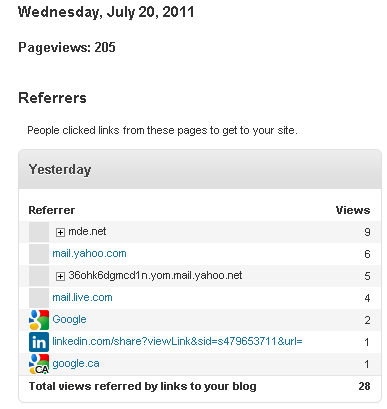
3. Referrers
Tells you who referred your site, , , visitors who selected links from other web sites to get to your Blog
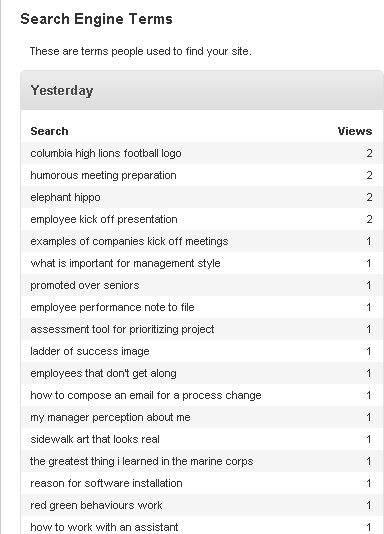
4.  Search engine terms
Shows you search engine terms used by people who came to your Blog from a search engine. This is one of my favorites and very helpful.
5.  Top Posts and Pages
It’s always nice to see what pages and posts people are looking at. This one is very helpful.
5.  Clicks
Another great tool is to know what links people are clicking on when they visit your Blog.
Now, you know as much as I do. WordPress is powerful, , , like it a lot. If you are about to develop new web sites in your company, you might want to take a look at WordPress, , , it has made our work easier and more productive.

Are you building personal capital?

Your career will only be as good as you make it. A question you should ask yourself often is, “Am I building personal capital in my company?”

Go a bit deeper with this question and ask:

  • “Am I succeeding in this job?”
  • “Do others view me as a contributor to our company success?”
  • “Does senior management realize my value?”
  • “Can I quantify the value I bring to the table?”

The personal capital you have in a company includes many things. People in a company have value and you are perceived as having more or less value than the people sitting next to you.

Obviously, you want your “personal capital value” to be perceived as very high, , , and well worth the investment in salary and benefits your company pays to include you as a member of the team.

You gain personal capital in many ways, such as:

  • Personal successes
  • Teamwork
  • Leadership successes
  • Ideas that create value
  • Attitude
  • Helping others succeed

I could list a dozen more things, , , what is important is that essentially everything you do in your company either adds or subtracts from your personal capital total.

Think about it this way. Let’s say you are the holder of 100 shares of stock in 50 companies. When you put them side by side to determine their value, you should think about several things, , , current stock price, , , potential growth opportunity, , , maybe some pay a dividend and others do not, , , etc.

Many things to think about if you had $5,000 and wanted to invest more in a few of your current stock holdings. Which stocks do you invest more in? Probably, the one you think offers the most opportunity for growth and has low risk.

Key point here, , , low risk. We like our investments to be safe investments.

When senior managers evaluate people in their company, they do the same thing to a certain extent.

First, they value you and compare the investment they have in you to other people in the company. Then they decide whether they should invest more in you for the future, , , or is it better to invest in someone else.

The people who get the most investment and career opportunity are the people who display competence and achieve success, , , their personal capital goes up when this happens.

The point
Think about whether you are adding to your personal capital balance or detracting from it in everything you do, , , even in the suggestions or ideas you present.

Do things that help your company succeed and it pays you back over time, , , focus only on yourself and it diminishes your opportunity.

An IT manager must be a teacher

Let me share a personal story that goes far back into the dark  ages of time, , , the mid-1980’s.

I was with a company and we reorganized the company to place more focus on our clients. In this reorganization I was assigned the IT support manager position to support 25 hospital clients using software applications our company developed.

I inherited 25 or so IT employees, , , mostly programmers with a few Business Analysts, Help Desk and Infrastructure people. Most of my new staff had 3-5 years experience in supporting these clients. It was a young group but very smart and high energy, , , one of the best IT organizations I’ve worked with.

They knew the software application inside out, , , knew a lot about client service, , , and were very conscientious about doing a good job for our clients.

Experienced, smart, and conscientious, , , seems like we would have been very successful without the new manager (me) having to do very much.

WRONG!!

What the team was missing was processes and insight about what it actually takes to take care of your client. I would learn the hard way over the first few months that I would need to teach them some of the basics in:

  • Troubleshooting problems
  • Follow-up
  • Communication, , , especially listening
  • “The client is always right”

Let’s take just the first one, , , troubleshooting.
We had a very large client who had apparently always had problems, , , people from this large hospital were difficult to deal with, demanding, and could even be rude.

If you step back for just a moment and think about these things, there is usually a reason why people act this way. In this case, it stemmed from a recurring problem the client had every month end. It was a real problem for them and my staff either discounted the issue or did not fully understand the problem, , , so the same issue came up every month.

After getting hit with this issue myself, I decide to take a small group to the client to observe what was taking place. To resolve a problem, you have to know what the specific issues are, so that’s what we set out to do, , , troubleshoot the problem.

The issues were immediately apparent because we were there and “heard” what the client was saying, , , we experienced it with the client so we understood what was actually taking place.

Here is where it gets important:

  • We quantified the specific issues
  • Got the client’s agreement these were the issues
  • Recommended a solution
  • Gained client agreement again to support our recommendation
  • Implemented the solution

This solved our client’s issues, , , and guess what!

They became less demanding and more pleasant to work with. Interesting how this works.

The point
Even though my team had tremendous knowledge and experience and they were very intelligent people, , , they were not troubleshooting the issues with this client very well. They could not quantify the issues for me when I asked about the problems the first time I received a phone call from our “unhappy client”.

It was a great teaching opportunity that helped the team develop into a more capable organization.

Inspect and be sure your people know how to troubleshoot a client issue.

Should your CIO be technical?

This is a long-standing debate in the IT world, , , should a CIO be technical or not?

I’ll give you my perspective having managed IT organizations at a CIO level for more than 20 years.

The answer you will get from me is “No, , , definitely not.”

Before you get mad and leave, let me explain.

I was technical early in my career and when I got an opportunity to manager I tried to continue doing some of the things that helped me achieve success as a technician. I tried to do much of the technical work.

The problem was that I was doing more of the work than I should have been doing and not requiring the work to be done by my IT staff. I was having a tremendous challenge in transitioning from technical expert to manager.

Let me describe it slightly different, , , difficulty in becoming a business manager.

In reality, I was stealing from my employees but didn’t realize it. I was still trying to be the hero like a technical expert tries to do in an IT organization by showing my boss “what I can do”.

I learned a hard but valuable lesson from this first CEO I worked for as an IT manager. He told me, “Mike it’s no longer important what you can do, , , but what you can get accomplished through your team. You can’t do it all and certainly can’t get enough accomplished yourself.”

This lesson was ingrained in my head and I’ve never forgotten it.

He wasn’t telling me I shouldn’t be technical but he was suggesting I needed to delegate and depend upon my IT staff much more.

It’s great to have a technical perspective, but a manager should spend time learning about management processes, strategic planning, how to communicate effectively, and how to coach and motivate IT employees, etc. These are the things that will make you successful as an IT manager, not being the technical doer.

Your success will be based upon what your team gets accomplished for the company.  The more you can organize and focus your team to do what’s needed by your company the more successful you will be, , , it’s about your organization becoming successful, not you.

As an IT manager or CIO, you now have a full-time job learning about the business issues and needs of each of the departments in your company and then developing IT support strategies and plans to address these needs.

Management is a full-time job, , , and IT management is more than a full-time job. There is much to learn and considerable amount to do, , , every day.

My recommendation is that you must leave your technical skills behind and accelerate your learning in areas of:

  • communication
  • strategy
  • negotiation
  • business understanding
  • budgeting
  • project management
  • employee development and motivation
  • planning skills
  • presentation skills

Most CIO’s come from technology backgrounds just like I did, but I have seen a few very effective CIO’s that had no technical background at all. What they did have was excellent management skills and understanding of what a manager role was all about, , , defining appropriate goals and objectives for your team and then organizing and focusing the team to achieve them.

Best of success in your transition from technical expert to business manager.

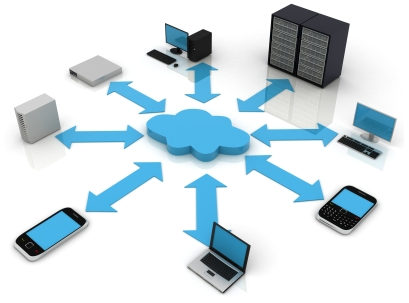
Is your head in the clouds with cloud computing?

Are you thinking about putting some of your computing services up on the cloud with an external vendor? Maybe you already have.

Just because someone else is maintaining these services and supporting you does not mean things can’t or won’t go wrong.

It is still computing services and computing services ultimately fail, , , sooner or later. The question is, “Will you be prepared?”

I just read a great Infoworld article titled, The 10 Worst Cloud Outages (and What We Can Learn From Them). Initially, I was just curious so I decided to take a look, but what I found was very interesting and worth the read.

Real case situations with lessons learned and tips that can help you be prepared.

Read the article.

IT strategy presentation tip

When you plan to deliver an IT strategy to senior management, pay attention to who is sitting in the room and what they want from you.

If your audience is the CEO, CFO, and COO or possibly the Board of Directors of your company, your presentation is quite different than if your senior manager is a CIO with a stronger technical background.

Let’s assume your IT strategy presentation is to the CEO and CFO, , , the top two executives in the company. There is also a difference in these two people, but the primary target is the CEO, , , the boss.

If this is the case, develop a presentation that targets your CEO’s need. Normally, a CEO wants “the answer” and not a lot of detail, , , especially not technical detail.

In most strategy presentation meetings you will have an hour, maybe two at most to present and discuss your strategy.

Think more like you have 20 to 30 minutes of actual presentation time. I can assure you an hour will go by faster than the “blink of an eye”.


An 18-24 month IT strategy probably has a dozen, maybe even up to 60 projects. You will never cover a dozen projects or more.

You need to summarize your list of projects into high level initiatives. Let’s say you have 60 projects you believe are needed to address the business needs and issues of your company.

Summarize your 60 projects by consolidating similar types of work into 6 to 8 major initiatives. For example, 10 projects may be Data Center type of work, , , if so, create an initiative called Data Center Improvements.

Maybe you have 3 technology conversion projects as a result of acquiring three companies, , , summarize these 3 projects into a high level initiative called Technology Assimilations Initiative, and show the key projects in it when you draw a time line picture.

Something like this:

You graphically show three assimilation projects (A1, A2, and A3), but you talk about the Technology Assimilations Initiative.

This saves lots of time and discusses your points at the proper level for a CEO and CFO.

Some initiatives may have dozens of projects that you discuss as a single initiative. Six to eight initiatives will be about the extent of what you will be able to cover and have ample time for questions and discussion.

I’ve seen many IT managers try to cram too much in an hour presentation and it ends up missing the mark and failing to get accomplished what was needed.

Summarize your projects into high level initiatives, plan on 20-30 minutes of real presentation time, and anticipate the questions you might get from the audience who will be in the room.

Do these things and your IT strategy meeting will go much smoother.

Ten reasons that cause IT projects to fail

Here are some things to ponder:

  • Delivering projects successfully creates credibility for an IT organization.
  • There are dozens of project management methodologies.
  • PM tools are everywhere you look.
  • Several PM certifications exist.
  • Project management training is easy to find.

Yet, project failure in the IT world is rampant, , ,  lots of press about it. So here is the question,

“With all this information and resources to help you manage projects effectively, how can we continue to have such high project failure rates?”

You would think the need for credibility alone would be enough to help us make improvements.

Here is a list of why I think IT projects have such high failure rates:

  1. IT managers may not understand how important delivering projects successfully is in establishing credibility so they don’t invest enough in PM training and methodology.
  2. Insufficient time is spent on the front end to define the specific objectives and deliverable of a project.
  3. The project lacks sufficient resource to execute the project.
  4. Not enough buffer  included in the project plan, especially when estimating how long tasks will take and how much things will cost.
  5. Scope creep, , , occurs when additional requirements are added to the project after the scope has been defined by the Project Manager and agreed to by the Project Sponsor.
  6. Insufficient commitment from the Customer, , , usually internal department managers of the company fail to invest the resources needed to complete the project successfully, , , they just want IT to get it done for them.
  7. Lack of getting buy-in from project team members in the beginning of a project that they can complete assigned tasks when they are targeted to.
  8. Lack of ongoing monitoring and managing of the project week to week.
  9. Project team members waiting to the last minute to work on tasks.
  10. Poor communication.

This last reason, , , poor communication, , , is the root cause of many of the items on the list. IT people are generally poor communicators because 70% of us are shy and introverted. This is a big reason a high percentage of IT projects fail year after year.

Invest in your team’s project management skills and keep records of your performance, , , both in success rates and the value delivered. A simple and quick way to do this is with an IT Initiatives Portfolio. Go to https://itlever.com/2010/05/11/it-initiatives-portfolio/

Awareness is one of the first things we need. Become aware of how important project management is to your team’s credibility and track record and prepare sufficiently to deliver projects successfully.

With today’s tools and training that’s readily available, there is no excuse for a poor project management track record. If you allow it to happen, it is undermining your credibility and preventing you from future opportunity.