My first presentation

Have you ever been truly scared of something, , , I mean really, really frightened?

I have been truly scared at least once in my life, and it probably isn’t what you might think it would be. It was when I had to make my very first presentation in front of a group of people I did not know.

You need some background
It was a cold, snowy January day when I arrived at my first IBM class in Atlanta. I was 28 at the time and had just graduated from college, , , I was a bit older than a typical college graduate because of spending 4 years in the Marine Corps.

In the class there were some 30 or so students from all parts of the US, , , we were all proud “IBM rookies” eager to make our mark in the world, , , and we were about to go through IBM’s class called A-Mod.

I remember having to introduce myself to the class like everyone else did and how nervous I got as it got closer and closer for my time to speak. I would soon learn this would just be a teaser.

At the end of the first day, our Instructor brings out flip chart pads and magic markers, , , then he proceeds to pass out assignment material to each of us. He returns to the front of the class and proceeds to assign us a task for the evening, , , we would learn that homework was going to be a common theme in all IBM classes.

Our assignment was to develop a short, 5-minute flip chart presentation on the topic we were given. Everyone had a separate topic, , , no teamwork in this exercise. The following day we were to deliver a stand-up presentation of our topic using the flip chart bullet points we came up with.

The presentation would be recorded so we could view it and our Instructors could critique them to help develop our presentation skills. Our presentations were to be graded and this is important because it leads to our final grade average, , , something our future Performance Review from our managers back home would take into consideration.

Grading would be based upon three things: content, organization of the content, and presentation delivery.

I had never made a presentation to a group of people I did not know, , , never, , , and even though I was older than most in the room and a former Marine, , , I was intimidated by the whole thing.

Intimidated is putting it mildly, , , I was scared.

Not physically scared mind you, , , but afraid of making a mistake, looking foolish, or just generally not doing well in front of my peers, , , even though I didn’t know any of them. It’s a trait I would learn 15 years later is pretty consistent among IT people.

Well, we all go to our apartments and everyone focuses on developing their presentation. My flip charts look great and I believe I have created bullet points that capture the key points of my topic. I was totally comfortable with this part.

But I’m still very much afraid of this task because of the presenting part to come, , , so much concern that I gave real thought to checking out, going to the airport, and heading home to tell my manager that I did not sign up to be  a salesman.

Fortunately, I didn’t go through with it. Can’t hurt that much, can it?

The next day we begin making our presentations and we deliver them in alphabetical order, , , so my name beginning with an “S” means I’ll deliver mine in the afternoon.

How much of the morning sessions do you think I heard?

That’s right, , , none of them.

Why? because I’m thinking through my presentation and analyzing every aspect of it, , , trying to remember what I need to say, etc. The closer we get to my turn, the more nervous I become.

Well, it finally comes my time to deliver, so I go up to the front of the room, they help me place my three flip chart sheets on the stand, , , put a microphone around my neck, , , , , , , ,

Did I mention they were going to place a microphone around our neck and record the whole thing?

More pressure!!!!!!!

OK, I’m finally all set and ready to begin, , , but first, a question for you:

Are you aware of what happens when you are truly scared, , ,  I mean truly frightened about something?

Well, your body does some strange things that I learned for the first time at this moment in my life.

First, you can perspire or sweat.

Your body can tremble or shake.

Your voice can quiver, even come out at a higher pitch.

Your heart certainly beats faster and pounds like it’s coming out of your chest. I know this to be true.

But there is another thing that happens to you that I had no idea of until it occurred to me in this presentation.

Your mouth gets very dry, , , cotton dry, , , dry as the desert sand.

Well, when you speak, your tongue actually bounces off the roof of your mouth as you say certain words and when your mouth is cotton dry, your tongue sticks to the roof of your mouth. As you talk, your tongue gets stuck and when it releases, there is a distinct “POP“.

That’s right, you will hear an intermittent “popping” sound, , , you don’t know exactly when the “POP” will occur but it definitely does.

And remember, I have a microphone hanging around my neck.

As I work through my presentation, I hear this “POP” from time to time and I’m sure everyone else hears it. It’s a bit unsettling, but something occurred during this ordeal, , , as I went further and further into my presentation, it all got easier and easier.

My presence here today is testimony that this frightful event did not kill me, , , but it truly did scare the “bejeevies” out of me leading up to the event.
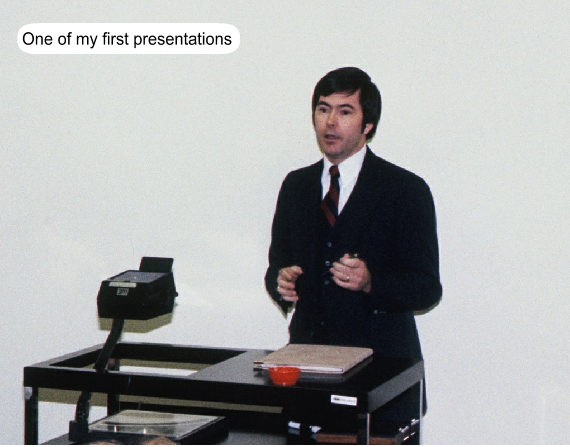
I’ve been very nervous in a few other large presentations in my career, but they got easier the more I presented.

The lesson
Today, I can deliver a presentation to hundreds of people and I don’t get nervous, , , as long as I’m prepared and know my material. What this says is that you can overcome your fears and learn how to do things that once intimidated you. It’s all about making an investment to become what you want to become.

They say the two things people are most afraid of are public speaking and death. Well, I’ve overcome the first one and so can you.

Being able to present to groups is an important skill for IT managers to have so create opportunities that forces you to present to groups, , , and especially groups that are outside of your immediate network of people.

Strong communication skills can help you considerably in your career, , , well worth the investment to gain them.

Start an employee training program in minutes

In my last post, I emphasized the need your IT people have in training and education, , , it is a key motivator for IT people and ranks as one of the top 3 reasons people say they stay with their company in surveys year after year.

How would you like to have the ability to customize your own training curriculum in minutes and make it available to your employees?

Tom Mochal and I spent three years developing weekly 20 Minute IT Manager (20MITM) training sessions to make a comprehensive training library available to IT managers.  There are 162 sessions in the series, each 20 minutes or less in length, , , an ideal time to focus on a specific topic.

Many of our clients host weekly training lunches or early morning training breakfasts for their team where they deliver a 20MITM session while everyone eats. At the end of the session, they discuss the training material and how it applies to their situation or what they can take from the session to improve their business.

The 20MITM sessions focus on 5 major categories that are important for IT organizations in any industry:

  • IT management
  • Project management
  • People management
  • Leadership
  • Personal development

In these categories, there are dozens of training classes that are appropriate for every IT employee to learn about, not just your IT managers. For instance, all your employees would benefit in learning about:

  • Problem solving techniques
  • Project roles
  • Simple project management tools
  • Fundamental status reporting
  • Dealing with an unhappy client
  • Effective communication tools
  • Understanding IT employee work behavior
  • Prioritizing your work
  • Coping with stress
  • Active listening is the key to effective communication

CLICK HERE to download and review the entire list of 162 sessions.

From such a large and diverse list of topics, you could create several training tracks for your staff, , , one for managers and supervisors, one for project managers, one for Help Desk staff, another for the programming support team, , , even one for your desktop technicians.

You could also put the training programs onto your Intranet and make them available for anyone in your company via the Enterprise license.

Create a specific program targeted to a group of people or make it available as needed in your company. The point is that you are making an investment in your people’s education and growing their professional skills, , , and this investment is valuable for your employees and your company.

Why is it valuable? Simple, , , one single tip or tool discussed in any one of the 20MITM sessions could be worth thousands of dollars to your company in cost savings, improving productivity, or avoiding a key risk.

Purchase individual licenses for $499.00 each or an Enterprise license for $2,000.00 that gives anyone in your company access to 162 online training sessions via your Intranet. It also gives you a great vehicle to develop teamwork and improve productivity of your IT organization.

CLICK HERE to learn more.

GET STARTED in minutes by ordering the complete 20MITM series, 162 sessions in all.

or

20 Minute IT Manager sessions are also available in single sessions at $9.99 each. Details are available at www.20minuteitmanager.com.


Top motivator for IT people is training and education

One of the top motivators for IT staff is always training and education. IT people have a huge need for continuing education in order to develop their skills and become more valuable.

Training and education is always in the top three reasons why IT employees stay with their company, what motivates them, and what they look for in a company.

If you are not investing in your employees, they will become disillusioned and seek alternatives that feeds this need; it can even cause them to leave your company. Because training is such a big issue for IT employees, you should develop a specific training program for each employee every year and include it in their Performance Plans.

Doing this shows commitment and an interest in your employee, , , and they pick up on it very quickly.

Some managers don’t want to train or educate their employees for fear it might position the employee to go somewhere else. My belief is that if you are managing your organization well, this investment is a big reason people stay with you, , , not look for ways to leave.

There are many training options these days, especially with all the online classes. There is absolutely no reason to not have an active training focus in your company in today’s world, , , and if you do not, you are missing a real opportunity with your employees.

The benefits are huge. Not only will your staff be doing things better, this investment goes over great in your efforts to improve morale, build teamwork and to develop a more capable organization.

Start an employee training program in minutes
In my next post, I’ll give you a quick and easy way to create an employee training focus in your company in minutes.

CEO doesn’t allow use of the overhead paging system

I was with a company once where it was common knowledge that the CEO would not allow anyone to use the overhead paging system. As a software development and support company, our rather large Help Desk organization had a true need to locate key people from time to time, , , and so did our switchboard operator. After all, we were a service organization.

When asked about the “no overhead paging” policy, the CEO was confused, , , you might say, even shocked.

No policy existed and he thought the need was certainly appropriate.

The reason everyone thought a policy existed that prevented the use of overhead paging was because when the company was much smaller (and everyone was in the same small building), the CEO discouraged it when clients or prospects visited their offices. He thought it was disruptive to the sales process and less professional, , , but that was 5-6 years ago.

Years later, employees were in several buildings with many floors and separate areas for things like Help Desk. In fact, the executive wing and conference areas where prospects and clients met with sales people was in a completely separate area and even had the ability to have the paging system turned off in their area, a requirement the CEO had installed when the company moved to a larger building.

The CEO had no issue whatsoever in preventing support groups from using the paging system. In fact, he made the comment, “I don’t know how you function without using it.”

The lesson: Sometimes, things exist because people think there is a reason but there may not be a reason at all. If it’s worth doing, go ask about it, , , you might find as our company did that a long standing taboo didn’t really exist at all.

Approved invoice log

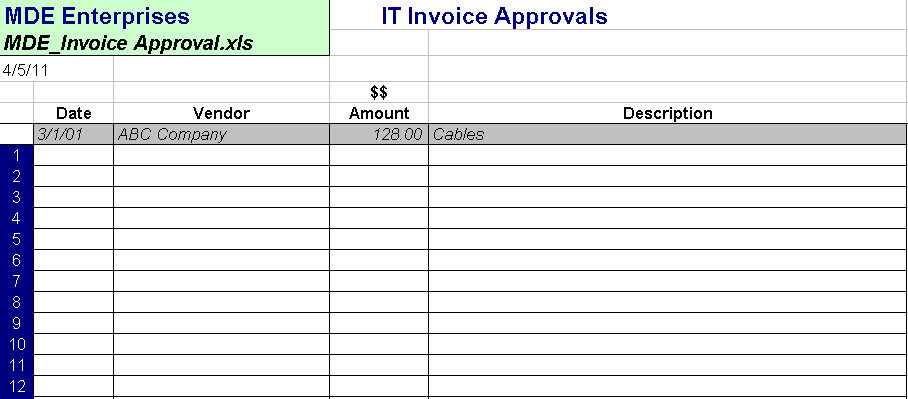
Have you ever received a vendor invoice and start thinking you have already approved it for payment, , , but just can’t remember if you did?

You can’t remember for sure so you go down to Accounts Payable and check with someone to see if they have it, , , it sure looks like the same amount you approved recently.

This used to occur to me all the time, , , until I got tired of it and created a simple Invoice Approvals Log. When I approve an invoice, my secretary or I update this log so I can determine quickly if I’ve received a duplicate invoice later on.

Saves time, improves your productivity, , ,  and reduces “hassle factor”.

The worst excuse for being late

Some people are constantly late, , , late for work, , , late for meetings, , , late for events, , , they are always late.

What’s the worst excuse you have heard as to why people are late?

Here are a few I’ve heard:

  • Had a flat tire  (you probably will now that you say it)
  • Accident on the freeway delayed traffic
  • Overslept
  • Sick
  • Ran out of gas
  • On the phone
  • Took a wrong turn
  • Road construction
  • Car battery was dead
  • Hit a deer
  • Forgot we had a meeting scheduled
  • Was up all night with a sick child
  • Went to the wrong office

Being prompt and on time is a sign of being organized and courteous to those who you work with. Being late wastes people’s time and it causes companies to lose lots of productivity when a dozen people sit around waiting for a meeting to start because a key person is late.

If you have a habit of being late all the time, you are telling others around you that you are unorganized, lazy, and that you don’t respect them, , , not a good thing. A word to the wise is that we need to be on time, , , and encourage people who work for us to do the same.

Got any good ones? I would like to hear them.

Make your resume look like you know your business

Most of the resumes I see of IT manager applicants have far too much technology expertise in them. Business managers aren’t as interested in your technical knowledge as you might think, , , or even as much as you might think they should.

Senior managers are looking for candidates who can deliver the goods, and when you load up your resume with all kinds of technology knowledge, , , it doesn’t say a thing about being able to deliver.

Please note, there are exceptions but they truly are exceptions, , , it helps to know what your interviewer is interested in, , , technology or results.

Senior IT managers and business executives generally want a manager who has shown they understand business need and can show they have delivered. What this means is that we need to list accomplishments and what our results have done for our company.

I literally would refrain from listing a dozen certifications and technology expertise, , , it tells me you are a technician, not a business manager who knows how to get results from their IT resources.

Benefits, accomplishments, and results, , , why would someone want to hire you? It’s usually not what you know about technology when interviewing for a management position.

Your resume is a sales tool that helps you get the interview or it will hinder your opportunity for that interview. Load your resume up with benefits and results and you might find yourself getting more interviews.

Put your oars in the water and row together

You don’t get very far in life unless you put all your oars in the water and row together.

You sort of have two choices, , , float along with the current and you will end up somewhere downstream, , , but probably not where you want to go.

The other choice is to put your oars in the water and focus on your destination to go right to it. Put all the oars in and row together and you will get there even faster.

My management team did a short skit (a play) many years ago to show our employees what we mean by “working together”. I even gave them a souvenir to remember the event, , ,  a short oar, actually a boat paddle , , , still have mine in my office.

Teamwork is not an easy thing for many of your people. Over 90% of them are independent and like to do things their way and do it themselves, , , not the best recipe for creating a team player.

It’s up to the IT manager to help your employees learn how to work as a team and discover how valuable it is when you do.

Go get ’em.

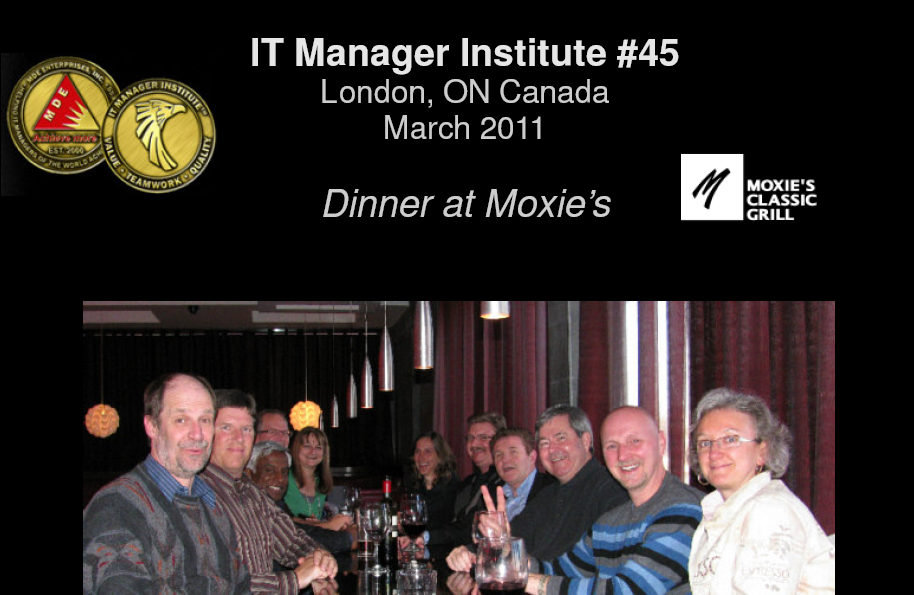
Dinner at Moxie’s

The IT Manager Institute is highlighted with a class dinner toward the end of the program. In last week’s class we held the dinner the night of the last day. Everyone was very relaxed as you will see from the photos.

CLICK HERE or on the image above to take a look.

What a great time we had. All of our dinners have been fun and every one of them unique. This one was great fun and the photos prove it. Moxie’s turned out to be a super place and this group of Canadians made it all the more enjoyable.

There was some “jabbing” going on, but I always get the last jab, , , because I’m a professional when it comes to jabbing and having fun with people. See the dinner photo captions and you will see why I can say this.

4:00am wake up call

I was up early to catch a 6:00am flight back to the US from London, Ontario Canada where I taught our 45th IT Manager Institute. Hard to believe there have been so many.

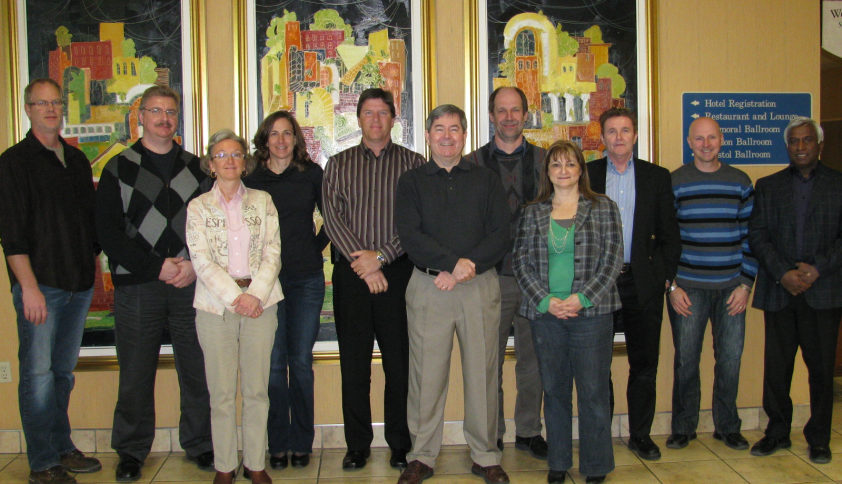
What a great group of IT managers to work with. All ten managers in this class are from the same company and they wanted to standardize their management approaches to a certain extent, , , something I heard from most of them on the first day.

IT Manager Institute #45  –  London, Ontario Canada

There have been many senior managers I’ve worked with decide to do this from many industries including government, healthcare, banking and manufacturing. They keep sending more students to the program so it’s a good sign they are receiving value from their investment.

Canadians are always a fun group of people to work with, , , great sense of humor and very committed to what they are doing. I truly enjoyed this group and feel that I’ve known them much longer than just a week.

Good luck and best of success guys and gals !!